


Quick answer
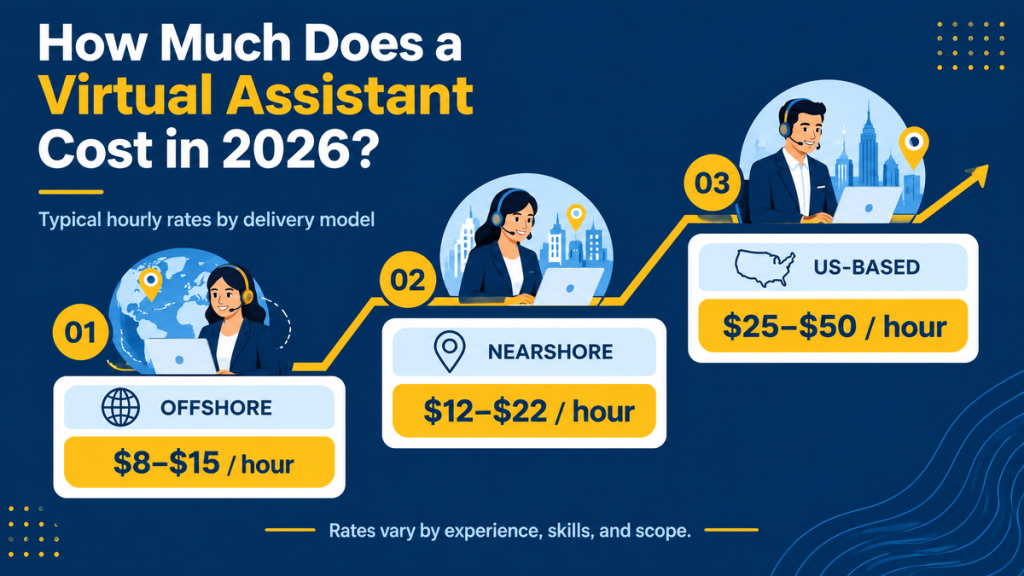
In 2026, a virtual assistant typically costs $8–$50 per hour. US-based VAs run about $25–$50/hour, offshore dedicated VAs hired through an agency run roughly $8–$15/hour, and nearshore (Latin America) VAs fall in between at $12–$22/hour. Full-time dedicated VAs usually cost $1,300–$2,800 per month. Your exact rate depends on location, experience, specialization, and whether you hire a freelancer or an agency.
If you’re weighing whether to hire a virtual assistant (VA), the first question is almost always the same: what will this actually cost me? Virtual assistant cost is the one number every buyer wants pinned down before anything else. The honest answer is that VA pricing spans a wide range, because “virtual assistant” covers everyone from a $10-an-hour offshore generalist to a $50-an-hour US-based specialist. This guide breaks the 2026 numbers down the way a buyer actually needs them: by the hour, by the month, by region, by task, and by hiring model so you can budget with confidence and spot where you’re overpaying.
We’ve spent 12+ years staffing dedicated VAs for US realtors, attorneys, loan officers, accountants, and busy executives, so the ranges below reflect what businesses are really paying, not list prices. Let’s get into it.
Virtual Assistant Cost at a Glance (2026)
Here’s the fast version. Virtual assistant rates in 2026 split cleanly by hiring model, so the gap between two quotes usually comes down to where and how you hire. Use this table to find the model that fits, then read the section below it for detail.
| Engagement model | Typical 2026 rate | Best for |
| US-based freelance VA | $25–$50 / hour | Onshore time zone, premium or sensitive tasks |
| Offshore dedicated VA (agency) | $8–$15 / hour | Ongoing full-time support at the lowest cost |
| Nearshore (Latin America) VA | $12–$22 / hour | Overlapping US hours and bilingual support |
| Part-time package (40–80 hrs/mo) | $400–$1,200 / month | Light, recurring admin work |
| Full-time dedicated VA | $1,300–$2,800 / month | A true team member who replaces a hire |
These are market ranges, not fixed quotes. The rest of this guide explains what moves your price within each band.
Virtual Assistant Hourly Rates in 2026
Your virtual assistant hourly rate depends almost entirely on where your VA sits. Here is how the three main regions compare.
US-based virtual assistant rates
A US-based VA generally charges $25–$50 per hour, and specialists like bookkeeping, paralegal support, marketing, and executive assistance sit at the top of that range or above. You’re paying for native-English communication, same time-zone availability, and familiarity with US tools and norms. For high-touch or confidential work where every nuance matters, that premium can be worth it.
Offshore virtual assistant rates
Offshore VAs commonly based in the Philippines, India, or Pakistan typically cost $8–$15 per hour through an agency, and sometimes less for direct freelancers. The lower rate reflects local cost of living, not lower skill. With a reputable provider, you get vetted, trained staff and built-in backup coverage, which is why offshore is the default choice for ongoing, scalable workloads. The main trade-off is time zone, which 24/7 providers solve by scheduling overlap with your business hours.
Nearshore (Latin America) rates
Nearshore VAs in Latin America run about $12–$22 per hour. They cost more than offshore but offer near-total overlap with US time zones and strong bilingual (English/Spanish) support useful if your customers call during US business hours or you serve Spanish-speaking clients.
Monthly and Retainer Pricing (Part-Time vs Full-Time)
Many businesses prefer a predictable monthly bill over tracking hours. Monthly virtual assistant pricing makes that easier, since you are buying a defined block of hours rather than watching a meter. Here’s how the packages usually break down.
Part-time packages
Part-time plans of roughly 40–80 hours per month typically cost $400–$1,200, depending on region and skill. This is the sweet spot for offloading a defined slice of recurring work inbox triage, scheduling, data entry without committing to a full-time seat.
Full-time dedicated VA
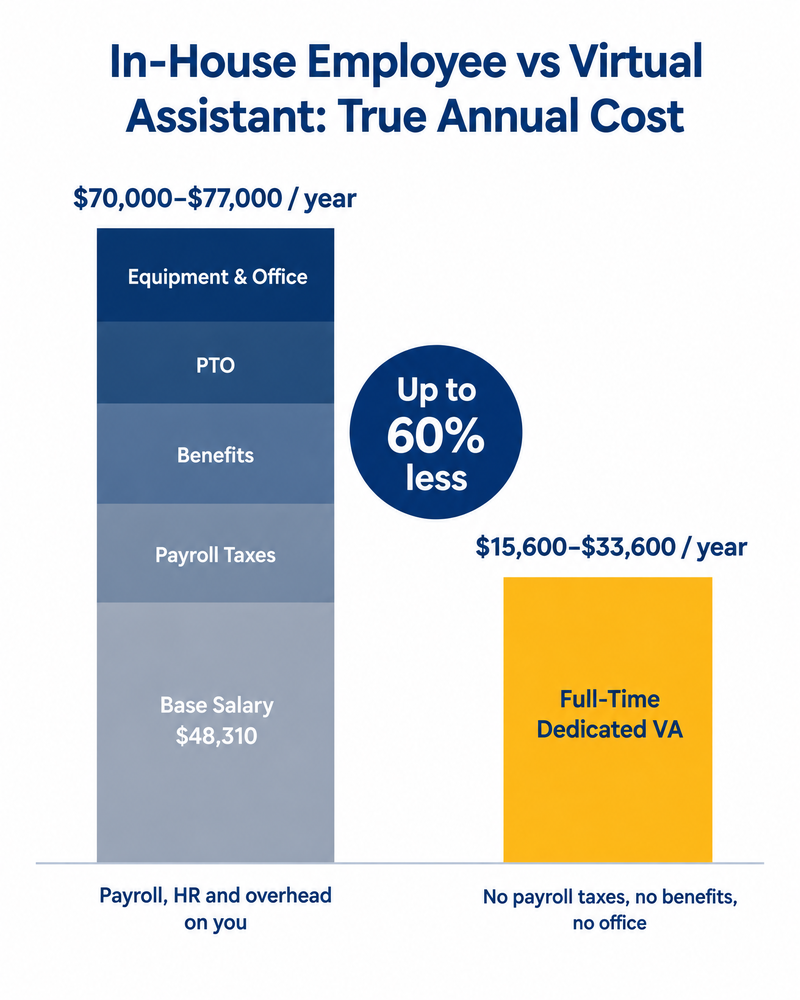
A full-time dedicated VA (about 160 hours/month) generally runs $1,300–$2,800 per month offshore-to-nearshore. For that, you get a single, consistent person embedded in your operation effectively a remote team member at a fraction of a US salary, with no payroll taxes or benefits on your side.
Pay-as-you-go vs retainer
Pay-as-you-go suits unpredictable, low-volume needs but carries a higher effective hourly rate. A monthly retainer locks in a lower rate and guaranteed availability, offering better value once your workload is steady. Most growing businesses start pay-as-you-go or on a small package, then move to a retainer as they delegate more.
What Drives Virtual Assistant Cost Up or Down
Two VAs can be priced 4x apart. Virtual assistant cost per hour moves on six variables, and most buyers only account for one or two of them. These are the factors that explain the gap:
- Location — the single biggest lever; offshore costs 50–70% less than onshore for comparable work.
- Experience and specialization — a generalist is cheaper than a trained bookkeeper, ISA, or paralegal.
- Hours and time-zone coverage — 24/7 or US-hours coverage costs more than flexible offshore hours.
- Language and communication — native or bilingual fluency commands a premium.
- Freelancer vs agency — agencies bundle vetting, training, management, and backup into the rate.
- Tools and software — specialized platform skills (CRMs, MLS, accounting suites) can raise the rate.
Virtual Assistant Cost by Specialization
Rates also vary by the type of work. Approximate 2026 ranges (blended across regions):
| VA type | Typical 2026 rate | Common tasks |
| General admin VA | $8–$25 / hr | Email, scheduling, data entry |
| Real estate VA | $8–$22 / hr | CRM & MLS updates, cold calling, transaction coordination |
| Customer support VA | $9–$25 / hr | Inbound/outbound support, chat, email |
| Bookkeeping VA | $12–$30 / hr | Invoicing, reconciliation, expense tracking |
| Marketing VA | $12–$35 / hr | Social media, content scheduling, campaigns |
If you’re a realtor, our 15 tasks realtors should outsource guide maps each task to a VA so you can see exactly where the hours go.
Freelancer vs Agency VA: the True Cost of Ownership
A freelancer’s headline rate often looks lower than an agency’s, but the sticker price isn’t the full story. With a solo freelancer, you absorb the cost of vetting, the risk of turnover, and the gap when they’re sick, on vacation, or simply disappear. Re-hiring and re-training every few months is expensive in both time and lost momentum.
An agency folds screening, training, management, and backup coverage into one rate. If your VA is out, someone covers; if they leave, a trained replacement steps in without you running a new search. For most businesses that need reliable, ongoing output, the agency model delivers a lower true cost of ownership even when the per-hour number is slightly higher. Judged over a full year rather than a single invoice, that is where the real virtual assistant cost difference shows up.
Virtual Assistant vs In-House Employee Cost
A US employee costs far more than their salary. Once you add payroll taxes, benefits, PTO, equipment, and office overhead, the fully-loaded cost runs roughly 1.25–1.4x the base salary (benefits alone average around 30% of total compensation, per US Bureau of Labor Statistics data). So a $55,000 admin hire really costs $70,000–$77,000 a year. A full-time dedicated VA delivering comparable output can cost a fraction of that, with none of the payroll or HR burden on your side.
We cover this trade-off in depth in Virtual Assistant vs Full-Time Employee, including a full side-by-side comparison and an annual-cost example.
Is a Virtual Assistant Worth the Cost?
Don’t think of a VA as an expense; think of it as buying back your time. The virtual assistant cost question is really a return question in disguise. The math is simple: if a VA costs you $1,500 a month and frees up 60+ hours you’d otherwise spend on admin, the return depends on what an hour of your time is worth when spent on revenue work.
| Worked example A realtor pays a VA $1,500/month and reclaims ~15 hours/week (≈60 hours/month) of admin and prospecting. That VA time costs about $25/hour. If those reclaimed hours let the agent close even one extra deal a quarter, the VA pays for itself many times over. The break-even isn’t the VA’s rate — it’s whether your freed time produces more than it costs. |
How to Get the Most Value From Your VA Budget
A few practices consistently separate the businesses that win with VAs from those that churn:
- Scope tightly. Write down the specific tasks and outcomes you want before you hire a vague roles waste hours.
- Start with a trial. Test the fit on real work before committing to full-time. (NSOL offers a 3-day free trial for exactly this.)
- Build simple SOPs. A one-page process doc per task dramatically improves output quality and speed.
- Track deliverables, not just hours. Measure what gets done so you can see the ROI clearly.
- Scale gradually. Add hours as you offload more, rather than over-committing on day one.
| Get an exact quote for your business. Tell us your tasks, hours, and time-zone needs, and we’ll quote within 24 hours — or start a 3-day free trial and see the work before you pay anything. 📞 +1 (360) 226-5707 · nsolbpo.com/contact |
Frequently Asked Questions
How much does a virtual assistant cost per hour in 2026?
US-based virtual assistants typically cost $25–$50 per hour in 2026, while offshore dedicated VAs through an agency run about $8–$15 per hour. Your exact rate depends on location, experience, specialization, and whether you hire a freelancer or an agency
How much does a virtual assistant cost per hour in 2026?
US-based virtual assistants typically cost $25–$50 per hour in 2026, while offshore dedicated VAs through an agency run about $8–$15 per hour. Your exact rate depends on location, experience, specialization, and whether you hire a freelancer or an agency.
How much does a virtual assistant cost per month?
Monthly virtual assistant costs range from about $400–$1,200 for part-time support to $1,300–$2,800 for a full-time dedicated VA in 2026. Agencies usually price by package or hours per month, which makes budgeting more predictable than hourly freelancers.
Are offshore virtual assistants cheaper than US-based ones?
Yes. Offshore VAs typically cost 50–70% less than US-based VAs for comparable work because of lower local wage costs. With a reputable agency, you keep quality and English fluency while cutting costs; the main trade-off is time zone, which 24/7 providers solve.
What is the average hourly rate for a US virtual assistant?
The average US-based virtual assistant charges roughly $25–$50 per hour in 2026, with specialized VAs at the higher end. Offshore and agency models lower the effective rate significantly.
Is hiring a virtual assistant worth the cost?
For most owners, yes. If a VA costs $1,500/month and frees 60+ hours you’d otherwise spend on admin, the ROI is strong when your time is worth more per hour spent on revenue work. Start with a short trial to confirm fit before committing.
Why is there such a big price range for virtual assistants?
Price varies with location, experience, specialization, language, hours of coverage, and freelancer-vs-agency model. A generalist offshore VA sits at the low end; a US-based specialist sits at the high end. Define your scope to land in the right band.
Does a cheaper virtual assistant mean lower quality?
Not necessarily. Lower offshore rates reflect local cost of living, not skill. The real risk is unvetted freelancers; an agency that screens, trains, and provides backup coverage delivers reliable quality at offshore pricing.
What’s cheaper: a freelancer or a VA agency?
A freelancer’s headline rate looks lower, but agencies often cost less in total once you factor vetting time, turnover, and coverage gaps. Agencies include replacement and backup at no extra hiring cost, reducing your true cost of ownership.
How many hours should I start with?
Most businesses start with 20–40 hours per month to test scope and fit, then scale to part-time or full-time as they offload more tasks. A free trial lets you validate output before increasing hours.
How do I get an exact virtual assistant quote for my business?
Share your task list, expected hours, and required time-zone coverage and a provider can quote within a day. With NSOL BPO, you can also start a 3-day free trial to see the work before you pay anything.
The Bottom Line
So how much does a virtual assistant cost when you strip out the noise? In 2026, expect to pay roughly $8–$50 per hour for a virtual assistant, or $1,300–$2,800 per month for full-time dedicated support, with offshore and agency models offering the strongest value for ongoing work. The smartest move isn’t chasing the lowest rate; it’s matching the right model to your tasks and proving the ROI on a short trial before you scale.
Ready to see what it would cost for your business? Book a free consultation or start your 3-day free trial with NSOL BPO’s virtual assistant, back office, and customer support services backed by 12+ years of experience and 24/7 coverage.







2 Responses
I gotta bookmark this web site it seems extremely helpful handy