
| Quick verdict: For most small and growing businesses, a dedicated virtual assistant is the better value. A VA costs roughly 50–60% less per year than an equivalent full-time hire, with no payroll taxes, benefits, PTO, or office overhead, and can start in days rather than months. Choose a full-time employee when the role requires on-site presence, deep system integration, or handling of highly confidential work. For scalable, remote-friendly tasks, a VA wins on cost, speed, and flexibility. |
You’ve got more work than hours, and you’ve narrowed the options for fixing it to two: hire a full-time employee or bring on a virtual assistant. They sound similar when someone takes work off your plate, but they’re very different in terms of cost, speed, risk, and flexibility. This guide compares them head-to-head so you can choose the right model for your situation, not just the familiar one.
We’ve placed dedicated VAs with US businesses for 12+ years, so we’ll be straight about where each option genuinely wins.
Virtual Assistant vs Full-Time Employee at a Glance
The side-by-side, before we dig into each row:
| Factor | Virtual Assistant (dedicated) | Full-Time Employee |
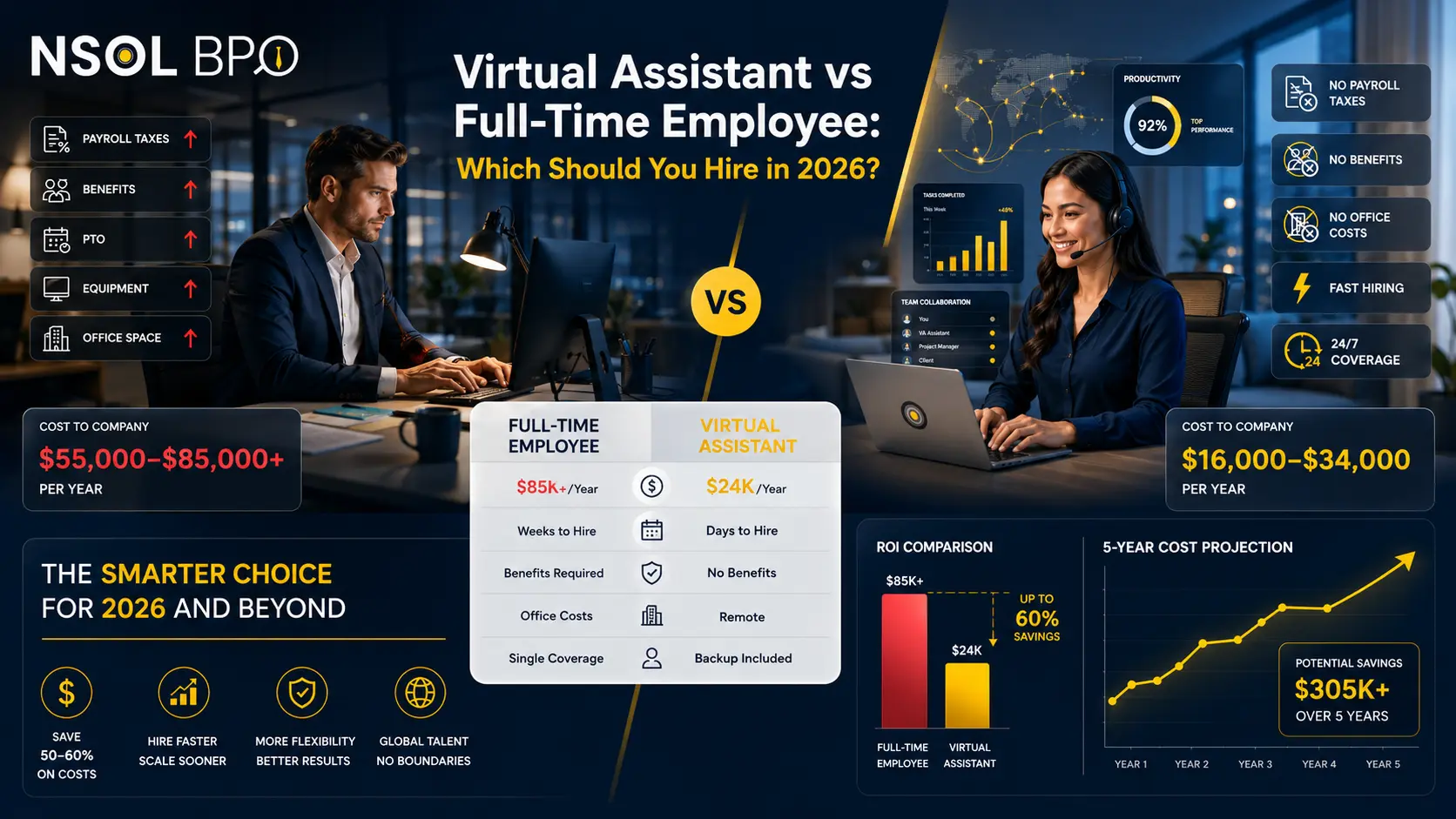
| Typical annual cost | ~$16k–$34k (offshore–nearshore) | ~$55k–$85k+ fully loaded |
| Payroll taxes & benefits | None — agency handles | +25–40% on top of salary |
| Office space & equipment | None | Required |
| Time to hire | Days | Weeks to months |
| Backup / coverage | Included (agency) | Single point of failure |
| Scalability | Scale hours up or down anytime | Fixed; hiring/firing friction |
| Hours coverage | Up to 24/7 | Standard business hours |
| Best for | Defined, scalable, remote-friendly tasks | On-site, integrated, confidential roles |
Cost figures are market estimates; validate against current BLS/SHRM data for your role and region.
True Cost Comparison
The fully-loaded cost of a full-time employee
Salary is only part of what an employee costs. Add payroll taxes, health benefits, paid time off, equipment, and software seats alone, and they average around 30% of total compensation, per US Bureau of Labor Statistics data. So a $60,000 salary really costs about $75,000–$84,000 a year. There’s also the cost of hiring itself: SHRM has put the average cost per hire at nearly $4,700.
The cost of a dedicated virtual assistant
A full-time dedicated VA typically runs $1,300–$2,800 per month, about $16k–$34k a year, with no taxes, benefits, or overhead on your side. You pay one simple invoice. For the full pricing breakdown, see How Much Does a Virtual Assistant Cost in 2026?.
Side-by-side annual example
| Cost line | Full-time employee | Dedicated VA |
| Base / contract | $60,000 | $24,000 |
| Taxes & benefits (~30%) | $18,000 | $0 |
| Equipment & office | $3,000–$6,000 | $0 |
| Hiring cost | ~$4,700 | Included |
| Approx. first-year total | ~$85,000+ | ~$24,000 |
Same output category, dramatically different cost. That gap is the core reason VAs have become the default first hire for lean teams.
Speed to Hire and Onboarding
Hiring a full-time employee is a project: write the job post, screen, interview, negotiate, onboard, train typically weeks to months. An agency VA arrives pre-vetted and can start in days, already fluent in common tools. And because the agency handles sourcing and replacement, you skip most of the recruiting work entirely.
Flexibility and Scalability
Business needs move; full-time headcount doesn’t, easily. With an employee, scaling down means layoffs and severance; scaling up means another full hiring cycle. A VA lets you add or reduce hours as you go, with no severance and no PTO gaps and you can layer on 24/7 coverage that a single employee simply can’t provide. This flexibility is repeatedly cited in Deloitte’s outsourcing research as a top reason businesses outsource, alongside cost.
Control, Management and Integration
Here’s where full-time employees genuinely win. An on-site employee is easier to integrate into informal, in-person workflows, can handle physical tasks, and may be the right call for roles that touch your most sensitive systems or require deep, long-term institutional knowledge. A VA works remotely and thrives on clear, written processes so if a role depends on hallway conversations and tacit knowledge, weigh that honestly.
That said, the gap is smaller than it used to be. A dedicated VA (one consistent person, not a rotating pool) integrates into your tools, attends your standups, and learns your business much like an employee would.
Reliability, Risk and Continuity
A sole employee is a single point of failure: if they’re sick, on vacation, or quit, the work stops and you bear the rehiring cost. A reputable agency builds in backup and replacement coverage, so output continues through absences and turnover. You also offload HR compliance, misclassification risk, and payroll administration to the provider.
Pros and Cons of Each
Virtual assistant — pros and cons
- Pros: much lower cost, fast to start, scalable hours, backup coverage, 24/7 options, no payroll/HR burden.
- Cons: remote-only, possible time-zone gaps, needs clear written processes, less suited to confidential on-site work.
Full-time employee — pros and cons
- Pros: on-site presence, deep integration, full strategic ownership, easiest for confidential or physical work.
- Cons: high fully-loaded cost, slow to hire, fixed capacity, single point of failure, full HR/payroll responsibility.
When to Choose a Virtual Assistant vs an Employee
| Your situation | Better fit |
| Recurring admin, support, data or lead-gen work | Virtual assistant |
| Need to start now and control cost | Virtual assistant |
| Unpredictable or seasonal workload | Virtual assistant |
| Need 24/7 or after-hours coverage | Virtual assistant |
| Role requires on-site presence or physical tasks | Full-time employee |
| Deep integration / highly confidential systems | Full-time employee |
| Full-time strategic ownership of a function | Full-time employee |
The Hybrid Model: Best of Both
You don’t have to choose once and forever. Many businesses use a dedicated VA to handle work now, prove the ROI, and reserve in-house hires for the few roles that truly need to be on-site. A dedicated VA gives you the employee experience with a consistent person who knows your business without the overhead, taxes, or hiring risk.
| Get the employee experience without the overhead Hire a dedicated virtual assistant in days, not months — no payroll, no benefits, no risk. Start a 3-day free trial and see the work before you pay. 📞 +1 (360) 226-5707 · nsolbpo.com/contact |
Frequently Asked Questions
Is a virtual assistant cheaper than a full-time employee?
Yes. A dedicated virtual assistant typically costs 50–60% less per year than an equivalent full-time hire because there are no payroll taxes, benefits, PTO, office space or equipment costs — the agency absorbs all of that.
Can a virtual assistant replace a full-time employee?
For many roles, yes — especially admin, customer support, scheduling, data entry, bookkeeping support and lead generation. A full-time dedicated VA can match an employee’s hours and output for defined, remote-friendly work, without the overhead.
What are the disadvantages of hiring a virtual assistant?
The main trade-offs are less on-site presence, potential time-zone gaps, and the need for clear written processes. Reputable agencies offset these with overlapping-hours scheduling, backup coverage and structured onboarding.
What is the fully-loaded cost of a full-time employee?
Beyond base salary, employers pay roughly 25–40% extra for payroll taxes, benefits, PTO, equipment and overhead. So a $60,000 salary really costs about $75,000–$84,000 per year — a gap that makes VAs attractive.
When should I hire a full-time employee instead of a VA?
Hire a full-time employee when the role needs on-site presence, deep integration with internal systems, handling of highly confidential data, or full-time strategic ownership. For scalable, remote-friendly tasks, a VA is usually the better value.
How fast can I hire a virtual assistant vs an employee?
A virtual assistant through an agency can start in days, while a full-time hire typically takes weeks to months to source, interview, onboard and train. Agencies also provide pre-vetted candidates, removing most of the hiring work.
Do I have to handle payroll and taxes for a virtual assistant?
No. With an agency model, the VA is the agency’s responsibility — you pay one simple invoice with no payroll taxes, benefits administration or HR compliance burden on your side.
Is a virtual assistant a contractor or an employee?
Through an agency, your dedicated VA is employed by the agency, not by you — so you get dedicated, full-time output without W-2 obligations, 1099 paperwork or misclassification risk.
What happens if my virtual assistant is sick or quits?
With a reputable agency, backup and replacement coverage is built in, so your work continues without the gap or rehiring cost you’d face if a sole employee left. That continuity is a key advantage over a single in-house hire.
Can I start with a VA and hire employees later?
Absolutely. Many businesses use a VA to handle work now, prove the ROI, and scale hours up or down as they grow — then add in-house roles only where on-site presence is essential. A free trial is a low-risk way to start.
The Bottom Line
A full-time employee makes sense for on-site, deeply integrated, or confidential roles. For nearly everything else, an admin, support, back office, lead generation with a dedicated virtual assistant delivers comparable output at roughly half the annual cost, starts in days, scales with you, and removes the payroll and HR burden. Most growing businesses get there fastest by starting with a VA and adding employees only where presence is essential.
Want to see the numbers for your role? Book a free consultation or start a 3-day free trial with NSOL BPO dedicated virtual assistant, back office, and customer support services, backed by 12+ years of experience and 24/7 coverage.
| About the author / reviewed by Written by the NSOL BPO team, who have staffed dedicated virtual assistants for US realtors, attorneys, loan officers, accountants and executives since 2013. Cost figures reflect current market ranges; statistics cited from the US Bureau of Labor Statistics and SHRM should be verified against the latest published data. |