
You have too much to do and not enough hours in the day, and you’ve boiled down the choices for solving your problem to two: a full-time employee and a virtual assistant. They seem the same when they relieve you of some tasks, but they are worlds apart when you consider cost, speed, risk, and flexibility. Virtual Assistant vs Full-Time Employee is an issue of buying capacity in different ways, and getting it wrong means overpaying for idle capacity or being stalled out for months by a key hire that you don’t dare lose. This guide will show you how to compare them so that you can make the right choice, not the easy one.
We’ve placed dedicated VAs with US businesses for 12+ years, so we’ll be straight about where each option genuinely wins.
| Quick verdict: For most small and growing businesses, a dedicated virtual assistant is the better value. A VA costs roughly 50–60% less per year than an equivalent full-time hire, with no payroll taxes, benefits, PTO, or office overhead, and can start in days rather than months. Choose a full-time employee when the role requires on-site presence, deep system integration, or handling of highly confidential work. For scalable, remote-friendly tasks, a VA wins on cost, speed, and flexibility. |
Virtual Assistant vs Full-Time Employee at a Glance
The side-by-side, before we dig into each row:
| Factor | Virtual Assistant (dedicated) | Full-Time Employee |
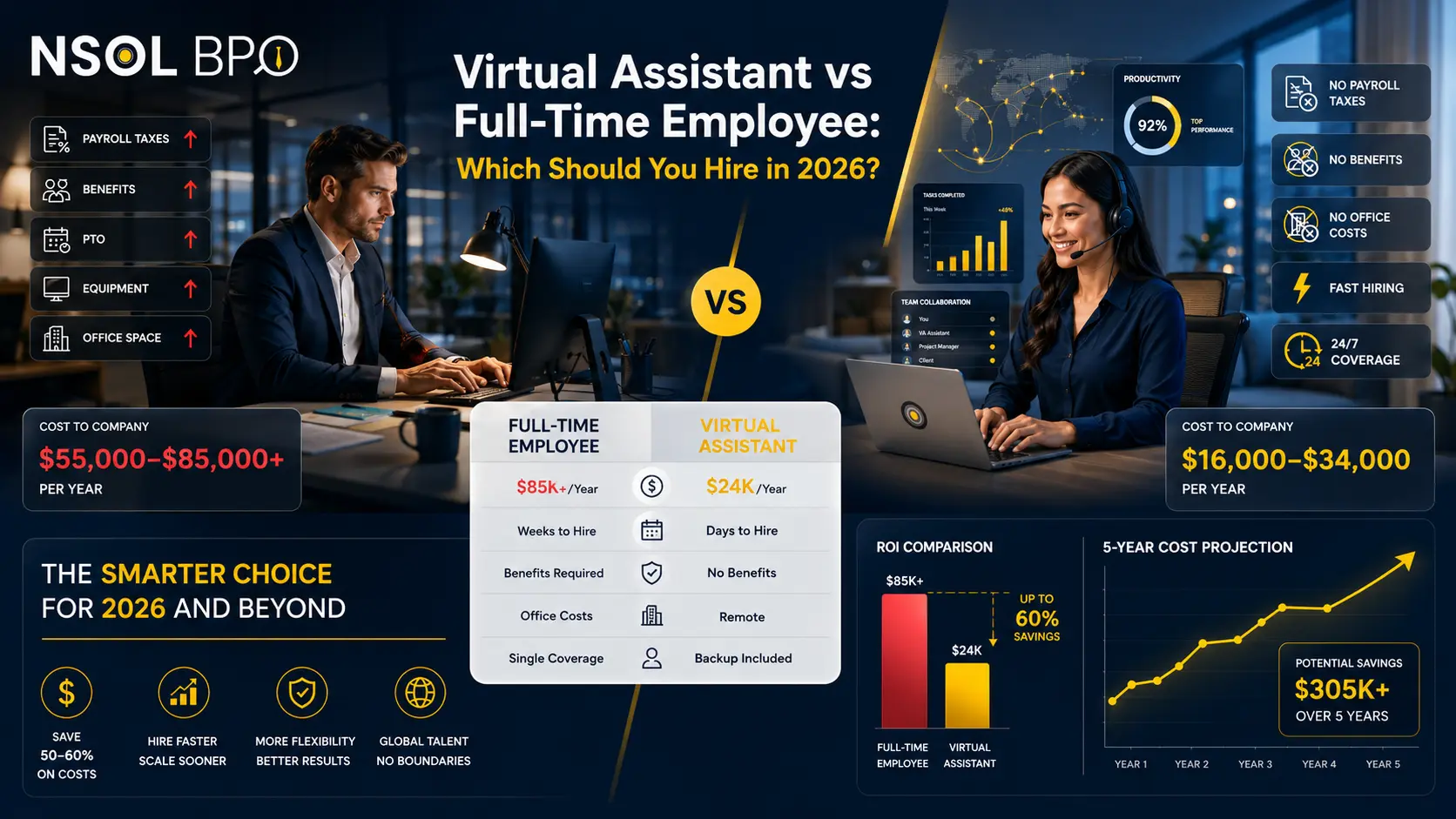
| Typical annual cost | ~$16k–$34k (offshore–nearshore) | ~$55k–$85k+ fully loaded |
| Payroll taxes & benefits | None — agency handles | +25–40% on top of salary |
| Office space & equipment | None | Required |
| Time to hire | Days | Weeks to months |
| Backup/coverage | Included (agency) | Single point of failure |
| Scalability | Scale hours up or down anytime | Fixed; hiring/firing friction |
| Hours coverage | Up to 24/7 | Standard business hours |
| Best for | Defined, scalable, remote-friendly tasks | On-site, integrated, confidential roles |
Cost figures are market estimates; validate against current BLS/SHRM data for your role and region.
Virtual Assistant vs Full-Time Employee: True Cost Comparison
When comparing Virtual Assistant vs. Full-Time Employee, salary is the number that people begin and end with. They shouldn’t. Here are the real costs of each option for twelve months.
The fully-loaded cost of a full-time employee
Salary is only part of what an employee costs. Add payroll taxes, health benefits, paid time off, equipment, and software seats alone, and they average around 30% of total compensation, per US Bureau of Labor Statistics data. So a $60,000 salary really costs about $75,000–$84,000 a year. There’s also the cost of hiring itself: SHRM has put the average cost per hire at nearly $4,700.
The cost of a dedicated virtual assistant
A full-time dedicated VA typically runs $1,300–$2,800 per month, about $16k–$34k a year, with no taxes, benefits, or overhead on your side. You pay one simple invoice. For the full pricing breakdown, see How Much Does a Virtual Assistant Cost in 2026?.
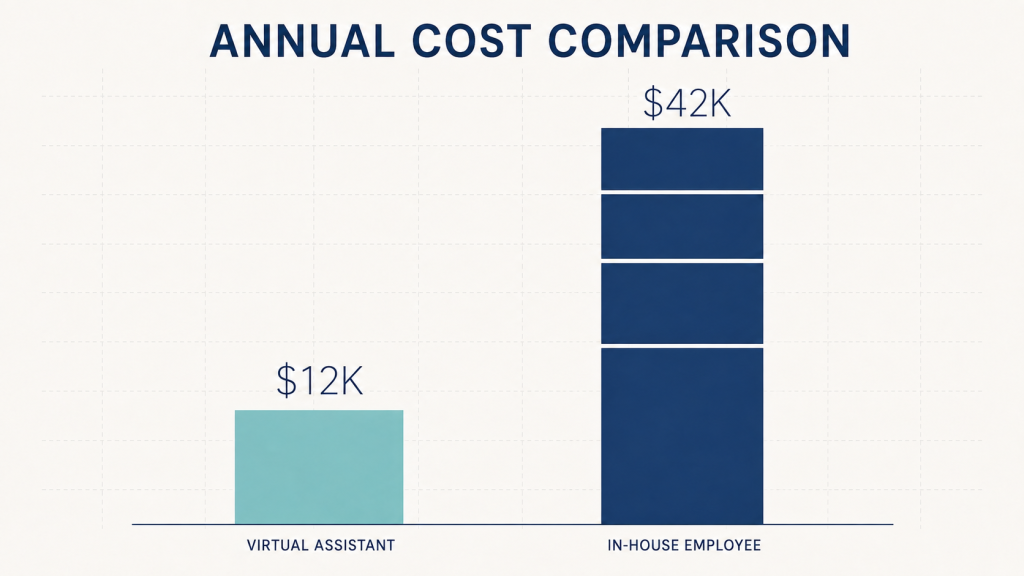
Side-by-side annual example
| Cost line | Full-time employee | Dedicated VA |
| Base/contract | $60,000 | $24,000 |
| Taxes & benefits (~30%) | $18,000 | $0 |
| Equipment & office | $3,000–$6,000 | $0 |
| Hiring cost | ~$4,700 | Included |
| Approx. first-year total | ~$85,000+ | ~$24,000 |
Q1. Is a virtual assistant cheaper than a full-time employee?
Yes. A dedicated virtual assistant typically costs $16,000–$34,000 a year, while a $60,000 employee costs about $85,000 once payroll taxes, benefits, equipment, and hiring fees are added. That’s roughly 60% less for comparable output, with no overhead on your side. On cost alone, Virtual Assistant vs Full-Time Employee isn’t close.
Same output category, dramatically different cost. That gap is the core reason VAs have become the default first hire for lean teams. On a pure Virtual Assistant vs Full-Time Employee cost basis, that’s roughly $61,000 back in your budget in year one money most owners redirect into inventory, ads, or a second VA.
Speed of Hiring & Onboarding
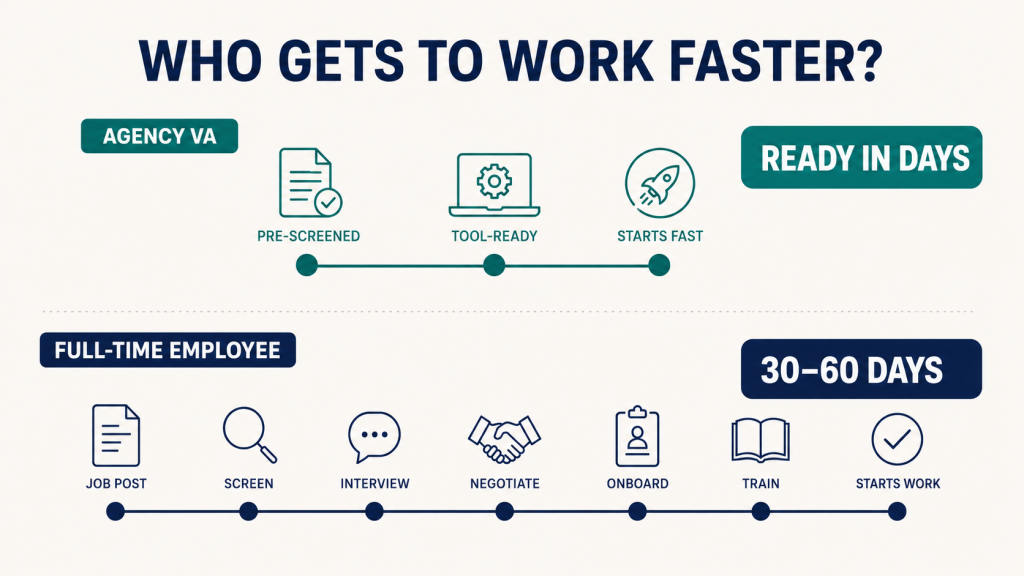
Hiring a full-time employee is a process that entails developing a job description, filtering, interviewing, negotiating, onboarding, and training, all of which take weeks or even months. But for an agency VA, he is ready to go immediately because he has already been screened by the agency, and he has knowledge of using the most common tools. Speed is often the deciding factor in Virtual Assistant vs Full-Time Employee: days versus 30–60 days before anyone touches real work.
Flexibility and Scalability
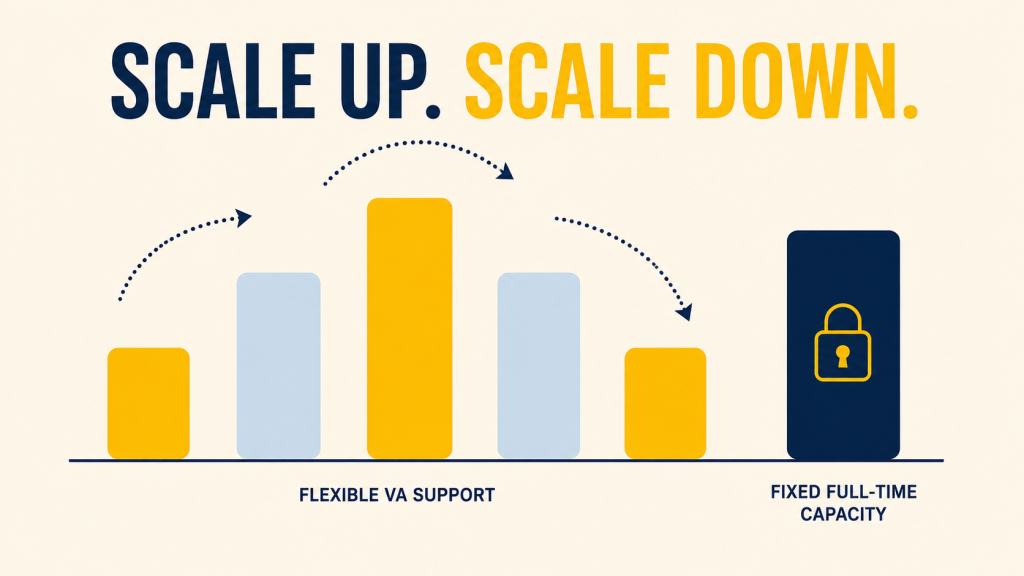
This is where the virtual assistant and full-time employee models diverge most sharply. Business needs move; full-time headcount doesn’t, easily. With an employee, scaling down means layoffs and severance; scaling up means another full hiring cycle. A VA lets you add or reduce hours as you go, with no severance and no PTO gaps, and you can layer on 24/7 coverage that a single employee simply can’t provide. This flexibility is repeatedly cited in Deloitte’s outsourcing research as a top reason businesses outsource, alongside cost.
Control, Management and Integration
However, all points from the Virtual Assistant vs Full-Time Employee cannot be used as arguments in favor of outsourcing. Here’s when full-time employees will clearly prevail. An on-site employee will be much easier to incorporate into your informal in-person processes, perform any physical work, and be hired for the job that requires the highest level of security within your company or access to the critical information that is stored there. A virtual assistant performs his duties remotely and relies upon written procedures; hence consider this point accordingly.
That said, the gap is smaller than it used to be. A dedicated VA (one consistent person, not a rotating pool) integrates into your tools, attends your standups, and learns your business much like an employee would.
Reliability, Risk and Continuity
The individual employee poses a single point of failure because if they are ill, on holiday or decide to quit, your production will be halted and you incur hiring costs. The right agency will ensure that there is a backup in place, thus the output is continuous despite the employees’ absence or change of individuals. You also get rid of human resource management issues, misclassification risk and payroll processing.
Pros and Cons of Each
Virtual assistant pros and cons
- Pros: much lower cost, fast to start, scalable hours, backup coverage, 24/7 options, no payroll/HR burden.
- Cons: remote-only, possible time-zone gaps, needs clear written processes, less suited to confidential on-site work.
Full-time employee pros and cons
- Pros: on-site presence, deep integration, full strategic ownership, easiest for confidential or physical work.
- Cons: high fully-loaded cost, slow to hire, fixed capacity, single point of failure, full HR/payroll responsibility.
When to Choose a Virtual Assistant vs an Employee
| Your situation | Better fit |
| Recurring admin, support, data or lead-gen work | Virtual assistant |
| Need to start now and control cost | Virtual assistant |
| Unpredictable or seasonal workload | Virtual assistant |
| Need 24/7 or after-hours coverage | Virtual assistant |
| Role requires on-site presence or physical tasks | Full-time employee |
| Deep integration / highly confidential systems | Full-time employee |
| Full-time strategic ownership of a function | Full-time employee |
The Hybrid Model: Best of Both
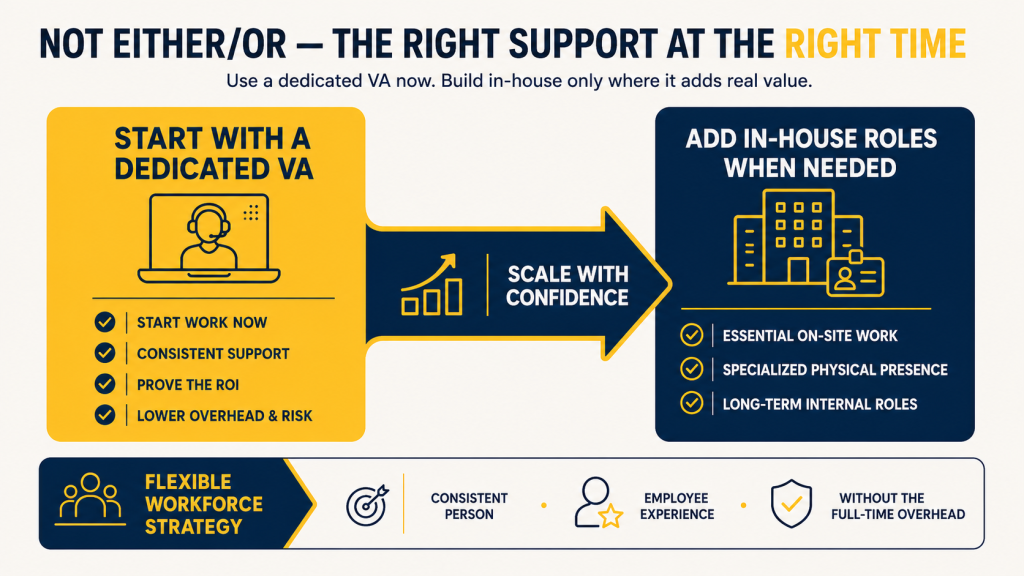
Virtual Assistant vs Full-Time Employee doesn’t have to be an either/or decision. You don’t have to choose once and forever. Many businesses use a dedicated VA to handle work now, prove the ROI, and reserve in-house hires for the few roles that truly need to be on-site. A dedicated VA gives you the employee experience with a consistent person who knows your business without the overhead, taxes, or hiring risk.
| Get the employee experience without the overhead. Hire a dedicated virtual assistant in days, not months no payroll, no benefits, no risk. Start a 3-day free trial and see the work before you pay. 📞 +1 (360) 226-5707 · nsolbpo.com/contact |
Frequently Asked Questions
Can a virtual assistant replace a full-time employee?
For many roles, yes, especially admin, customer support, scheduling, data entry, bookkeeping support, and lead generation. A full-time dedicated VA can match an employee’s hours and output for defined, remote-friendly work, without the overhead. The virtual assistant and full-time employee models overlap most where the work is process-driven and documented.
What are the disadvantages of hiring a virtual assistant?
Tradeoffs include reduced physical presence, possible time zone mismatches, and the requirement for detailed documentation. But good VA firms balance this with shift scheduling, support systems, and proper training. This is one of the very few instances where the Virtual Assistant vs Full Time Employee debate favors the employee.
What is the fully-loaded cost of a full-time employee?
Beyond base salary, employers pay roughly 25–40% extra for payroll taxes, benefits, PTO, equipment, and overhead. So a $60,000 salary really costs about $75,000–$84,000 per year a gap that makes VAs attractive. That gap is the single biggest factor in Virtual Assistant vs Full-Time Employee.
When should I hire a full-time employee instead of a VA?
Hire a full-time employee when the role needs on-site presence, deep integration with internal systems, handling of highly confidential data, or full-time strategic ownership. For scalable, remote-friendly tasks, a VA is usually the better value.
How fast can I hire a virtual assistant vs an employee?
A virtual assistant through an agency can start in days, while a full-time hire typically takes weeks to months to source, interview, onboard, and train. Agencies also provide pre-vetted candidates, removing most of the hiring work.
Do I have to handle payroll and taxes for a virtual assistant?
No. With an agency model, the VA is the agency’s responsibility; you pay one simple invoice with no payroll taxes, benefits administration, or HR compliance burden on your side.
Is a virtual assistant a contractor or an employee?
Through an agency, your dedicated VA is employed by the agency, not by you, so you get dedicated, full-time output without W-2 obligations, 1099 paperwork, or misclassification risk.
What happens if my virtual assistant is sick or quits?
With a reputable agency, backup and replacement coverage is built in, so your work continues without the gap or rehiring cost you’d face if a sole employee left. That continuity is a key advantage over a single in-house hire.
Can I start with a VA and hire employees later?
Absolutely. Many businesses use a VA to handle work now, prove the ROI, and scale hours up or down as they grow, then add in-house roles only where on-site presence is essential. A free trial is a low-risk way to start.
The Bottom Line
Virtual Assistant vs Full-Time Employee comes down to one question: does this role need a seat, or does it need hours? A full-time employee makes sense for on-site, deeply integrated, or confidential roles. In all other cases, a virtual assistant doing administration, customer support, back-office operations, or lead generation work will give the same output for half the price and with half the hassle each year. The quickest way to get there for most growing companies is to start with a virtual assistant and hire staff only where needed. On cost and flexibility, Virtual Assistant vs Full-Time Employee is a clear win for the virtual assistant.
Still weighing Virtual Assistant vs Full-Time Employee for a specific role? Book a free consultation or start a 3-day free trial with NSOL BPO dedicated virtual assistant, back office, and customer support services, backed by 12+ years of experience and 24/7 coverage.
| About the author / reviewed by: Written by the NSOL BPO team, who have staffed dedicated virtual assistants for US realtors, attorneys, loan officers, accountants, and executives since 2013. Cost figures reflect current market ranges; statistics cited from the US Bureau of Labor Statistics and SHRM should be verified against the latest published data. |