

Here’s a scenario that probably sounds familiar. You start working on your laptop on a Monday morning, knowing exactly what you need to get done this week: write a proposal, make sure to follow up with a contact, get that process documented. Three hours have passed, and you’ve replied to some customer emails, rearranged a couple of appointments, updated a spreadsheet, and done no work at all that you intended to do.
This is not a problem of productivity. This is a problem of staffing. And for many small business owners, the best solution to this kind of problem is to hire a virtual assistant.
The hard part is not deciding to delegate it is working out which of the best virtual assistant companies actually fits how you run things.
This guide will be useful for those who are beyond the “should I hire a VA?” dilemma and are now comparing the best virtual assistant companies to hire. We’ll discuss the structure of the market, differences between good and average providers, and will see how to understand the type of service that works for you.
Understand the Service You Are Looking for
Virtual assistant services for small businesses cover a pretty wide range of work Prior to the analysis of various providers, it is crucial to know what category you want to enter:
• Administrative support: sorting emails, scheduling, making travel arrangements, entering information, formatting papers
• Customer service: providing answers, live chats, order tracking, follow-up emails
• Marketing activities: social media scheduling, content repurposing, basic graphics editing, newsletter management
• Back office: bookkeeping assistance, invoice processing, research, reporting
Knowing which of these four you actually need is the first filter to apply when you shortlist the best virtual assistant companies.
Some providers specialize. A company that’s built around executive assistant work might not touch customer support at all. Others, particularly BPO-style providers, are set up to handle multiple functions, which can simplify things if you need help in more than one area.
The other thing worth understanding early is the difference between hiring through a platform versus hiring through a company. When you hire someone on Upwork, you’re basically hiring an individual. This makes you in control and saves money, but at the same time, it’s you who’s responsible for everything, from selection through training to fixing any problems that occur. A VA company handles more of that on its end you get structure, backup coverage, and someone else’s quality control. For a business owner who’s already stretched, that structure is usually worth paying for.
That structure is the main thing separating the best virtual assistant companies from a marketplace listing.

How the Market Is Actually Organized
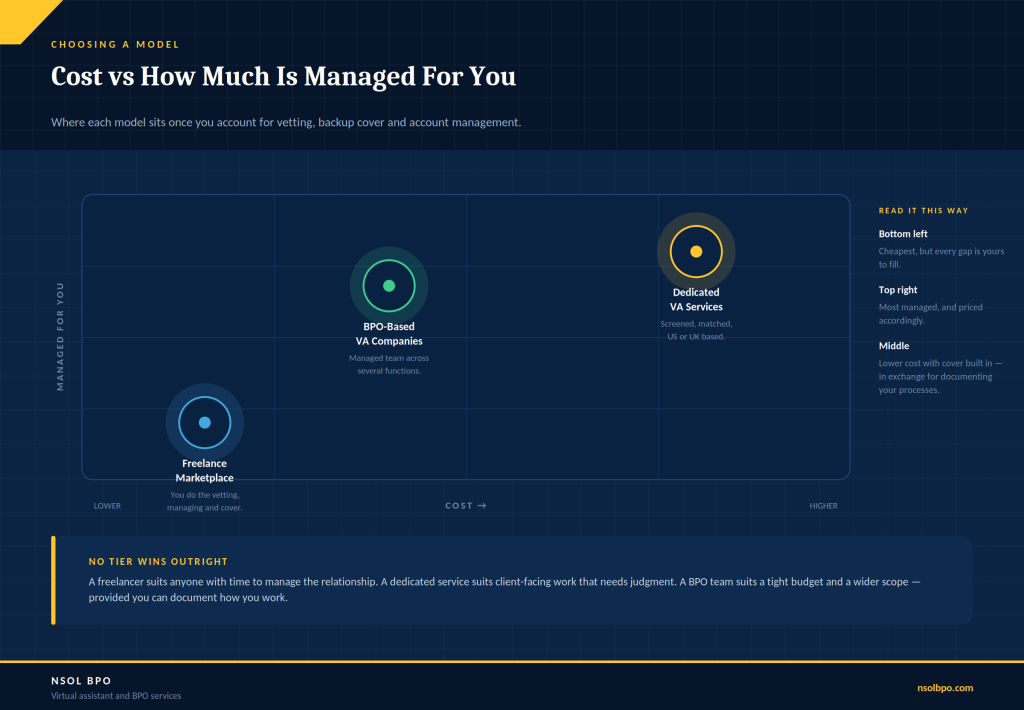
The best virtual assistant companies fall into three broad categories, and they serve pretty different needs.
Knowing which category a provider sits in tells you more than any list of the best virtual assistant companies ever will.
Freelance Marketplace
You can interact with your own virtual assistant via websites like Upwork and Fiverr. You can prepare your own job posting, hire a candidate, and conduct an interview on your own. Rates can be very low, especially for assistants based outside the US or UK. The risk is that you’re on your own if it doesn’t work out: no backup, no account manager, no guarantee.
This model works best if you have time to manage a VA relationship yourself and you’re comfortable doing the upfront vetting. If that sounds exhausting, it probably will be.
This tier is where most people start, and it is why the best virtual assistant companies win business from marketplaces so often.
Dedicated VA Services
This is the mid-to-premium tier: companies like Belay, Time Etc, and Boldly. They screen and match you with vetted assistants, usually based in the US or UK. Some offer a dedicated assistant (your person, full stop); others use a shared pool where different assistants may handle your tasks over time. Quality tends to be higher, but so does the price, typically $30 to $75+ per hour depending on the service and the scope of work.
These providers are built for businesses where reliability and communication really matter. If you’re delegating client-facing work or anything that requires judgment and context, this tier is worth the investment.
For client-facing delegation, this is the tier most rankings of the best virtual assistant companies are built around.
BPO-Based VA Companies
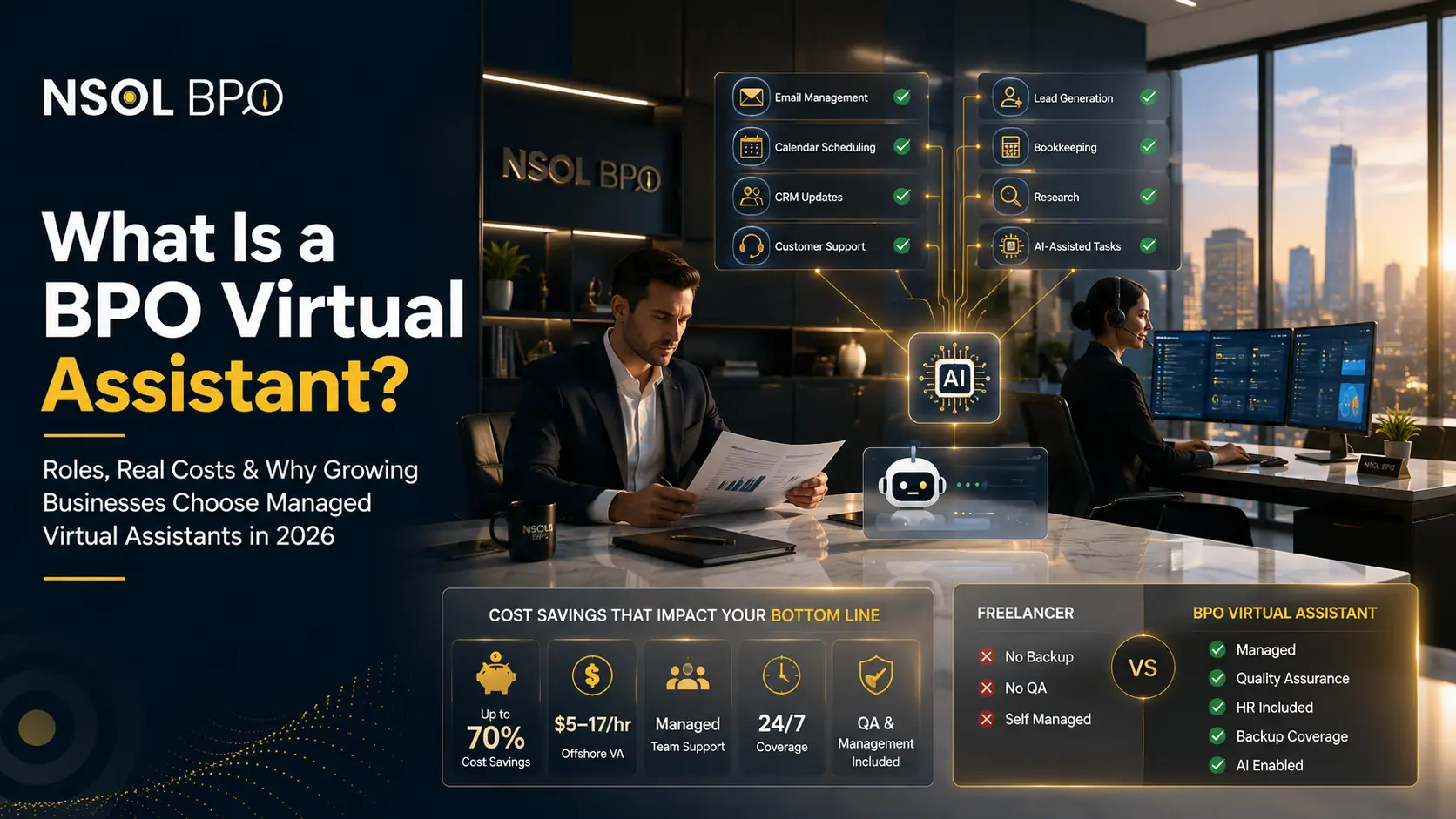
BPO stands for business process outsourcing, and it represents a different model entirely. Rather than matching you with an individual assistant, a BPO provider staffs a managed team often across multiple time zones that can cover a wider range of functions at a lower cost. Companies like NSOL BPO operate in this space, offering virtual assistant solutions for small businesses that include admin support, customer service, and back-office operations under one roof.
The appeal is cost and scale. The trade-off is that working with an offshore or hybrid team requires more upfront process documentation; you can’t rely on shared cultural context the way you might with a US-based assistant. For small companies that actually face the issue of a tight budget, the cost disparity is huge.
On budget alone, BPO providers are frequently the best virtual assistant companies available to a small team.
A Realistic Look at the Best Virtual Assistant Companies
Here is how three of the best virtual assistant companies actually compare once you look past the marketing pages.
Belay
Belay has built a strong reputation in the US market, particularly among business owners who need serious executive support. They have assistants who are based in the United States and have experience. The matching process is rigorous. In case you need an assistant who can handle an elaborate calendar, handle communications, or even work with your leadership, Belay is a viable choice.
The honest caveat: it’s expensive. If what you actually need is data entry, inbox management, and basic scheduling, you’re paying for capability you won’t use. That’s a common mistake: buying a premium service because it feels safer, when a more affordable option would have done the job fine.
Paying premium rates for basic tasks is the most common way businesses overspend on the best virtual assistant companies.
Works best for: Business owners who need high-trust, experienced admin support and have the budget for it.
Time Etc
Time Etc offers a subscription model with a pool of experienced, US and UK-based assistants. It sits in the middle of the market more structured than hiring a freelancer directly, more affordable than fully dedicated services. The catch is that you may work with more than one assistant over time, since tasks are distributed across a team. For recurring, well-defined work, that’s usually not a problem. Any task that requires much background information about your business may cause irritation. This middle tier is where a lot of buyers land after comparing the best virtual assistant companies on price alone.
Is suitable for: Businesses with a well-defined set of tasks to delegate that do not require high continuity.
Boldly
The Boldly approach focuses on premium solutions without any apology. Its approach assumes working in long-term relationships. You get one assistant who will get to know your business over time. The assistants are usually senior specialists covering administration, marketing, project management, and many other areas. The subscription is monthly, and the costs depend on the experience level. Continuity is the differentiator here, and it is what separates the best virtual assistant companies from a rotating task pool.
If you have been working with a VA before and you have noticed that one of the main problems was always explaining things to a different person each time, then you may like this model.
Is suitable for: Growth-stage businesses that would like a right-hand person rather than task coverage.
Fancy Hands
Fancy Hands is built differently from the others. You pay for task credits, not hours. Want someone to place a phone call, conduct research, or make a reservation? Just submit a task, and it will be done. It is not about personal support – no assistant will be assigned to you, and it is not suitable for something complicated or long-lasting. But for specific occasional tasks, it is cheap and simple.
Recommended for: Businesses that have some recurring tasks and do not need dedicated support.
Virtual Assistant Service Cost
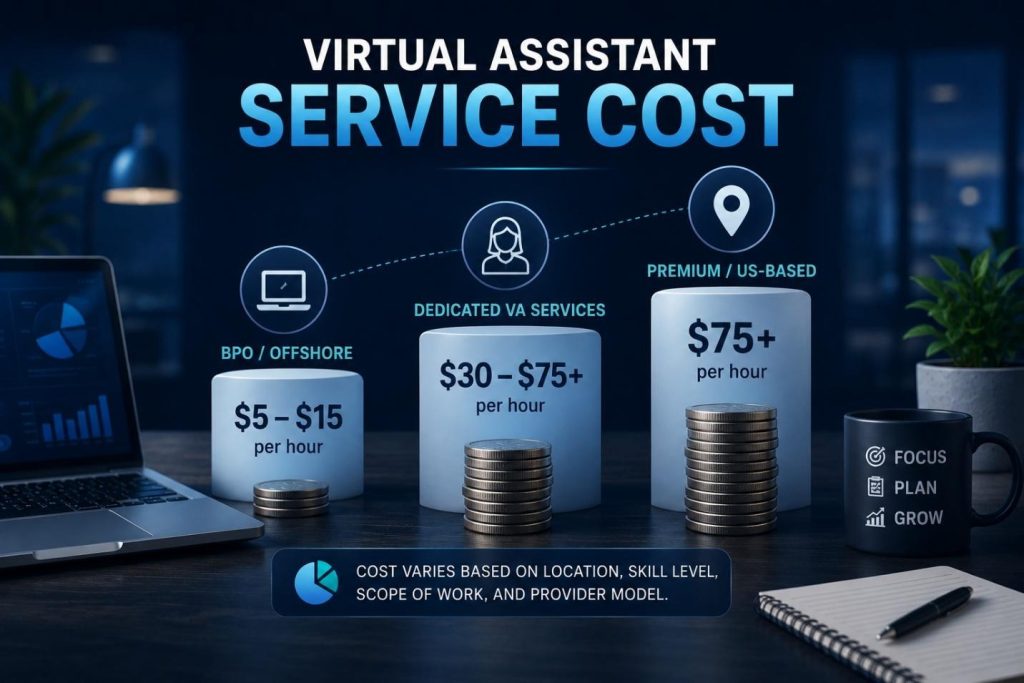
Pricing across the best virtual assistant companies varies widely, and the website rate is never the full story.
| Service Type | Typical Rate | What to Know |
|---|---|---|
| Freelance marketplace | $5–$30/hour | You manage everything; rates vary widely by location |
| Shared VA service | $25–$45/hour | Subscription-based; assistant pool, not dedicated |
| Dedicated US/UK VA | $40–$75+/hour | Higher experience level; better for complex work |
| BPO/managed team | $10–$25/hour equivalent | Usually packaged monthly; broader service range |
One thing a lot of buyers don’t think through: the real cost includes onboarding time. With any provider, you’ll spend the first few weeks documenting processes, answering questions, and giving feedback. A $15/hour VA who takes three months to get up to speed can easily cost more in total than a $45/hour VA who’s running independently after two weeks.
The U.S. Small Business Administration has practical resources on evaluating outsourcing decisions that can help you think about this as a real business investment rather than a line-item expense.
The Factors That Actually Determine Whether It Works
Price is the thing most people research first. But the factors below are what actually determine whether a VA relationship succeeds or fails.
Communication. This is the number one thing. How does the company expect you to communicate with your assistant? Email only? A project management tool? Real-time chat? Whatever it is, it needs to match how you actually work. And there should be a clear point of contact not a help desk ticket for every question.
Coverage when things go sideways. Freelancers get sick. People take vacations. What’s the plan when your assistant is unavailable? A company should have a real answer to this. If they don’t, factor that risk in.
What’s actually in scope? Some providers only do administrative work. There are others who can do the customer support and marketing jobs. It is important to check if the service meets your requirements before comparing prices.
Room to grow. If your business picks up and you suddenly need more hours or a wider range of support, can this provider keep up? Starting over with a new vendor six months in is a real cost in time, in lost context, and in friction.
Security basics. If your assistant will have access to client data, financial accounts, or internal systems, ask about NDAs and data handling policies before you sign anything. According to research from Clutch, data security is one of the most consistent concerns among small businesses evaluating outsourcing partnerships, and it’s one that’s easy to overlook when you’re focused on price and features.
Before You Start Interviewing Providers
A little homework done initially will make the entire process easy and more likely to succeed. It also makes it far easier to tell the best virtual assistant companies apart once you are on a call with them.
Write down the tasks that you want to delegate. Not categories, actual tasks. “Manage my email” is too vague. “Sort incoming emails into folders, flag anything that needs my attention, and respond to standard customer inquiries using the templates I’ll provide” is something a VA can actually do on day one.
Track a week of your own time. Rather than estimating how many hours you will require for your time estimate, try doing it for a week and recording how much time these particular tasks take.
Define what success looks like. If you hire someone and it works, what’s different in your week? That answer should drive how you evaluate providers on outcomes, not on feature lists.
Document before you delegate. A good assistant will ask how you do things. The cleaner your documentation, the faster they’ll be productive. Loom is useful here; short screen-share recordings are faster to make than written SOPs and easier for an assistant to follow.
Start with less than you think you need. Almost all experienced entrepreneurs would say that they have overscored their first virtual assistant project. Start by identifying the simplest to define tasks and then scale up from there.
Choosing the Right Provider for Where You Are Now
There’s no universal winner among the best virtual assistant companies. What there is a best fit for your budget, your task list, and how much management bandwidth you have right now.
For startups on a budget, the cheaper alternative of a BPO-based service or a shared VA service may be what you require at the start. For executive services requiring a high level of trust and cost isn’t an issue, the dedicated service of Belay or Boldly might be what you need. If you simply require assistance for a few tasks, fancy hands or freelance assistance might suffice. Matching the tier to your stage matters more than picking from a list of the best virtual assistant companies.
For businesses that want something in between structured support, a reasonable price point, and room to grow, working with a managed outsourcing provider like NSOL BPO is worth a direct conversation. The goal isn’t to find the most impressive provider. It’s to find the one that frees up your time without creating a new set of problems to manage.
The tasks on your plate right now? Most of them don’t need you. A good virtual assistant handles them so you can focus on the work that actually matters.
What is the most appropriate virtual assistant company for small business use?
For small businesses, there are three tiers of virtual assistant companies, which include freelance marketplaces such as Upwork, dedicated companies such as Belay, Time Etc and Boldly, and business process outsourcing companies such as NSOL BPO. Each type of company is chosen based on the budget and available management capacity. Dedicated companies are good for front-facing projects, while business process outsourcing companies are suited to businesses needing broad coverage.
How much does a virtual assistant company cost?
The cost varies according to the model used and ranges from $5-$75+/hour. For freelance marketplaces, it is $5-$30/hour, shared virtual assistant services cost $25-$45/hour, dedicated US or UK virtual assistants cost $40-$75+/hour, while business process outsourcing managed teams cost $10-$25/hour equivalent. Remember to calculate for the onboarding time – the low-cost assistant that will take three months to get going might end up being more expensive.
H3: What is the distinction between an online assistant agency and a freelance platform?
In an online assistant agency, assistants are hired, screened, trained, and managed for you, while the agency itself handles the backup assistant when your own is unable to perform their duties. In a freelance platform, you get a lower rate, but the burden of screening, training, and solving problems lies solely on you.
Which virtual assistant company is best for startups on a budget?
BPO-based providers offer the strongest value for startups. Because they staff managed teams rather than matching you with a single premium assistant, a virtual assistant company for small business budgets can cover admin, customer service and back-office work under one monthly cost. The trade-off is that you’ll need clearer process documentation upfront.
H3: Should I hire a dedicated virtual assistant or use a shared service?
Choose dedicated if your work requires business context and continuity a dedicated assistant learns how you operate over time. Choose shared if your tasks are well-defined and repeatable, since a rotating pool handles those fine at a lower price. The frustration with shared services comes from re-explaining context to a different person each time.
How do I choose between the top virtual assistant companies?
Compare five things beyond price: how communication works, what happens when your assistant is unavailable, what’s actually in scope, whether the provider can scale with you, and their data security and NDA policies. Most buyers compare top virtual assistant companies on hourly rate alone, which is why so many switch providers within six months.
What tasks can I delegate to a virtual assistant?
Administrative support, customer service, marketing activities, and back-office work are the four main categories. Start with the tasks that are easiest to define: inbox sorting, scheduling, data entry — then expand. Write out specific tasks rather than broad categories, since “manage my email” gives an assistant nothing to act on.
Is it safe to give a virtual assistant access to my business accounts?
Yes, with the right controls. Ask any provider about NDAs, role-based access, and data handling policies before signing. Data security is one of the most consistent concerns among small businesses evaluating outsourcing partnerships. Start with limited permissions and expand as trust builds.