

Most firms try outsourcing the wrong way round. They start with the work that scares them least, which is usually the work that mattered least, and conclude it wasn’t worth the trouble.
Legal process outsourcing pays off when you move the functions that eat the most hours and need the least judgment. Get that order right, and the economics are obvious. Get it backwards, and you’ve added a vendor without removing a problem.
Here’s the number underneath all of it. The Bureau of Labor Statistics puts the median wage for lawyers at $76.76 an hour and paralegals at $30.24. Any hour of firm work sitting with the wrong person is paying one of those rates for the other one’s job.
This guide covers what the category actually includes, which eight functions move well, what it costs, and the ethical duties that stay with you no matter who does the work.
What Legal Process Outsourcing Actually Covers
Legal process outsourcing means contracting legal and legal-adjacent work to a provider outside your firm. That’s the whole definition, and it covers more ground than most people assume.
Legal process outsourcing splits into two halves, and the split matters more than the label.
Substantive legal support. Document review, discovery, legal research, drafting from templates, contract abstraction. Work that needs legal training and attorney review.
Back-office support. Data entry, billing, file management, transcription, calendaring. Work that needs process discipline rather than legal education.
The confusion in the market comes from providers selling both under one label and firms buying one expecting the other. A provider who’s excellent at legal data entry may be no good at contract abstraction. Ask which half they actually do before you ask about price.
What outsourcing never covers is advice, representation, fee-setting, or signing anything. Those need a licensed attorney in your jurisdiction, and no contract moves them.
The 8 Functions Worth Moving First
Ranked roughly by how cleanly they move to a legal process outsourcing provider. Start at the top.
The best legal process outsourcing strategy starts with identifying repetitive tasks that consume valuable staff hours without requiring constant attorney involvement.
1. Document review. The original LPO use case and still the clearest. High volume, defined criteria, measurable output. A first-pass review by trained reviewers followed by attorney spot-checks is standard practice now, not an experiment.
2. Discovery and e-discovery support. Collection, processing, Bates numbering, privilege logs, production sets. Enormously time-consuming, highly procedural, and painful when it’s done carelessly.
3. Legal data entry and file management. Matter setup, CRM and practice management updates, document indexing, records organization. Pure process, zero judgment, and usually the fastest win.
4. Contract abstraction and review. Pulling key terms, dates, obligations, and renewal clauses into a usable summary. Template-driven work that scales badly in-house and well outside.
5. Legal research and memo drafting. Case pulls, statute checks, research memos you then read and act on. You decide what it means. Someone else finds it and writes it up.
6. Billing and time capture support. Chasing unbilled time, drafting invoices, running collections follow-up. Most firms lose more revenue to uncaptured hours than to clients who refuse to pay.
7. Transcription and summarization. Deposition summaries, hearing transcripts, interview notes. Predictable, template-driven, and slow to do yourself.
8. Docketing and calendar management. Every deadline from every order, entered with reminders. Low glamour, high stakes, since malpractice claims are built out of missed dates.
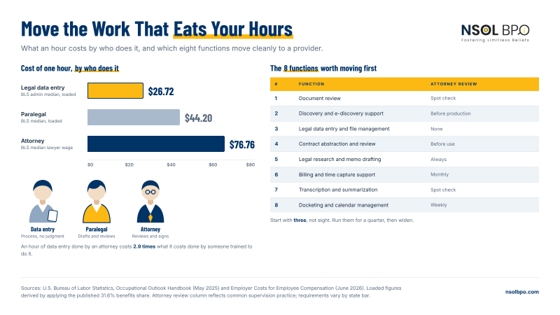
What an hour costs by who does the work, and which functions move cleanly.
Pick three, not eight. Move those, run them for a quarter, and add more once the first three run without you checking every output.
If you’re not sure which three, track where your week actually goes for two weeks. Not billing codes, real minutes. Most firms that do this are surprised by how much of the week disappears into file setup and document assembly, and how little of it is the work they would call lawyering.
What Legal Process Outsourcing Services Cost
Firms pricing legal process outsourcing services almost always compare against a salary. A salary isn’t what an employee costs.
When evaluating legal process outsourcing services, firms should look beyond hourly rates and consider workload flexibility, supervision requirements, and the actual cost of maintaining an in-house team.
BLS puts the median paralegal wage at $62,890 a year, which is $30.24 an hour. Then add benefits. As of June 2026, total employer compensation for civilian workers ran $49.46 per hour worked. That splits into $33.85 in wages and $15.61 in benefits, so benefits are roughly 31.6% of the package. Apply that and an in-house paralegal costs about $91,940 a year. Call it $44.20 an hour, before software seats and desk space.
Set that against your own hour at $76.76, and the arithmetic resolves itself.
The structural advantage of legal process outsourcing isn’t the rate, though. It’s that you stop paying for idle time. A salaried person costs the same in a quiet month, busy or not. Outsourced hours track your caseload, which for most firms swings hard between quarters.
There’s a cost nobody puts in the spreadsheet either: hiring. Posting the role, screening, interviewing, onboarding, then doing it again in eighteen months if the fit is wrong. In a firm with no HR function, that work lands on a partner, billed at partner rates to nobody. Our comparison of a virtual assistant versus a full-time employee runs the same tradeoff, and the virtual assistant cost guide has the broader hourly ranges.
LPO Services and the Duties You Still Own
This is the part that stops most firms from trying legal process outsourcing at all, and the rules are clearer than the anxiety suggests.
ABA Model Rule 5.3, Responsibilities Regarding Nonlawyer Assistance, is the governing text. It requires that a lawyer with direct supervisory authority over a nonlawyer “shall make reasonable efforts to ensure that the person’s conduct is compatible with the professional obligations of the lawyer,” and that partners and lawyers with comparable managerial authority put firm-wide measures in place giving the same reasonable assurance.
Read that carefully. It doesn’t prohibit outsourcing. It makes you responsible for supervising it.
Rule 5.3 also makes a lawyer responsible for a nonlawyer’s conduct that would breach the Rules where the lawyer “orders or, with the knowledge of the specific conduct, ratifies the conduct,” or where a supervising lawyer knows about it in time to limit the damage and does nothing.
The ABA addressed outsourcing directly in Formal Opinion 08-451, on a lawyer’s obligations when outsourcing legal and nonlegal support services. If you’re building an LPO relationship, read it before you sign anything.
In practice, that translates into four things any firm can do:
- Attorney review before anything leaves the firm, every time, with no exceptions once the work starts coming back clean.
- A signed confidentiality agreement, defined access controls, and a written answer on where files are stored.
- Client disclosure where your jurisdiction requires it, which varies, so check your own state rather than relying on a provider’s assurance.
- A documented supervision process, so that supervision is practical rather than theoretical.
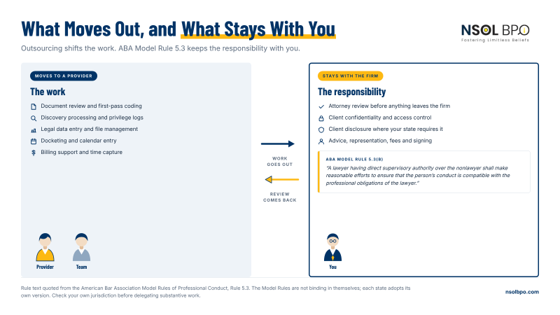
What moves out, and what never leaves your desk.
Good LPO services will have answers to all four before you ask. The ones that go quiet when you raise Rule 5.3 are telling you something useful.
None of this is legal advice, and state rules differ. Check your own bar’s position before you delegate anything substantive.
Offshore Legal Services: What Changes and What Doesn’t
Offshore legal services get discussed as though they were a different category. Ethically, they aren’t. Rule 5.3 applies identically whether your provider sits in Ohio or overseas.
What genuinely changes is practical, and it’s worth planning for.
Time zones cut both ways. Work handed over at 6 pm can be back by morning, which is a real advantage on deadline-driven files. It also means your questions wait until their morning.
Jurisdictional familiarity varies. A reviewer fluent in US discovery practice isn’t automatically fluent in your state’s forms. Ask which jurisdictions, and how recently.
Data location matters. Where client files physically sit, which laws govern that location, and what happens if the relationship ends. Get it in the contract.
The firms that do this well treat an offshore team as part of the firm rather than a vendor at arm’s length. Same onboarding, same systems, same standards.
The ones that struggle treat it as a transaction. They send work over a wall, get something back, and are surprised when it doesn’t match house style. Nobody wrote the house style down.
Where Legal Data Entry Services Fit
Legal data entry services are the least glamorous item on the list and usually the first thing worth moving.
The work is matter setup, practice management updates, document indexing, contact records, and records organization. It needs accuracy and consistency, not legal education, which makes it the lowest-risk thing to hand over and the easiest to check.
It’s also where most firms quietly bleed hours. A paralegal spending six hours a week on data entry at $44.20 fully loaded is a meaningful annual number, and none of those hours were paralegal work.
Start here if you’re nervous about outsourcing. The output is checkable in minutes, the confidentiality exposure is manageable, and the habit of supervising outside work gets built on something low-stakes. Our post on data entry support covers the mechanics, and back office services cover the wider function.
How to Choose a Provider
Choosing the right legal process outsourcing partner comes down to more than cost. The provider must understand your workflows, protect confidential information, and deliver work your attorneys can confidently review.
Six questions for anyone selling you legal process outsourcing.
Which half of the work do you actually do? Substantive legal support and back-office support are different businesses. Providers who claim both equally are usually good at one.
Which practice areas and jurisdictions? Personal injury discovery and corporate contract abstraction share almost nothing. Ask for specifics and recency.
How do you handle Rule 5.3 supervision? A provider who’s never heard of it isn’t ready for legal work.
What is the confidentiality and data arrangement? Signed agreement, access controls, storage location, and what happens to your files when the contract ends.
Which systems do you already work in? Clio, MyCase, Smokeball, Filevine, Relativity. If they’ve never touched yours, you’re paying for their training.
Who covers when your person is unavailable? If the answer is a pause, you’ve found a single point of failure.
We cover how NSOL structures legal support on our legal virtual assistant services page, and the role-level version in our guide to the virtual paralegal.
The Bottom Line
Legal process outsourcing is not complicated. It’s just usually sequenced badly.
Move the work that’s high volume and low judgment first. Legal data entry, document review, discovery support. Verify the output for a quarter. Then widen.
The supervision duty under Rule 5.3 never leaves you, and that’s the point rather than the obstacle. A firm that supervises outside work properly gets the capacity without the payroll. A firm that doesn’t supervise it has a problem, whether the work sits inside the building or outside.
Paralegal supply is flat for the next decade while lawyer numbers grow. That gap has to close somewhere, and legal process outsourcing is how most firms are closing it.
NSOL BPO builds legal support teams that work inside your systems and under your supervision. If you want to talk through which three functions to move first, get in touch and we’ll be straight with you about what fits. Our wider business process services cover the rest of the back office, and our full virtual assistant services cover the roles around it.
FAQ Block
What is legal process outsourcing?
Legal process outsourcing is hiring an entity outside your firm to perform legal or quasi-legal functions. This can be divided between substantive legal assistance (document review, discovery, etc.) and administrative assistance (data entry, billing, etc.). It never includes the activities requiring a licensed lawyer, such as advice, representation, fee establishment, and agreement.
Is legal process outsourcing unethical?
Yes and no. According to ABA Model Rule 5.3, a lawyer who supervises non-lawyers is obligated to take reasonable steps to ensure that the conduct of those people does not put the lawyer at odds with his duties. The matter of outsourcing was covered directly in ABA Formal Opinion 08-451. There is nothing against outsourcing in any rule. You will be held accountable for it.
What should a law firm outsource first?
Begin with highly repeatable tasks, where there is a lot of material and little judgment needed. Legal data entry and file organization, document review, and discovery assistance are the candidates. Perform three tasks initially, not eight, and for one quarter only.
How expensive are legal process outsourcing service providers?
Cheaper than the in-house one since you need to compare the price against the full cost of employing an individual rather than just their salary. According to the BLS, the median pay for paralegals is $62,890 annually. Taking benefits, which account for approximately 31.6% of the total compensation, into account, the cost of hiring an in-house paralegal amounts to $91,940 without the software and space cost, while outsourced hours depend on your caseload, not the calendar.
Are the legal services provided offshore treated any differently?
No. The only difference lies in the practicalities of working in a different time zone, working with a familiar jurisdiction, and keeping track of the physical location of the client data. Make sure that you get the location of the data and the contract termination terms in writing.
Does the client need to be told about outsourcing?
Maybe. This decision will depend on your jurisdiction and the type of service provided. Some states require disclosing it in writing, while others need your clients’ approval. In order not to run into problems, make sure to ask your bar association what should you do in this situation.
Sources & References
This article is supported by authoritative sources from the American Bar Association (ABA) and the U.S. Bureau of Labor Statistics (BLS).
- American Bar Association (ABA): Model Rule 5.3 – Responsibilities Regarding Nonlawyer Assistance
- American Bar Association (ABA): Formal Opinion 08-451 – Outsourcing Legal and Nonlegal Support Services
- U.S. Bureau of Labor Statistics (BLS): Lawyers – Occupational Outlook Handbook
- U.S. Bureau of Labor Statistics (BLS): Paralegals and Legal Assistants – Occupational Outlook Handbook
- U.S. Bureau of Labor Statistics (BLS): Employer Costs for Employee Compensation
Editorial Note: Salary and employee compensation estimates are based on published BLS data. The ABA Model Rules provide professional guidance but are not independently binding; applicable requirements depend on each jurisdiction’s adopted rules.