
It’s 9 p.m., and you’re formatting a table of authorities.
You went to law school for this. Three years, a bar exam, and here you are fixing citation formatting because the alternative is adding payroll you’re not sure the firm can carry.
A virtual paralegal solves a narrower problem than most sales pages claim, but it solves that problem well. The work that doesn’t need your license stops landing on your desk.
Here’s the number that should decide this for you. The Bureau of Labor Statistics puts the median wage for lawyers at $76.76 an hour and paralegals at $30.24. Every hour you spend on paralegal work costs your firm roughly two and a half times what delegating it would.
This guide covers what to hand over first, what it actually costs, and the one line you can’t let anyone cross.
What a Virtual Paralegal Actually Does, and Doesn’t
A virtual paralegal is a trained legal support professional who works remotely, usually for several firms at once, on the tasks a paralegal handles in an office.
Document preparation. Discovery organization. Court filing. Research. Client intake. Calendar and deadline management.
Here is what they won’t do, which isn’t an omission of services; it is the law. They won’t offer legal counsel, sign pleadings, set prices, or form a client relationship. And we will revisit this quote because it is the one thing that makes firms uneasy and the one thing most sales pages leave out.
And here is the truth: a virtual paralegal is the same position you are familiar with, minus the office, the employment perks, and the requirement for a full-time workweek of forty hours regardless of demand.
The 9 Tasks Worth Delegating First
Not everything should move at once. Start with work that’s high volume, low judgment, and easy to check. These nine qualify for most practices, and a trained virtual paralegal can pick up any of them inside a week.
1. Preparation of documents using your templates. Engagement letters, retainers, standard motions, correspondence. The templates were created by you. It does not count as utilization of your license to fill them in.
2. Organization of discovery materials. Bates-numbering, document organizing, creation of privilege logs. High volume, high tedium, and truly destructive if performed carelessly – and that’s why having a trained individual do it is better than the individual who is available.
3. E-filing. Portal filings, monitoring confirmations, and dealing with rejections. Each jurisdiction has its own peculiarities, and this task requires a coordinator who has already filed in your courts.
4. Calendaring of deadlines and dockets. All deadlines and dates from all orders and rules, including reminders. Malpractice suits are based on missed dates, making this the most valuable task on the list.
5. Client intake and conflict checks. Collecting information, running the conflict search, opening the matter, setting up the file. All process, no judgment.
6. Legal research and summaries. Case pulls, statute checks, research memos you then review. You decide what it means. Someone else can find it and write it up.
7. Medical and business record retrieval. Requests, follow-ups, chasing custodians who ignore the first three letters. Pure persistence work that eats paralegal weeks.
8. Deposition and trial prep support. Exhibit assembly, transcript summaries, witness binders, chronologies. Predictable, template-driven, and enormously time-consuming.
9. Billing support and time capture. Chasing unbilled time, drafting invoices, running collections follow-up. Most firms lose more to unbilled hours than to any client who refuses to pay.
Start with four, not nine. Pick the four that cost you the most evenings and move those. Add the rest once the first four run without you checking.
In case you are unsure about what the four are, keep your own log of your time for two weeks. It’s not billing codes; it’s minutes. Most lawyers who have done this are quite surprised to see how much time per week is spent on the retrieval of documents and their preparation, and how little time is actually devoted to what they call “lawyering.”
Virtual Paralegal Services vs an In-House Hire
Firms comparing virtual paralegal services against hiring usually compare against the wrong number. They look at a salary. A salary is not what an employee costs.
BLS puts the median paralegal wage at $62,890 a year, which is $30.24 an hour. That’s the figure that lands in the partners’ meeting.
Now add benefits. BLS tracks that separately: as of June 2026, total employer compensation for civilian workers ran $49.46 per hour worked, split $33.85 in wages and $15.61 in benefits. Benefits are about 31.6% of the package. Apply that to $62,890 and your in-house paralegal costs roughly $91,940 a year, or $44.20 an hour, before software seats and office space.
Set that against your own hour at $76.76 and the picture resolves.
Virtual paralegal pricing works differently. You buy hours or files rather than a salary, which means the bill tracks your caseload instead of the calendar. In a slow month, you pay less. In a heavy month, you pay more and bill more.
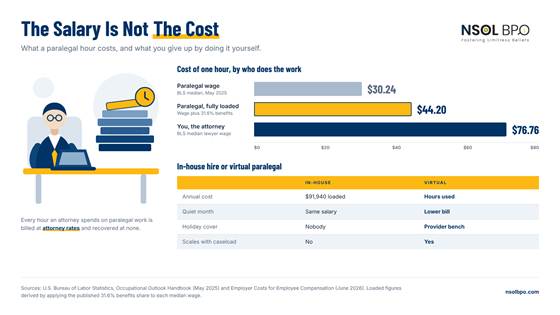
What an hour costs by who does the work, and how the two hiring models compare.
This is why the small-firm math rarely favors a full-time hire. A solo or three-attorney practice doesn’t generate forty hours of paralegal work every week. It generates fifty hours one week and eight the next. Salary doesn’t flex. Hourly coverage does.
There’s a second cost nobody puts in the spreadsheet: the hiring itself. Posting the role, screening, interviewing, onboarding, and then doing it again in eighteen months if the fit is wrong. For a firm with no HR function, that work lands on a partner, which means it is billed at partner rates to nobody.
Our comparison of a virtual assistant versus a full-time employee runs the same tradeoff across other roles, and the virtual assistant cost guide has the broader hourly ranges.
Why Firms Are Turning to Outsourced Paralegal Services
Cost is only half the story. The other half is supply, and it explains why virtual paralegal demand has grown the way it has.
BLS projects paralegal and legal assistant employment to stay flat through 2035, a 0% change across the decade, with about 40,800 openings a year, almost all from people leaving the field rather than new positions opening. Meanwhile, lawyer employment is projected to grow 5%.
More attorneys. The same number of paralegals. You can see where that goes.
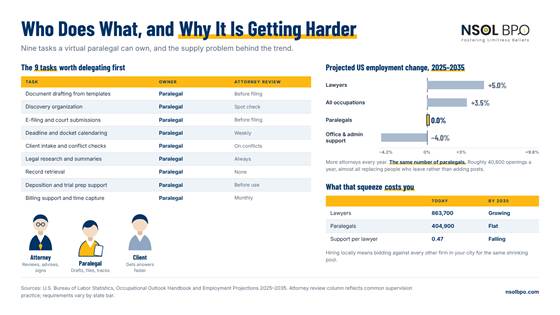
Who owns which task, and the supply squeeze behind the trend.
Outsourced paralegal services exist because that gap has to close somewhere. A firm competing for one of 40,800 annual openings in its own city is bidding against every other firm in town. A firm hiring remotely is drawing from a national pool and paying for hours instead of headcount.
The same squeeze is hitting legal admin generally. BLS projects office and administrative support occupations to decline 4.0% and shed 752,100 jobs over the same decade. The support layer under every law firm is thinning, and back office services are where most firms are replacing it.
What to Look for in Paralegal Support Services
Every provider selling paralegal support services says they’re experienced. These six questions find out whether they are.
Which practice areas, and for how long? Personal injury discovery and corporate M&A support share almost nothing. Paralegal support services that have only handled immigration intake will be learning on your file.
Have they filed in your courts? E-filing rules are county-level in much of the country. Ask which jurisdictions, and how recently.
What is the confidentiality arrangement? You need a signed confidentiality agreement, defined access controls, and a clear answer on where files are stored. Your duty to the client doesn’t shrink because the work left the building.
Which platforms do they already use? Clio, MyCase, Smokeball, Filevine, NetDocuments. If they’ve never touched your practice management system, you’re paying for their training.
Who supervises the work? Under your state’s rules, you do. Ask how the provider structures review so supervision is practical rather than theoretical.
What happens when your person is unavailable? If the answer is a pause, you’ve found a single point of failure. A provider with a bench says so immediately.
We go deeper on vetting any provider in our guide to the best virtual assistant companies, and our legal virtual assistant services page covers how NSOL structures legal support specifically.
Virtual Paralegal or Legal Assistant: Which Do You Need?
No, and the difference matters when you are comparing quotes.
The legal assistant, or law firm virtual assistant, deals with the management of the law firm business. Managing phone calls, scheduling, e-mail screening, billing, CRM management, marketing. All very important tasks, but no legal knowledge necessary.
A virtual paralegal does substantive legal support work: discovery, drafting, research, filing. That takes legal education or equivalent experience, and it costs more because of it.
Plenty of firms need both, and some providers package them together. What you shouldn’t do is pay paralegal rates for someone answering the phone, or expect a general assistant to organize a production set. Our post on the customer service virtual assistant covers the front-office side, and data entry support covers the volume work that sits beneath both.
The Line You Cannot Let Anyone Cross
Every state prohibits the unauthorized practice of law, and that prohibition doesn’t care where your paralegal sits.
A virtual paralegal cannot give legal advice, set fees, accept a case, sign pleadings, or represent anyone. Those acts require a licensed attorney, and the responsibility for making sure they don’t happen is yours, not the provider’s.
In practice, this is simpler than it sounds. Three rules cover almost all of it.
- Every document that leaves your firm gets attorney review before it goes.
- Client communications either route through you or stick to scheduling and status, never substance.
- Your engagement letters disclose the use of support staff the way your state’s rules require.
Those three rules cost you very little time, and they close most of the exposure. The review step is the one firms are tempted to skip once the work starts coming back clean. Don’t skip it. The duty is personal to you, and a provider’s internal quality process is not a substitute for an attorney reading the document.
Rules on supervision, disclosure, and fee arrangements vary by state, and some bars have published specific guidance on remote and outsourced support. Check your own jurisdiction’s rules before you delegate anything substantive. This article is not legal advice, and no provider’s compliance claim replaces reading your own state bar’s position.
FAQ’s
How does virtual paralegal pricing compare to hiring in-house?
Less than the in-house equivalent, and the comparison worth running is against the loaded cost rather than the salary. BLS puts median paralegal pay at $62,890 a year, and with benefits at roughly 31.6% of total compensation, an in-house paralegal costs near $91,940 before software and space. Hourly arrangements cost less again because you only pay for the hours your caseload actually generates.
Can I use a virtual paralegal to give legal advice to my clients?
No, all states control unauthorized practice of law regardless of the fact that you have a paralegal in your office or remote. It is not allowed to give legal advice, charge fees, accept clients, or sign pleadings. It is your job to supervise and review their outgoing work.
What is the difference between a virtual paralegal and legal assistant?
A virtual paralegal does substantive legal work – discovery, document preparation, legal research, pleadings. A legal assistant handles administrative issues – telephone calls, appointments, billing, customer relationship management. The former needs legal training and earns more money. Many law firms use both kinds, and many companies offer them in one package.
Is it ethical to outsource paralegal services?
Yes, basically, as long as your state allows you to do that. You have to make sure that you supervise the process, maintain client confidentiality, and disclose the required information.
What are some things I should start delegating to the virtual paralegal right away?
Begin with high-volume activities that don’t require much judgment to be done and are easy to check – template drafting, discovery management, calendaring deadlines, and retrieving records. Delegate four functions, not nine. Delegate more after the first four work smoothly without requiring constant monitoring of results.
Would outsourced paralegal services integrate into my practice management software?
Yes, they will if your provider is good at it, and they should. Common options include Clio, MyCase, Smokeball, Filevine, and NetDocuments. Inquire about the systems they work in beforehand because otherwise you will be paying for them getting acquainted with your system.
The Bottom Line
The case for a virtual paralegal comes down to one comparison.
Your hour is worth $76.76 at the national median. A paralegal hour costs $30.24 as a wage, $44.20 once benefits are counted, and less again if you buy hours instead of headcount. Every evening you spend on work that doesn’t need your license is that gap, multiplied.
Paralegal supply is flat for the next decade. Lawyer numbers are growing. That gap isn’t closing on its own.
Start small. Pick four tasks, hand them over, and check the work for a month. You will know quickly whether it holds.
NSOL BPO places trained legal support staff who work inside your practice management system and under your supervision. If you want to talk through which four tasks to move first, get in touch and we’ll be straight with you about what fits and what doesn’t. Our full virtual assistant services cover the rest of the firm if the paralegal work is only part of it.