
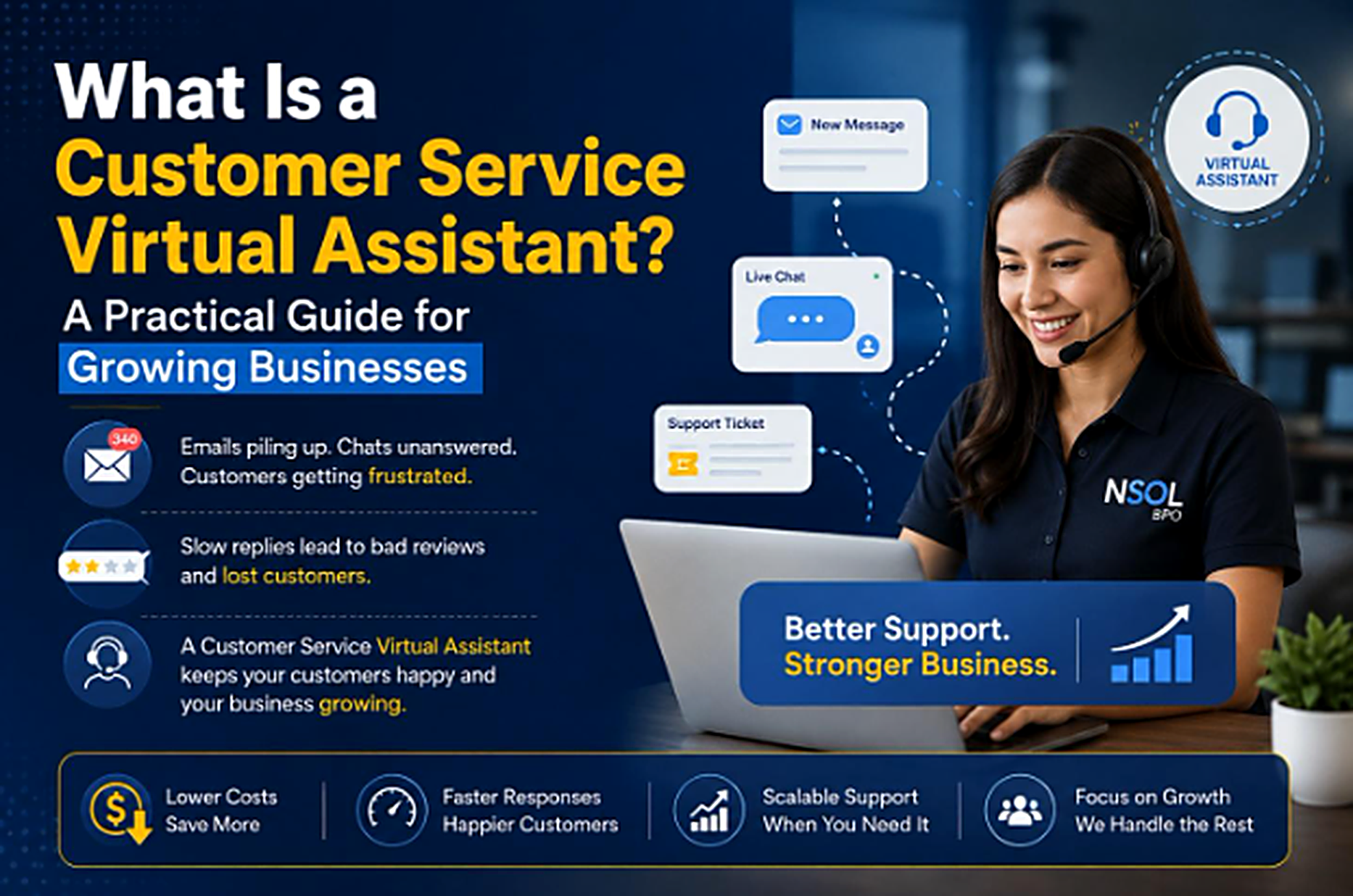
It usually starts with tiny things. Just some emails not answered during the busy hours of Friday afternoon. An instant messaging box that is kept open for 10 minutes without any reply. And then one day, you check your customer support box and see that you now have 340 emails unanswered, half your team is trying to solve billing problems, and one of your customers has rated you two stars because you didn’t get back to him for three days. This is when most of the businessmen start thinking about the possibility of using a Customer Service Virtual Assistant, an online professional who can handle customer service chatting for them without hiring a full-time employee.
This guide explains what these roles really entail, when it’s worth hiring one, the situations that it does not fix, and how to avoid being conned by the provider’s promise of the moon. It also covers where outsourced customer support quietly fails, so you know what to watch for before you sign.
Understanding a Customer Service Virtual Assistant.
A customer service virtual assistant is a person who provides customer service to a business but who works from a remote location, typically using the same tools, brand voice, and service standards as the business they are assisting. The “virtual” is just a way of saying they are employed from a different location, typically at a much lower cost than an in-house employee due to their lower overhead. The “assistant” part is also what trips people up; it sounds like something that is informal or part-time, but a well-run support VA is much more akin to a fully briefed support agent than a generalist gofer.
It’s a merging of two very old concepts: the traditional virtual assistant (admin, scheduling, inbox management) and the traditional customer support rep (tickets, calls, resolution). A customer service virtual assistant combines the best of both: the freedom of remote employees and the accountability of a human customer service representative, backed by metrics and targets. That accountability layer is what turns outsourced customer support into something you can actually measure.
It’s important to be specific here, since virtual assistant is a term used loosely. Some VAs fall into the category of generalists who do some admin duties and provide support. Others are experts who spend their entire day helping others in a helpdesk application like Zendesk or Freshdesk. If the volume of your tickets is significant, you’re looking for the second type. Providers offering live chat outsourcing as a named service usually sit in that second group.
What Does a Customer Service Virtual Assistant Actually Do?
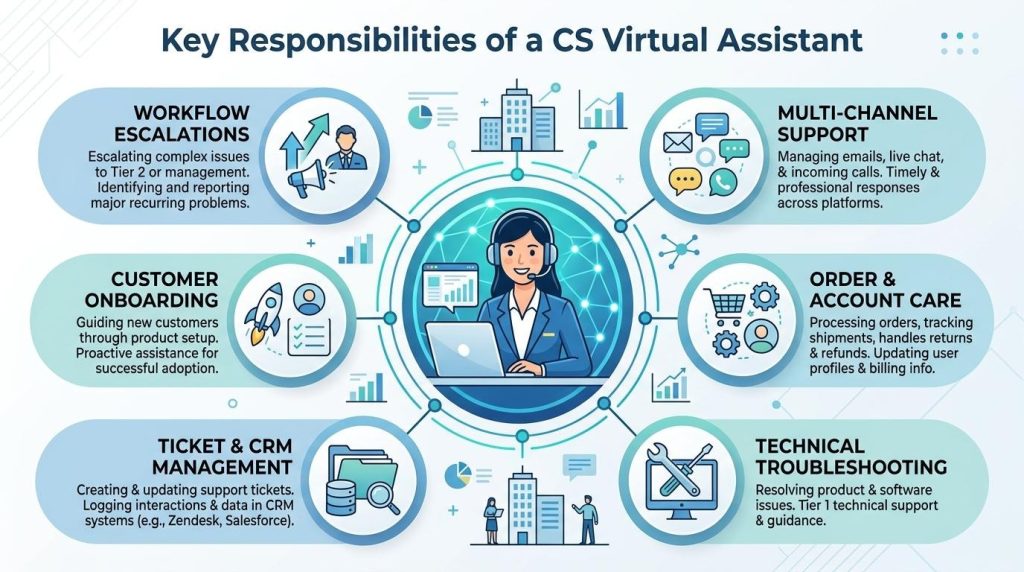
Generally, the work for the day is divided into a few key areas:
Email support and ticket support: filtering incoming emails, answering common questions, passing on more complex ones, and making sure that the response time is within any SLA you have agreed to.
Live chat support: Real-time conversations with customers on your website or app that are often a high-pressure channel, as customers want an immediate response.
Phone support: incoming and sometimes outgoing phone support for order problems or account changes.
Order and account management: follow up on orders, issues, returns and refunds, and update billing information, resetting accounts.
CRM and ticket logging: ensuring that each interaction is captured, no stone is left unturned, and your team has access to a complete history to reference.
Tier 1 troubleshooting: For SaaS and tech products, this involves talking consumers through some possible fixes that don’t require getting escalated to engineering.
Onboarding support: assist new customers in getting not so lost that they leave after week one.
Judging and deciding without a process that involves legal, financial, or brand risk is something that a good VA should not be doing. It isn’t a rule for virtual assistants alone; it’s just a fact of being in any support role, whether in-house or not, that mundane tasks are delegated, while high-stakes tasks are kept in writing and reviewed.
When Should a Business Hire a Virtual Assistant?
While there is no fixed point, there are some patterns that seem to recur. It’s a sign that if your team is answering the same 15 questions repeatedly, and it’s taking hours to do so, rather than being a time for product or sales. That’s another if response times have gone past what your customers expect and they’re high, HubSpot research revealed that about 90% of customers consider an immediate reply essential, and many define that as 10 minutes or less. If you are anticipating a certain time period of the year (holiday shopping, tax season, open enrollment) and don’t need to hire and fire as a result, that’s a third.
However, if your support volume is truly minimal, if your product is extremely technical and you need a lot of technical knowledge to build, and/or you’ve never documented your processes at all, you may want to consider looking elsewhere first. Passing on chaos typically results in “outsourced chaos. Before adding anybody to your workflows, whether internal or external, it’s best to tighten things up a bit, at the very least.
The advantages of a Customer Service Virtual Assistant
Those benefits which people usually anticipate are market-related and are real, namely, a dedicated remote assistant is usually cheaper than a similar in-house recruit, considering factors such as salary, payroll tax, benefits, recruitment, and equipment. However, the lasting gains are more likely to be found elsewhere.
Coverage without burnout: Weekend and after-hours support stops depending on who is willing to look at their phone on Sunday.
Faster response time: Tickets are likely to be answered before customers go so far as to write a review or chargeback when there are more people in the queue.
Focus for your core team: The time a VA spends on routine tickets is time your product and/or sales team can get back.
Flexibility: A VA engagement is typically more flexible to scale up for peak season and scale down after, whereas it is much more difficult with a permanent headcount.
This is not necessarily automatic; it’s up to the trained, matched, and managed training of the assistant.
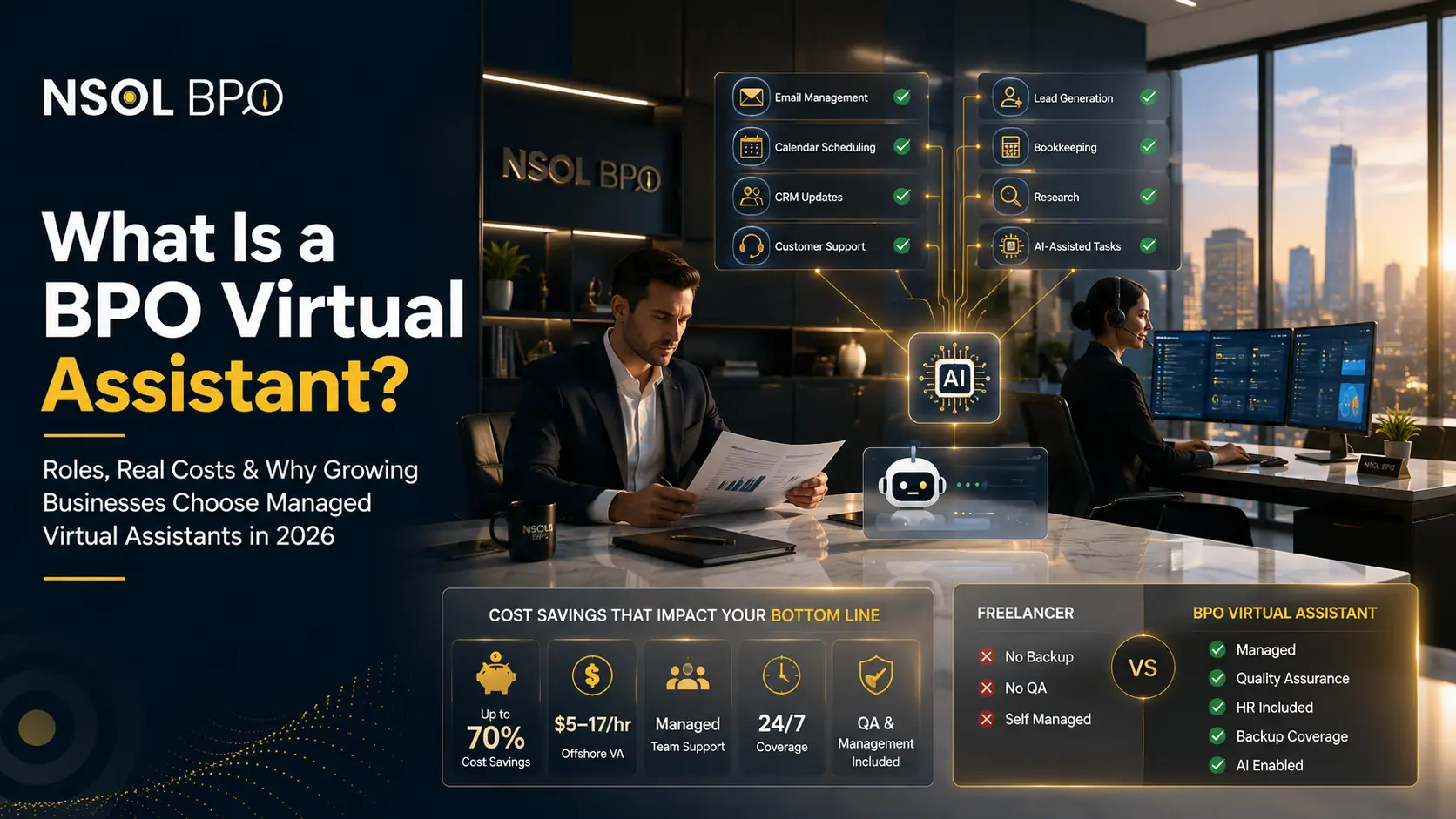
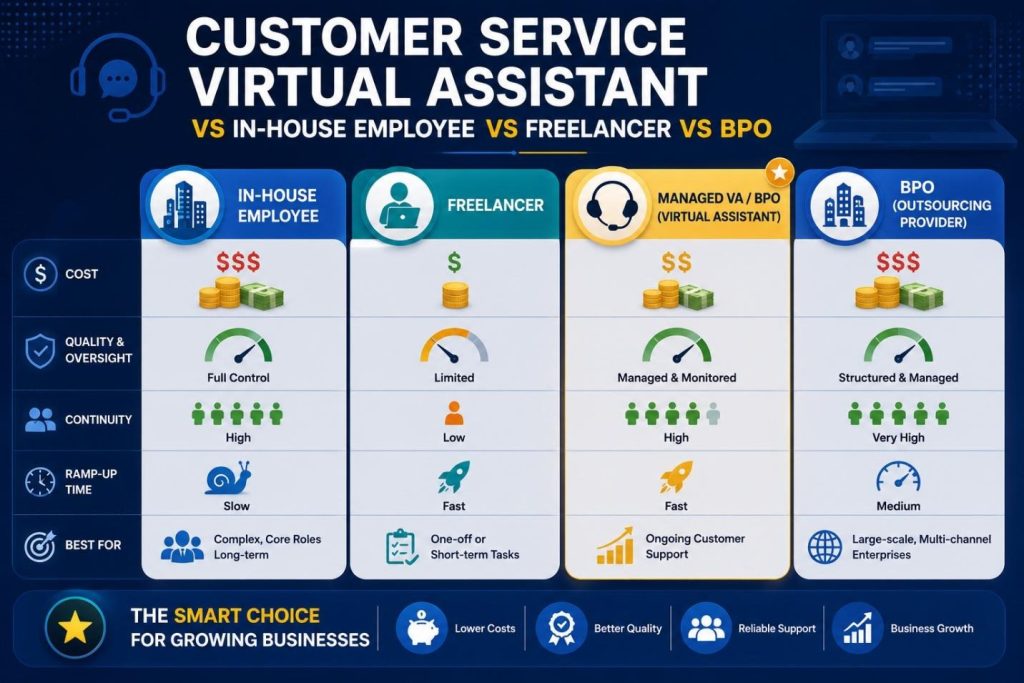
Customer Service Virtual Assistant Vs In-House Employee Vs Freelancer Vs BPO
This is where most of the decisions are made, and the truth of the matter is that each choice is more suitable for some than others.
| Factor | In-House Employee | Independent Freelancer | Managed VA / BPO Provider |
| Cost | Highest (salary, benefits, taxes, equipment) | Lowest hourly rate, but variable | Mid-range, often bundled |
| Oversight & QA | Full control, requires management time | Usually none built in | Provider handles training and QA |
| Continuity | High, if retention is good | Low; freelancers disappear or juggle clients | Higher backups and account managers |
| Ramp-up time | Weeks to months (hiring, onboarding) | Fast, but inconsistent quality | Days to a few weeks |
| Best for | Complex, judgment-heavy roles you want deeply embedded | One-off or highly specific tasks | Ongoing, structured support volume |
A freelancer is an excellent choice for a short-term project or for a very specific task. An in-house hire is best when you need someone with specific product knowledge and in-house for the long haul. The managed virtual assistant option for ongoing, regular tasks that require support and back-up coverage, and accountability, but don’t warrant a full-time employee per seat, is probably more suitable for a customer support virtual assistant.
How Virtual Assistants Improve the Customer Experience.
The customer does not care, nor does he care, who is answering, or where they are sitting. They take note if the response is quick and correct, and they don’t have to repeat the same thing three times. The best way to enhance experience with a virtual assistant setup is by consistency: a consistent tone across channels, tickets that don’t fall through the cracks between shifts, and coverage that doesn’t become a huge mess while your one support is on vacation.
Then there is also a more subtle effect to note. They reach not just the complicated tickets faster, but also those which aren’t buried beneath password resets and shipping inquiries.
Industry-Specific Use Cases
There is a wide diversity of needs across sectors, and great providers build on this; they do not provide one template. What a customer service virtual assistant handles day-to-day shifts noticeably by industry.
E-commerce and DTC brands: E-commerce and DTC brands need to use order tracking, returns, refunds, and Shopify or WooCommerce Live Chat, particularly during high-traffic shopping seasons.
SaaS and tech companies: Tier 1 and Tier 2 help, troubleshooting, and onboarding assistance are important for Saas and tech companies to minimize early churn, as well as having support staff that can follow up a knowledge base without escalating everything.
Real estate brokerages and agents: They frequently require assistance that is coupled with CRM and MLS updates, buyer and tenant inquiry management, and transaction coordination a specificity that makes dedicated real estate virtual assistant support more effective than a general virtual assistant.
Legal practices: In legal, client intake, calendaring, and communication about cases have their own sensitivity, with legal practices looking for legal virtual assistant services with legal-specific workflows versus a generic support template.
Healthcare and insurance companies: They require an employee who is familiar with the work process of HIPAA compliance and the type of documentation that is required in this field.
The common thread that runs through them all: if this is done properly, it is generic support that works, until it doesn’t. The more specialized the question for your customer, the more it becomes important that the person answering it knows the industry and not just the ticketing software. That industry fluency is what separates outsourced customer service that holds up from outsourced customer service that needs constant correction.
How to find the best Customer Service Virtual Assistants
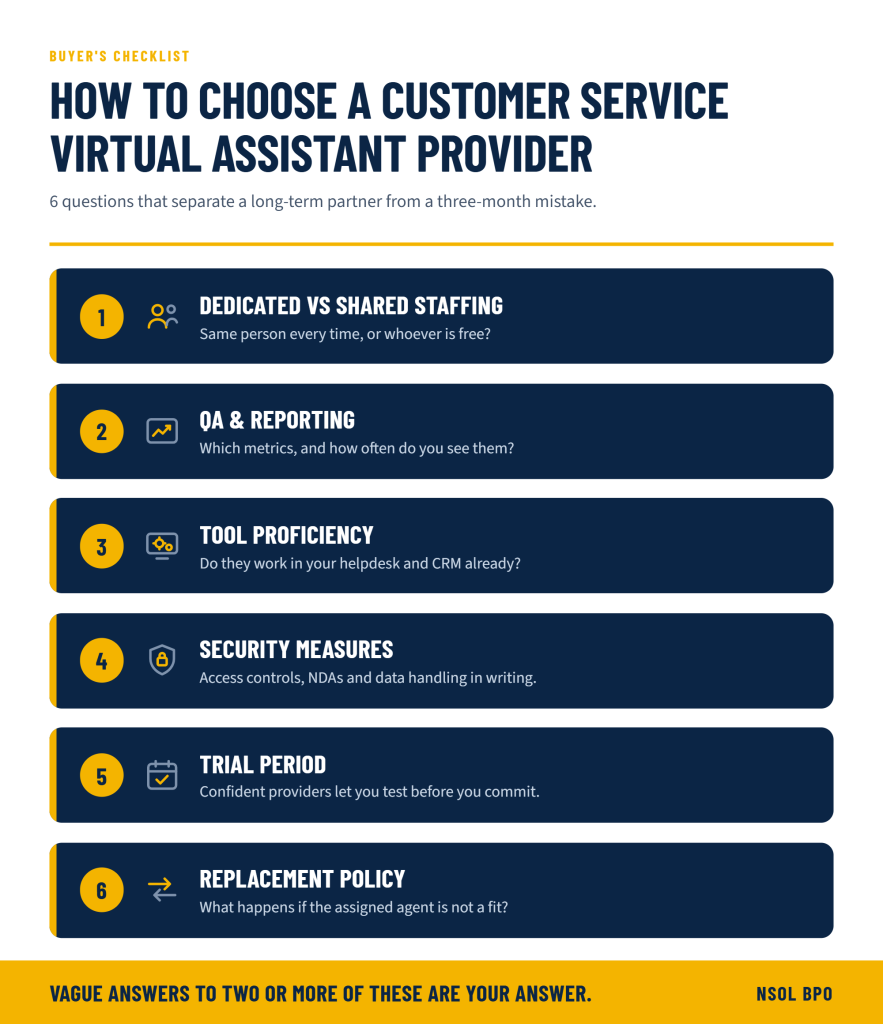
There are some distinct differences between a provider that you’ll be working with and one that you’ll be letting go in three months. Six questions surface the difference before you commit to outsourced customer service:
Dedicated vs. shared staffing: Do you have the same individual or group on every call, or is it a rotating group serving the person next in line?
QA and reporting: Ask what metric they measure (response time, resolution time, CSAT), and at what interval you will find out about it.
Tool proficiency: Are they compatible with your current help desk software, CRM systems, or communications and collaboration tools? Or do you need to switch platforms?
Security measures: The way they handle data, access controls, and NDAs is more significant than many think, especially if the VA has access to billing or account details.
Trial Period: If they are so sure about their process, then there should not be an issue with doing a trial run before signing a contract.
Replacement policy: What if the individual assigned to your account is not suitable? An obvious response to this question is an effective indicator of the provider’s practices.
Questions to be asked prior to signing a contract
Before signing anything, it’s worth getting direct answers to.
- Do I get my own special assistant, or will the tickets be assigned to the one available?
- Who keeps track of my procedures and for how long during onboarding?
- What is the frequency of reporting and communicating? Weekly? Monthly? On request?
- How is quality really monitored if not “we check in sometimes”?
- How will they handle it if suddenly there are a lot more tickets?
- What is covered in the base engagement and what is not?
- What happens to data security and confidentiality in a contract (not just verbally)?
Once a provider becomes vague on over a couple of these, consider that a valuable piece of information.
How Outsourced Customer Support Actually Works
Bringing on a customer service virtual assistant follows a clearer path than most buyers expect. The mechanics aren’t as mysterious as one might think. A reasonably structured engagement typically unfolds in a similar fashion: discovery call to outline current support needs and tools, customized plan (channels and hours of support, agent selection, training on your product and tone, supervised soft launch with interactions closely monitored, and then a full launch with regular reporting). Quality outsourced customer support should feel more like an extension of your team on an international basis rather than handing over the customers to someone else.
It is also where the difference between a free and a true managed customer support provider becomes apparent. A managed engagement has documented SOPs, continual training, and a point of contact who will be held accountable if something goes wrong, not just a person who answers tickets. That distinction is what separates a reliable customer service virtual assistant from a cheap seat filler.
Frequently Asked Questions
What is a customer service virtual assistant?
The customer service virtual assistant is an expert working remotely and managing your customer support tickets, live chats, phone support, and CRM activities according to your systems and brand. In contrast to the general-purpose admin virtual assistant, a customer service VA works in a helpdesk system such as Zendesk or Freshdesk, and their performance is estimated in terms of time to response, ticket resolution rate, and CSAT score.
How much does a customer service virtual assistant cost?
Offshore customer service virtual assistants are paid $8-$15 per hour through agencies, while in the United States, assistants’ rates go from $25 to $50 per hour. Full-time dedicated customer support specialists cost about $1,300-$2,800 monthly.
When should a business hire a customer service virtual assistant?
There are three signs to look out for: your staff is answering the same fifteen questions over and over again, response times are exceeding customer expectations, and there are seasonal peaks in volume that you’d rather not deal with through hiring and firing. First, get your processes sorted – outsourcing mess will yield outsourced mess.
Is outsourced customer service cheaper than in-house?
Normally, yes. Hiring a US-based support representative will cost substantially more than just their base salary due to payroll taxes, benefits, equipment, and recruitment expenses. An outsourced customer service solution eliminates all of those costs and scales up or down depending on the volume, although a managed customer service outsourcing option will be more expensive per hour than a barebones freelancer because it includes training, quality assurance, and redundancy.
What are the responsibilities of a customer service virtual assistant?
Email & ticketing support, live chat, inbound and outbound call support, order and return handling, CRM and ticketing, tier 1 support, and new client onboarding. It is inappropriate for them to make decisions that involve legal, financial, or brand risk without a proper decision-making process.
How does the virtual assistant impact customer satisfaction?
The impact comes from poor documentation, undefined escalation procedures, or a lack of internal process knowledge when an external group runs the support process outside of the helpdesk. Make sure to track CSAT by handler starting from week one in order to identify any quality discrepancies right away.
What is the difference between a virtual assistant, a freelancer, and BPO?
The freelancer is good for short or specialized projects, but offers no substitute if the freelancer leaves the job. An internal hire is ideal for complicated tasks that require deep integration. A managed VA/BPO company is ideal for long-term structured support volume where you don’t need to take care of training and replacement yourself.
Will the customer service virtual assistant fit my helpdesk and CRM?
An experienced provider will be able to work inside of your current helpdesk and CRM without forcing you to use their software and tools. It’s important to ensure the compatibility of your helpdesk and CRM with the services of the provider.
Is it safe to provide a virtual assistant access to customer accounts?
Yes, but it depends on controls put into place. Request a signed NDA, role-based access limited to the responsibilities of that particular role, and a written document outlining data handling protocol rather than a mere promise made verbally. This applies especially where the assistant will have access to billing or account information.
How fast can the customer service virtual assistant get up and running?
The managed provider will be able to provide an effective person within days because the virtual assistants come with pre-existing training on popular help desk software. There is going to be a short discovery call, planning, and a soft launch before transferring control. A reputable provider will give you a trial before signing you up for the contract.
Conclusion
Customer service virtual assistant service isn’t a cure-all, nor is it the cheapest kind of labor available, especially when you do things properly. It is the method for delivering accountability and structure behind the customers’ needs without having to deal with all the overhead that comes with in-house help, especially once you start getting more tickets, more coverage, or seasonal peaks than your existing staff can handle. Most successful implementations happen when the company enters with a proper process and realistic expectations, not a magic wand that would solve all its problems. Outsourced customer support rewards preparation more than budget.
If your customer service help desk is overrun by support tickets and you need to choose between hiring people, contracting services, or outsourcing to a virtual assistant agency, you might try a dedicated service of a customer service virtual assistant. NSOL BPO provides a three-day free trial for their customer service virtual assistants, so you would be able to understand how they perform on your tickets without signing up for a longer period of time. It is the fastest way to see whether outsourced customer support fits how your team already works. You can book a free consultation to discuss your customer service needs. For other business operation tips, visit NSOL BPO blogs.