

Ask a partner what they did on Tuesday, and you’ll hear about a client matter. Look at their calendar, and you’ll see two hours of scheduling, an invoice chase, and a software renewal nobody else could approve.
That gap is what a law firm virtual assistant exists to close. Not the legal work. The business of running the place.
It’s a different role from a paralegal, and firms that confuse the two end up paying legal-support rates for calendar management. The Bureau of Labor Statistics puts median paralegal pay at $62,890, and median administrative assistant pay at $48,310. Those are different jobs with different price tags.
This guide covers the ten tasks worth handing over first, what the role costs, and how to tell it apart from the three adjacent roles it gets sold alongside.
What a Law Firm Virtual Assistant Actually Does
A law firm virtual assistant handles everything that keeps a firm running and none of the work that needs a license.
Calendars, phones, invoicing, vendor accounts, CRM upkeep, marketing admin, travel, onboarding paperwork. If a well-run business of any kind would need it, a law firm needs it too, and most small firms have a partner doing it at partner rates.
What the role doesn’t cover is substantive legal support. Discovery organization, document drafting, legal research, e-filing. That work needs legal training and belongs with a virtual paralegal. Plenty of firms need both, and some providers package them, but you should know which you’re buying.
The test for what belongs with a law firm virtual assistant is simple. Would this task be recognizable in a dental practice or an engineering consultancy? If yes, it’s assistant work. If it only makes sense inside a law firm, it probably needs legal training.
The 10 Tasks Worth Handing Over First
Ordered roughly by how much time each gives back per hour of setup. A law firm virtual assistant can take all ten, but nobody should start that way.
1. Calendar and scheduling. Consults, depositions, internal meetings, travel. Including the part nobody counts: the four emails it takes to find a slot three people can make.
2. Inbox triage. Sorting what needs an attorney, what needs a reply, and what needs filing. Not answering for you. Sorting so you’re answering fewer things.
3. Invoicing and collections follow-up. Drafting invoices, sending them, chasing the ones that age past thirty days. Most firms lose more to invoices nobody chased than to clients who refused to pay.
4. CRM and matter record upkeep. Contact records, matter status, pipeline notes. The work that makes your reports true.
5. Client communication logistics. Appointment confirmations, document requests, status updates that carry no legal substance. Scheduling and chasing, never advice.
6. Marketing admin. Scheduling posts, updating directory listings, formatting newsletters, keeping the website’s attorney bios current. Firms let this rot because nobody owns it.
7. Vendor and subscription management. Software renewals, office supplies, insurance dates, bar dues. Small items that each take an afternoon to sort out.
8. Travel and expense. Booking, itineraries, receipts, reimbursements. Pure admin with real time attached.
9. Onboarding and HR paperwork. New hire forms, equipment requests, access setup, CLE tracking. Infrequent, which is exactly why it always lands badly.
10. Document formatting and templates. Letterhead, pleading formatting, template maintenance, PDF assembly. Not drafting the content. Making it presentable.
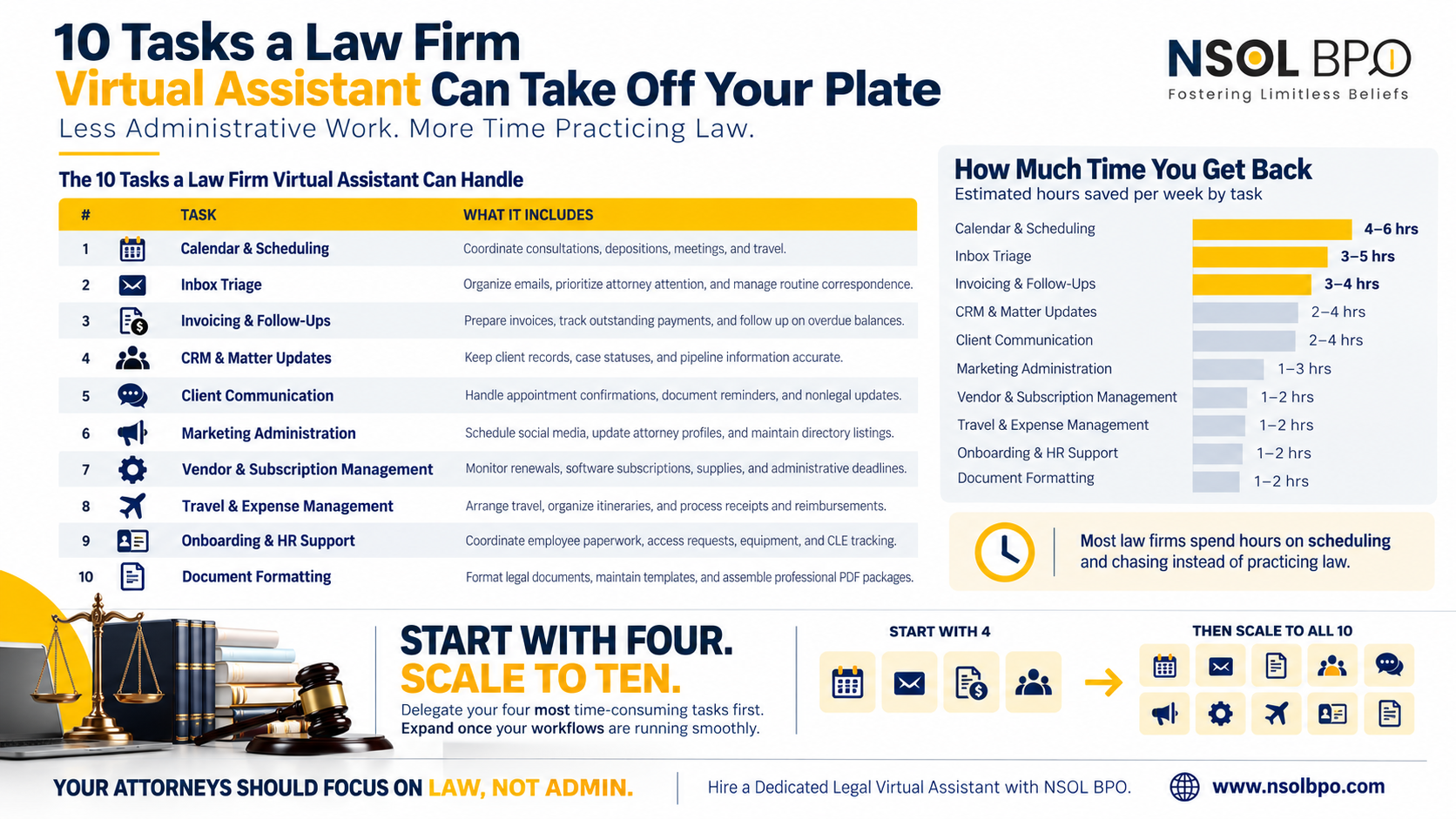
Ten tasks, and which of them need legal training. None of them do.
Hand over four, not ten. Pick the four that cost your partners the most Tuesday afternoons, and add the rest once those four run unsupervised.
If you’re not sure which four, track where a partner’s week actually goes for two weeks. Real minutes, not billing codes. Most firms that try this are surprised by how much of the week disappears into scheduling and chasing, and how little of it is the work they’d describe as practicing law.
What a Virtual Assistant for Law Firms Costs
Firms pricing a virtual assistant for law firms compare against a salary, and a salary isn’t what an employee costs.
BLS puts median administrative assistant pay at $48,310 a year, which is $23.23 an hour. Then add benefits. As of June 2026, total employer compensation for civilian workers ran $49.46 per hour worked, split $33.85 in wages and $15.61 in benefits, so benefits are roughly 31.6% of the package. Apply that and an in-house administrative hire costs about $70,630 a year, or $33.96 an hour.
Set that against your own hour at $76.76, the BLS median lawyer wage. A partner doing their own expense reports is spending the firm’s most expensive hour on its cheapest work.
The structural point isn’t the rate, though. It’s that admin volume in a small firm doesn’t fill forty hours a week. It fills fifty one week and eight the next. Salary doesn’t flex with that. Hourly coverage does.
Our comparison of a virtual assistant versus a full-time employee runs the same tradeoff across other roles, and the virtual assistant cost guide has the broader hourly ranges.
Remote Legal Assistant, Paralegal or Receptionist?
Four roles get sold to law firms under overlapping names, and a law firm virtual assistant is only one of them. Knowing which you need saves paying the wrong rate.
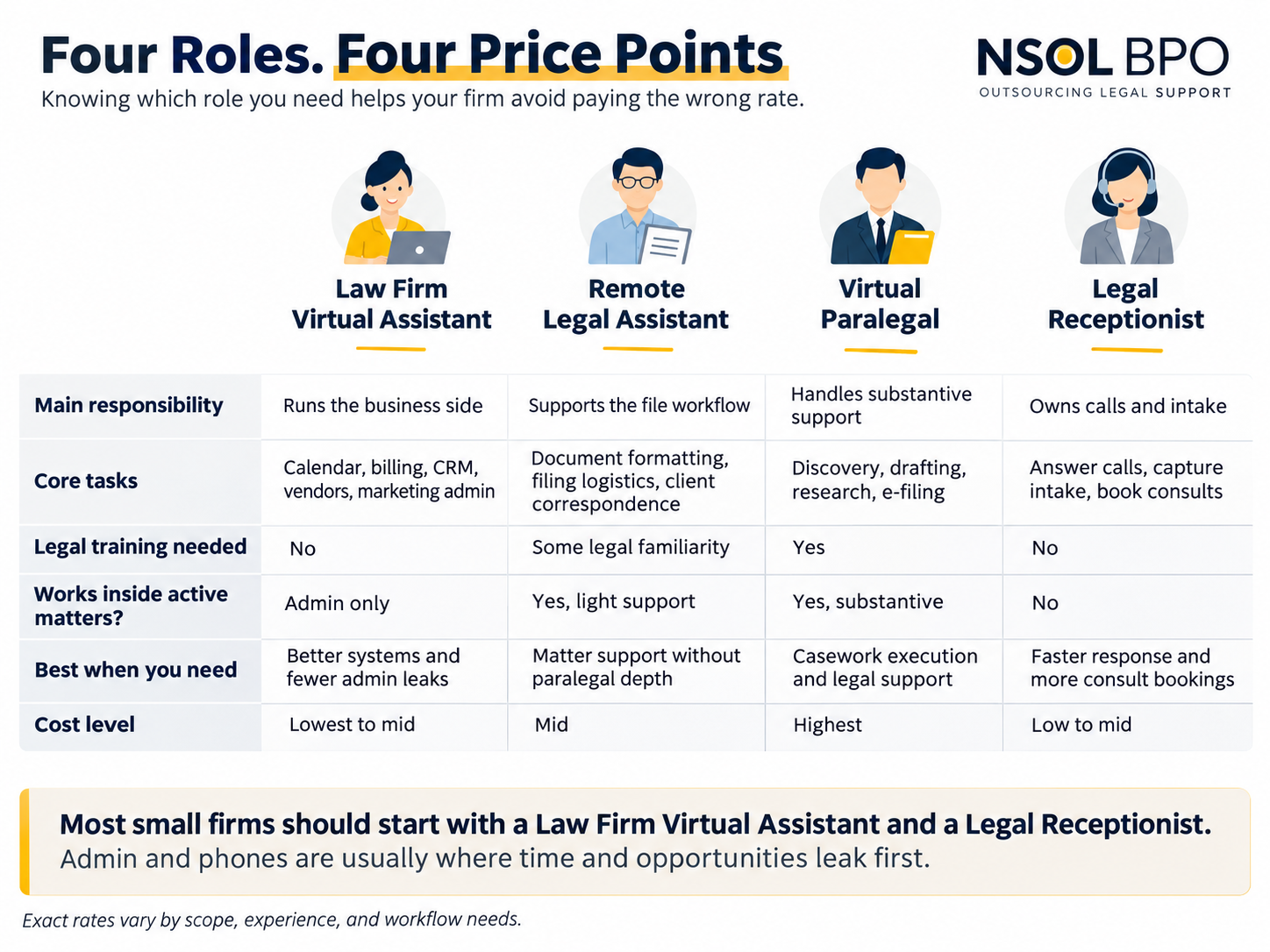
Four roles, four price points, and the work each one actually owns.
A law firm virtual assistant runs the business: calendars, billing, CRM, vendors, marketing admin. No legal training needed.
A remote legal assistant sits a step closer to the matter. Document formatting, filing logistics, client correspondence that touches the file. Some legal familiarity, not paralegal depth.
A virtual paralegal does substantive support: discovery, drafting, research, e-filing. Legal training required, higher rate.
A legal receptionist answers the phone, captures conflict information and books consults. Our guide to the virtual legal receptionist covers that role properly.
Most small firms need a law firm virtual assistant and a receptionist before they need the other two. Admin and the phone are where the hours leak first.
Firms get this wrong in one direction almost every time. They hire the paralegal because it sounds like the serious choice, then watch a partner keep doing the scheduling because nobody was hired to do it. The expensive hire did not touch the problem.
Legal Back Office Support and the Supervision Rule
Legal back office support sits outside the practice of law, which makes it the lowest-risk thing a firm can outsource. That doesn’t mean no duty attaches.
ABA Model Rule 5.3 on responsibilities regarding nonlawyer assistance requires a lawyer with direct supervisory authority over a nonlawyer to “make reasonable efforts to ensure that the person’s conduct is compatible with the professional obligations of the lawyer.” An assistant with inbox access sees client names and matter details from day one. The duty follows the information, not the job title.
Three things cover a law firm virtual assistant in practice:
- A signed confidentiality agreement covering the individual, not just the provider as a company.
- Access scoped to what the role needs, so an assistant handling invoices isn’t sitting in privileged matter files.
- A written boundary on client communication: scheduling and status only, never substance.
None of that is onerous, and a provider who’s worked with firms before will have all three ready. One who hasn’t will want a week to think about it.
State rules on supervision and disclosure vary. Check your own bar rather than relying on a provider’s assurance. None of this is legal advice.
Firms moving more than admin will want our guide to legal process outsourcing, and back office services covers the wider function.
Legal Secretary Services and What Changed
Legal secretary services are the role’s older name, and the name is doing less work than it used to.
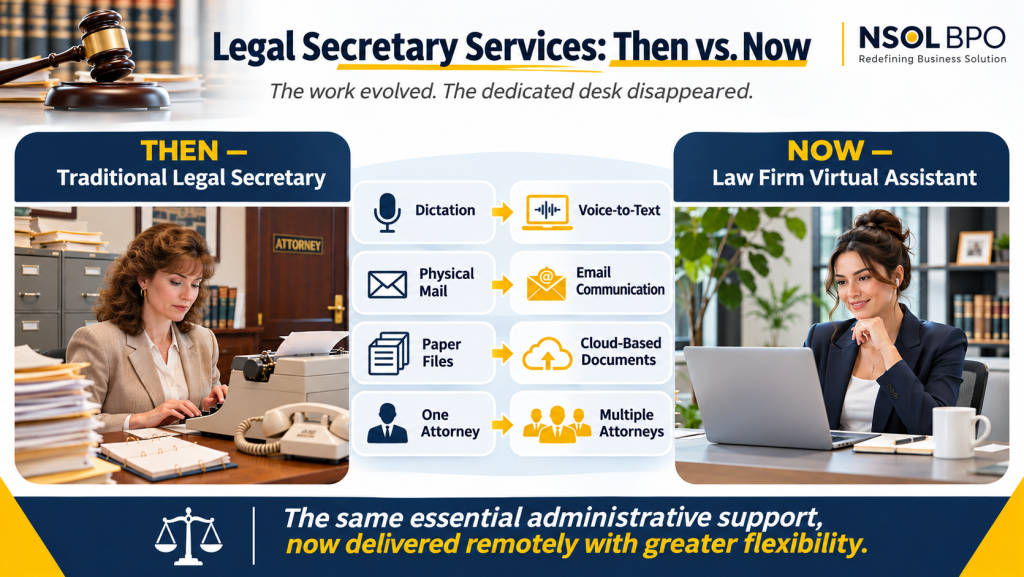
The traditional legal secretary sat outside an attorney’s office, typed dictation, managed one person’s diary, and handled their post. The job was built around proximity and paper. Both have gone.
The function survived. It just redistributed. Dictation became voice-to-text, post became email, and one-to-one support became one-to-several across a team. BLS projects office and administrative support occupations to decline 4.0% and shed 752,100 jobs between 2025 and 2035, the fastest decline of any major occupational group. The work didn’t disappear. The dedicated chair did.
Which is why the modern version is a law firm virtual assistant: remote, shared across a team, same tasks, no desk, paid by the hour rather than the year.
What to Ask Any Provider
Five questions for anyone selling you a law firm virtual assistant. By email, so the answers are in writing.
Have your assistants worked with law firms before? Legal admin has its own vocabulary and its own deadlines. A general VA will learn it, on your time.
Which systems do they already use? Clio, MyCase, Smokeball, QuickBooks. If they’ve never touched yours, you’re paying for training.
What is the confidentiality arrangement, per person? Individual agreements, scoped access, and a written answer on where anything they handle is stored.
Who covers when your assistant is away? If the answer is a pause, you’ve found a single point of failure.
How do we hand work over day to day? A provider with a documented process has done this before. One who says “whatever works for you” is improvising.
We cover how NSOL structures legal support on our legal virtual assistant services page.
The Bottom Line
Your partners’ hours are the firm’s whole inventory. Spend them on scheduling and invoice chasing and the pipeline goes quiet.
That’s the part that doesn’t show up in any report. A missed billable hour is visible. An hour that never became business development because somebody was booking flights is invisible, and it costs the same.
A law firm virtual assistant isn’t a legal hire and shouldn’t be priced like one. It’s the business-operations role every firm already has, usually performed badly by whoever has the least billable work that week.
Start with four tasks and thirty days. Calendar, inbox triage, invoicing, CRM. If those four run without you checking, give your law firm virtual assistant the next four.
NSOL BPO places assistants who have worked law firm operations and know where the admin line sits. If you want help picking the first four tasks, get in touch and we’ll be straight with you about what fits. Our full virtual assistant services cover the roles around it, and legal intake services covers the front of the funnel.
FAQ Block
What are some duties of a law firm virtual assistant?
He or she operates the business end of the law firm: scheduling, inbox management, invoice creation and follow-up, CRM maintenance, vendor and subscription management, marketing administration, travel and expenses, on-boarding paperwork and document formatting. She does not perform substantive legal work that falls into the paralegal category.
What are the costs involved in hiring a virtual assistant for law firms?
Be sure to compare to fully loaded cost and not salary. According to BLS, the median annual wage of an administrative assistant is $48,310, and when including estimated benefits of 31.6% of the compensation package, the cost will be around $70,630 per year or $33.96 per hour. An hourly option will be cheaper if there are fluctuations in your administrative workload.
How does a law firm virtual assistant differ from a paralegal?
An assistant runs the business: scheduling, billing, CRM, vendors. A paralegal provides substantive legal work: discovery, document preparation, legal research, filings. The second type requires training and costs more. The easy test to see which one is required is whether you could have done it in a dental office.
Will a remote legal assistant be able to access our client records?
Absolutely no further than the task demands it. Give him/her access only to what the job demands so that he does not end up accessing privileged matter records while working on invoices. According to the ABA Model Rule 5.3, the supervision responsibility lies with the lawyer, and the responsibility goes with the information.
What tasks should we delegate first?
Four, not ten. Calendaring/scheduling, inbox management, billing, and collections management tasks can give you back the most hours per hour spent on setting up delegation for these tasks. The other tasks can wait until these tasks work smoothly.
Are legal secretary services and law firm virtual assistants services the same thing?
Yes. While the traditional legal secretary services were all about proximity and paper, and one lawyer in the adjacent office, the legal secretary has transformed into the virtual assistant in terms of work but remains a different service. The chair may not be there anymore.
Sources
Every figure in the post traces to one of these. All five are primary government sources, linked with descriptive anchor text.
- American Bar Association, Model Rule 5.3 on responsibilities regarding nonlawyer assistance
- U.S. Bureau of Labor Statistics, median pay for secretaries and administrative assistants
- U.S. Bureau of Labor Statistics, median pay and job outlook for lawyers
- U.S. Bureau of Labor Statistics, median pay for paralegals and legal assistants
- U.S. Bureau of Labor Statistics, employment projections for 2025 to 2035 by occupation group