

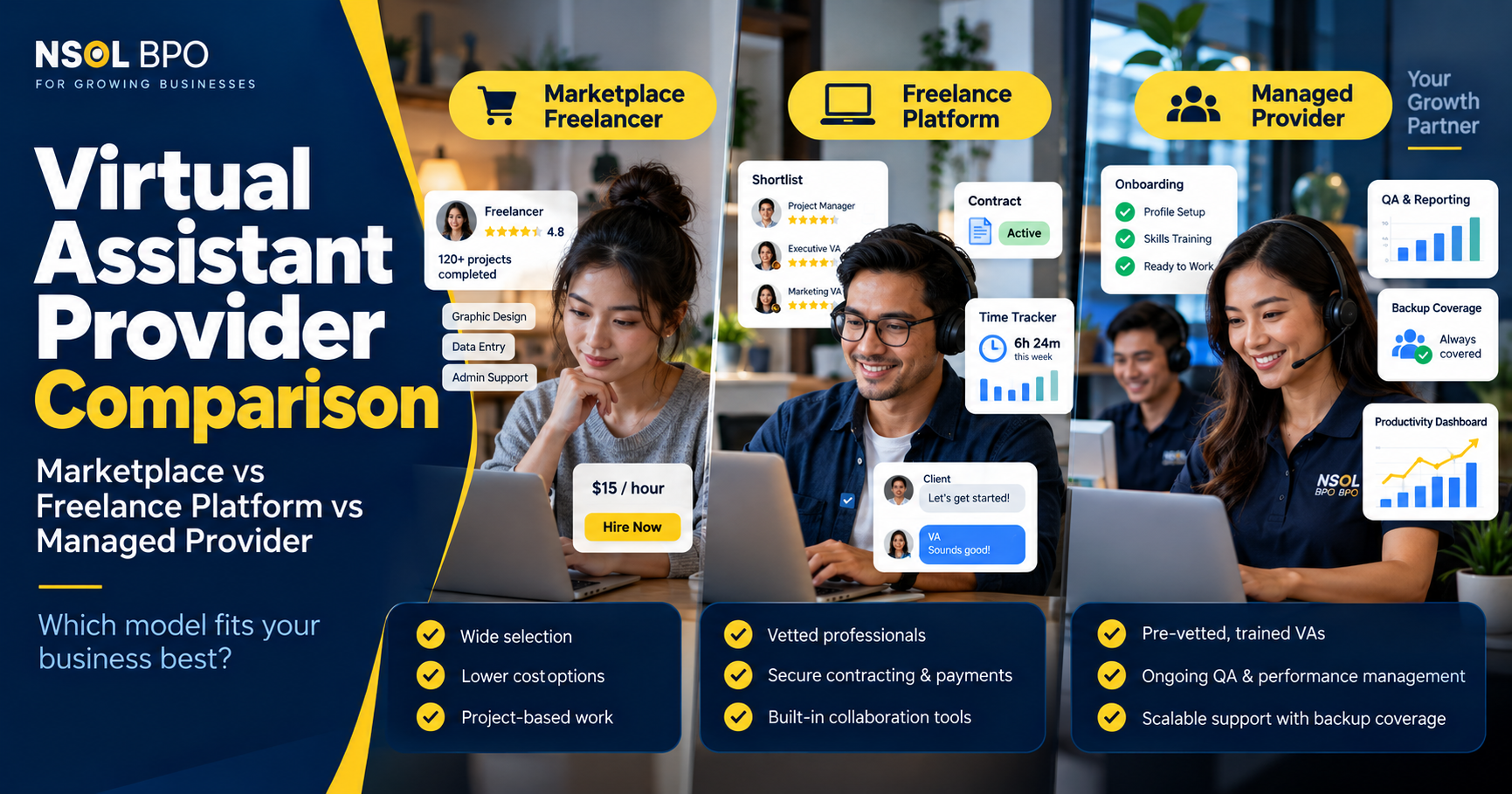
Most people shopping for help start in the wrong place. They open a pricing page.
Which is understandable, and also how you end up comparing an $8 gig against a $2,500 monthly retainer and concluding one of them is a rip-off. They aren’t the same product. They aren’t even really the same category.
So before the numbers, the actual question: what are you buying when you pick a virtual assistant provider?
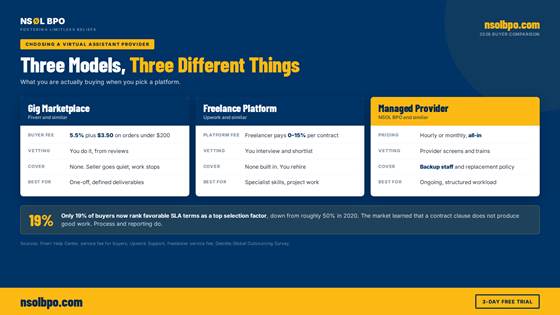
Three models, three different things.
What you are actually choosing between
Three models. Everything else is a variation on one of them.
A gig marketplace sells you a deliverable. You pick from listings, you pay, something arrives. Fiverr’s published buyer fee is 5.5% of the purchase amount, plus $3.50 on orders under $200. No vetting beyond the review score. No cover if the seller vanishes.
A freelance platform sells you access to people. You post, shortlist, interview, hire. Upwork’s own support documentation puts the freelancer service fee at 0% to 15% per contract, paid by the freelancer, which means it is already priced into the rate you see.
A managed virtual assistant provider sells you an outcome. They screen, train, supervise and report. Somebody covers when your person is sick. If the match fails, replacing them is their job, not yours.
None of those is better in the abstract. They answer different questions.
Why people start hunting for Upwork alternatives
The search volume tells you something. Roughly 880 people a month type upwork alternatives into Google in the US alone, and most of them aren’t angry at Upwork. They’ve just hit a limit.
Usually one of these three.
The hiring overhead. You post a role, get 40 proposals, read maybe 15, interview four, hire one. Then they’re slow, and you do it again. The hourly rate was never the cost. Your Tuesday was.
The continuity problem. Freelancers juggle clients. Good ones get busy, raise rates, or disappear mid-project. There’s no bench. Nobody picks up your inbox because the person handling it took a better contract.
The management load. A marketplace gives you a person, not a process. Quality assurance, training, documentation, performance reporting. Want any of that? You build it yourself, on top of a freelancer who doesn’t report to you.
That’s the gap people are searching for. Not a cheaper platform. A different model entirely.
Best virtual assistant websites, sorted by what they are actually good at
Forget rankings. The useful question is which tool fits which job, so here’s the honest version.
- Gig marketplaces (Fiverr and similar) — one-off, tightly defined deliverables. A logo. A single landing page. Something you can describe completely in a paragraph and check in ten minutes.
- Freelance platforms (Upwork and similar) — specialist skills you need for weeks, not years. A developer for a specific build. A designer for a campaign. Work where you can judge quality yourself.
- Talent-matching services — a curated shortlist for a premium. Faster than a marketplace, still your hire to manage.
- Managed providers — recurring operational work. Support inboxes, scheduling, data entry, back office. The stuff that happens every single day and quietly eats your team.
- Direct hiring — deep product knowledge, judgment calls, anything that genuinely needs to sit inside your business.
Anybody telling you one of those five is the answer every time is selling that one. The best virtual assistant websites for a logo and for a daily support inbox are not the same websites, and no ranking list will tell you that.
What it costs on each model
Here’s where most comparisons fall apart, because people put an hourly rate next to a salary. A salary isn’t what an employee costs you.
The BLS Employer Costs for Employee Compensation release from June 2026 puts private-industry compensation at $46.89 an hour. Wages are $32.82 of it. The other $14.07 is benefits, which works out to 30% of the bill and shows up in exactly zero job postings.
Run that against a real role. A US administrative assistant earns a median $48,310 a year, or $23.23 an hour. Load the benefits and you’re near $62,800, before a recruiter, a desk, software seats or one minute of supervision.
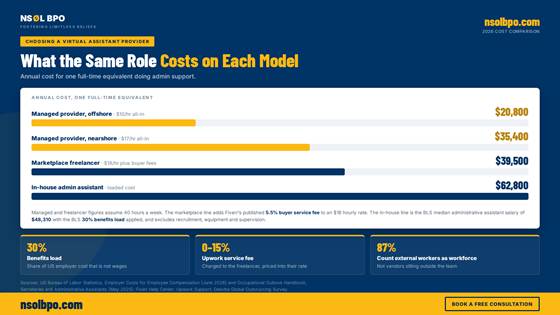
Annual cost for one full-time equivalent doing admin support.
A marketplace freelancer at $18 an hour looks cheap next to that. Add Fiverr’s 5.5% buyer fee and run it full time and you’re at roughly $39,500 a year. Still cheaper than in-house, but you’re carrying the management, the vetting and the risk yourself.
A virtual assistant provider runs $8 to $15 an hour offshore and $12 to $22 nearshore, all-in. Full time, that’s $20,800 to $35,400, with screening, training, supervision, cover and reporting included in the number.
So the gap between a marketplace freelancer and a managed provider isn’t really price. On a full-time basis the managed option is frequently cheaper. The gap is what’s bundled.
Virtual assistant services for small business: what actually matters at your size
Enterprise buyers care about procurement terms and compliance frameworks. If you’re shopping virtual assistant services for small business at ten people, you care about three things, and the vendor brochures mention none of them.
Can you afford the onboarding time? A managed provider absorbs training. A freelancer needs you to do it, and you’ll do it again in six months when they leave.
What happens on the bad week? Someone’s sick, volume spikes, a client escalates. A provider with a bench handles it. A solo freelancer tells you they’ll catch up Thursday.
Who owns quality? This is the one small teams underestimate most. You do not have a QA function. If the provider doesn’t bring one, nobody is checking the work until a customer complains.
Deloitte’s research backs the direction of travel here. Their Global Outsourcing Survey of 500-plus business and technology leaders found 87% of organizations now count external workers as part of their actual workforce, not as vendors sitting outside it. And only 19% still rank favorable SLA terms as a top selection factor, down from roughly half in 2020.
That second number is the interesting one. Buyers stopped shopping on contract language, because a tight SLA on paper has never once produced good work. Process did. Reporting did.
What changes when you hire remote staff through a managed team
The practical differences, which rarely make it onto a comparison page.
- Screening happens before you see anyone, so you interview two candidates rather than fifteen
- Training is the provider’s cost, not your Tuesday afternoon
- There is a named account contact when something goes wrong, which is different from a support ticket
- Coverage exists. Holidays and sick days are somebody else’s staffing problem
- Reporting arrives on a schedule instead of when you remember to ask
- Replacement is a process with a timeline, not a fresh job post
None of that is magic. You pay for it inside the hourly rate. The question is whether you’d rather hire remote staff and absorb the management yourself, or buy it bundled, and for most owners the honest answer is bundled.
Deloitte also found budget moving this way: 67% of organizations expect to grow spend on operate services over the next two years, against just 32% for traditional outsourcing. People want somebody who owns the outcome, not a supplier who fills a seat.
How to choose a virtual assistant provider without wasting a quarter
Start from the work, not the vendor.
Write down the single task eating the most hours while needing the least judgment. Usually it’s inbox triage, scheduling, data entry or order support. Document it as a checklist. Scrappy is fine, nobody’s grading the formatting.
Then match the model to the task. One-off and fully specified? Marketplace. Specialist and temporary? Freelance platform. Recurring, daily, structural? That is when a virtual assistant provider earns its margin.
Then run it small. Hand over that one task for two weeks, review every output yourself, and only widen the scope if it holds. If it doesn’t, you’ve lost two weeks instead of a quarter.
What to ask before you sign
Six questions. They sort serious operators from resellers.
- Dedicated to me, or shared across accounts?
- What does onboarding involve, who runs it, and how long before they are productive?
- What gets reported, how often, and against which numbers?
- Who covers when my person is out?
- How is access to my systems provisioned and revoked, and is that written down?
- If the match fails, what is the replacement process and the timeline?
Vagueness on more than one of those is useful information. So is how long the answers take.
When a marketplace is genuinely the right call
Worth saying plainly, because the managed model is not always the answer.
The work is a one-off. You need a single thing built or fixed, you can describe it fully, and you will never need it again. Go to a marketplace. Paying for a managed engagement would be absurd.
You need a rare specialist. A niche developer, a translator for an unusual language pair. Freelance platforms have depth no managed provider can match.
Your volume is genuinely tiny. Three hours of admin a week does not justify an ongoing engagement. Wait until the backlog is structural rather than occasional.
Where NSOL BPO fits
We’ve been building outsourced teams since 2014. NSOL BPO has worked with more than 29,000 clients across the US, UK, UAE and beyond, with over 350 people behind the service, operating as Niku Solutions PTE LTD out of Singapore.
We sit in the managed column, which means we are the wrong answer for a one-off logo and the right one for a support inbox that needs covering every day. For the fuller picture of what each role covers, our guide to virtual assistant services sets it out, and our breakdown of virtual assistant costs in 2026 goes deeper on rates by region.
Still weighing models? Our virtual assistant vs full-time employee comparison runs the in-house numbers properly, the roundup of best virtual assistant companies for small businesses covers how to build a shortlist, and what a BPO virtual assistant actually is explains the managed model in detail.
If you already know which function you want covered, our guides to hiring a customer service virtual assistant and an ecommerce virtual assistant go role by role.
Frequently asked questions
What is a virtual assistant provider?
A company that recruits, trains, supervises and reports on remote staff working for you, rather than a platform that simply connects you with freelancers. The practical difference is what comes bundled: screening, quality assurance, backup cover and a replacement policy are the provider’s responsibility, not yours.
Is a managed provider cheaper than hiring on a marketplace?
Often, on a full-time basis. A marketplace freelancer at $18 an hour costs roughly $39,500 a year once Fiverr’s published 5.5% buyer fee is added and the hours run full time. Managed providers typically run $8 to $15 offshore and $12 to $22 nearshore, all-in, so $20,800 to $35,400. For a few hours a month, the marketplace wins easily.
What fees do Upwork and Fiverr charge?
Fiverr publishes a buyer service fee of 5.5% of the purchase amount plus $3.50 on orders under $200. Upwork’s support documentation states a freelancer service fee ranging from 0% to 15% per contract, which the freelancer pays, meaning it is already built into the rate you are quoted.
How do I compare virtual assistance platforms properly?
Start from the task, not the vendor. One-off and fully specified work suits a gig marketplace. Specialist, temporary work suits a freelance platform. Recurring daily operational work suits a managed provider. Comparing hourly rates across those three tells you almost nothing, because each bundles a different amount of management.
What should a small business outsource first?
Whatever eats the most hours and needs the least judgment. For most teams that is inbox triage, scheduling, data entry or order support. Document it as a checklist, hand over that one task, and review every output for the first two weeks before widening the scope.
Do I still manage someone from a virtual assistant provider?
You direct the work, they manage the person. You set priorities and review output. Training, performance management, cover and replacement sit with the provider. That split is the main thing you are paying for.
Conclusion
Most people searching upwork alternatives are not comparing virtual assistance platforms properly. They compare on price, and that is how you end up disappointed with all three models.
A gig marketplace sells deliverables. A freelance platform sells access. A virtual assistant provider sells an outcome with the management already built in. Put those side by side on an hourly rate and the comparison is meaningless, because you’re pricing three different amounts of work being done for you.
The numbers do say something, though. An in-house admin hire lands near $62,800 once the BLS benefits load goes on. A marketplace freelancer at full time comes in around $39,500 with buyer fees. A managed provider sits between $20,800 and $35,400, with screening, cover and reporting inside the number rather than on your calendar.
And the market has already moved. Eighty-seven percent of organizations now count external workers as part of their workforce. Budget is shifting toward managed engagements over traditional outsourcing by better than two to one. Only 19% still shop on SLA terms, because everyone learned the same lesson about contract language.
Pick the virtual assistant provider model that matches the work. Document one task. Run it for two weeks. Judge it on whether your week looks different afterward, not on what the pricing page promised.
Try it on one task
We run a three-day free trial, so you can hand over one real task and see what comes back before committing to anything. Book a free consultation and we’ll work out whether a virtual assistant provider is even the right fit for what you need.
Sources
Fiverr Help Center. buyer service fee on orders, extras and custom offers. Source for the 5.5% buyer service fee and the $3.50 charge on orders under $200.
Upwork Support. freelancer service fee documentation. Source for the 0% to 15% per-contract freelancer service fee.
Deloitte. Global Outsourcing Survey of 500-plus leaders. Source for the 87% external-workforce figure, the 19% SLA finding and the 67% versus 32% budget split.
US Bureau of Labor Statistics. Employer Costs for Employee Compensation, June 2026. Source for the 30% benefits load and the $46.89 hourly total compensation figure.
US Bureau of Labor Statistics. administrative assistant pay data. Source for the $48,310 median salary and $23.23 hourly wage.



2 Responses
I just like the helpful information you provide in your articles
çok yararlı bir paylaşım olmuş teşekkür ederim çok işime yarıcak.