
Ask any practice manager where the day goes, and you’ll get the same answer. Not patients. Paperwork.
Insurance verification. Prior auth forms. Rescheduling the four people who no-showed. Chasing a fax that never arrived. It’s the work nobody trained for, and everybody ends up doing.
That layer is stripped away by the virtual medical assistant. Remote staffing, operating in your system, taking on the administrative burden so you can get back to clinical duties.
Here is the scope of the job, its price tag compared to a traditional employee, and the compliance angle that gets overlooked by many practices.
What the administrative load actually looks like
Before the solution, the size of the problem. Because most practices underestimate it badly.
The American Medical Association surveyed physicians on prior authorization alone. Not billing. Not scheduling. Just prior auth. The result: 43 requests per physician per week, consuming 12 hours of physician and staff time.
Twelve hours. That’s a day and a half of capacity, gone, every week, to one administrative function.
The downstream effects are worse. Ninety-five percent of physicians said prior authorization increases burnout. Ninety-four percent said it delays patient access to care. Nearly a quarter, 24%, reported that a prior auth delay had led to a serious adverse event for a patient.
And 35% already employ someone whose entire job is prior authorization. So a third of practices have quietly solved this by hiring a person. The question isn’t whether the role is needed. It’s where that person sits and what they cost.
Zoom out and the number gets harder to ignore. The 2024 CAQH Index put routine administrative processes, including insurance verification, at $90 billion a year in US healthcare spending. It also found that around 70 minutes could be saved per patient visit through wider adoption of automated workflows.
Seventy minutes. Per visit.
What a virtual medical assistant does day to day
You’ll see the same role advertised as a medical virtual assistant, which trips people up. Same job, different word order. Neither version is clinical.
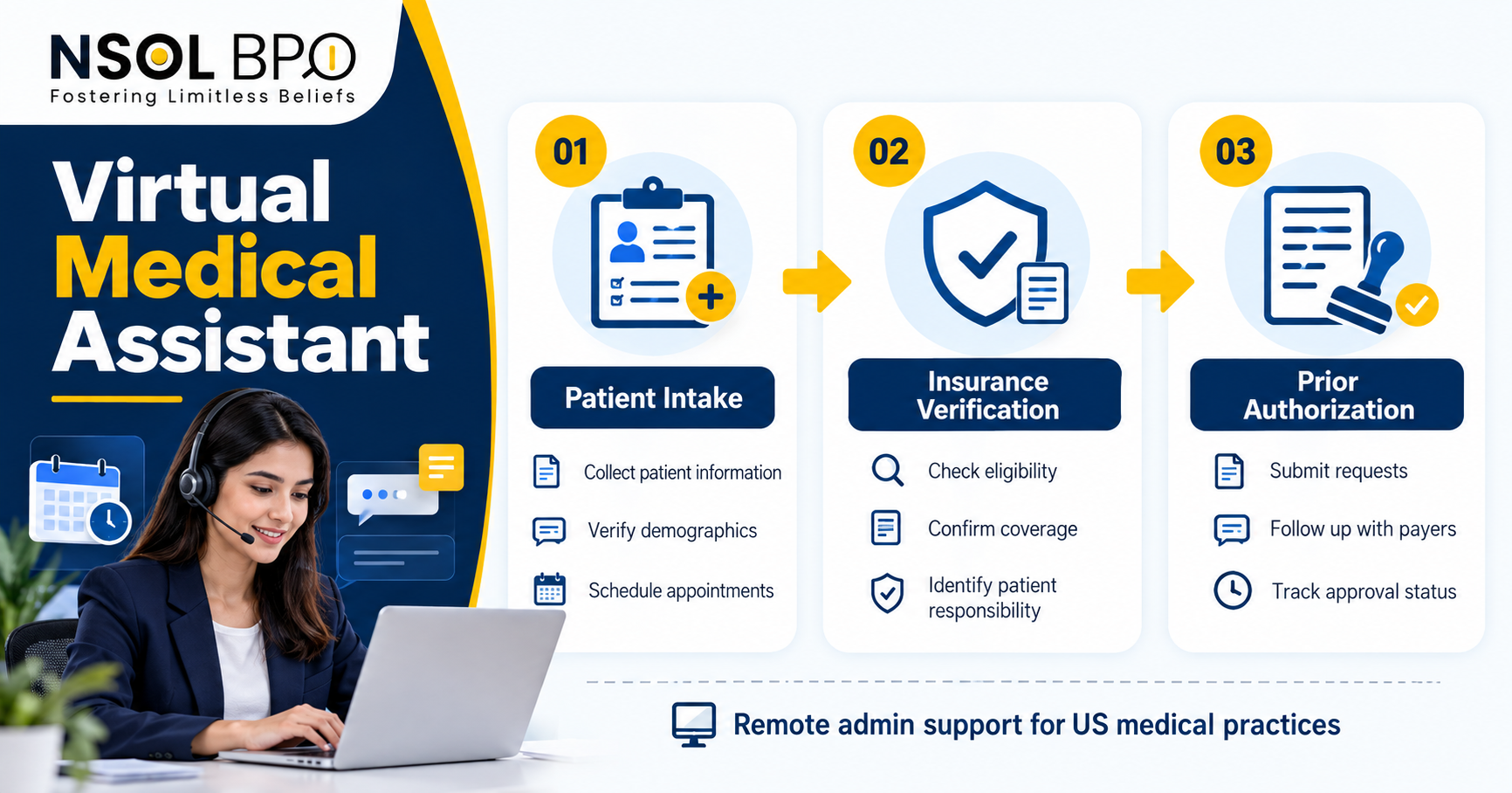
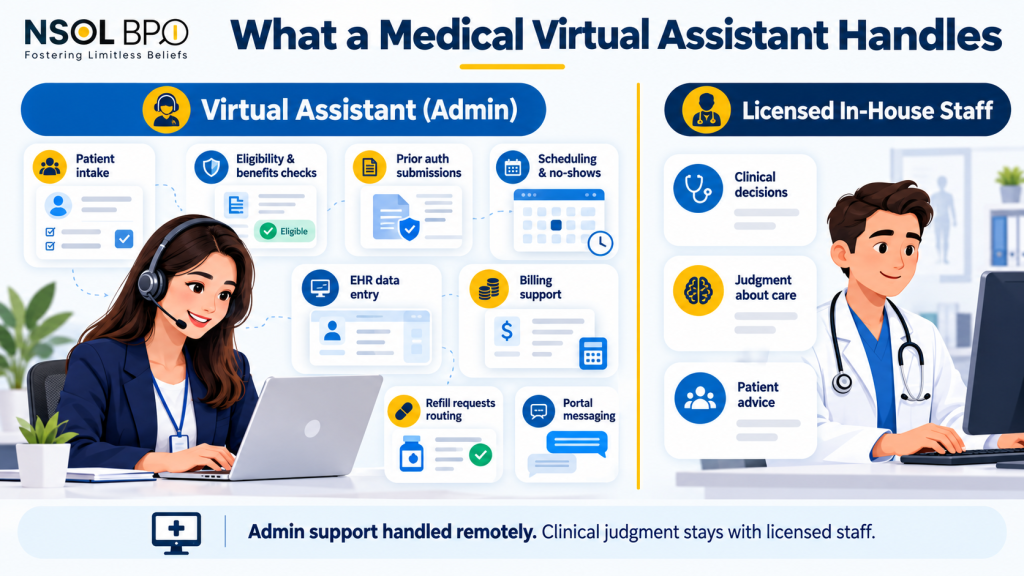
So let’s be specific about what that means. They don’t triage, they don’t advise, they don’t touch anything requiring a license. What they do handle:
- Patient intake forms, demographics, chart prep before the appointment
- Insurance verification before the appointment
- Prior authorization requests and follow-ups of phone calls that nobody is able to do
- Appointment scheduling, confirmation, and handling no-shows
- EHR documentation after the appointment
- Medical billing assistance: claims processing, denials follow-up, aging reports
- Referral coordination between your office and specialists
- Prescription refill requests routed to the right provider
- Patient messaging through the portal, within scope
What stays with your licensed staff: anything clinical, anything requiring judgment about care, and any conversation that could turn into advice. A good provider draws that line clearly in the contract. If they don’t, that’s your answer about them.
Insurance virtual assistant work is where most practices start
And there’s a good reason why verification is always the first process to be offloaded.
It’s high volume, highly repetitive, scripted, and done before the patient even shows up. No aspect of it requires a license. But do it wrong, and you just made sure you won’t be getting paid for the claim.
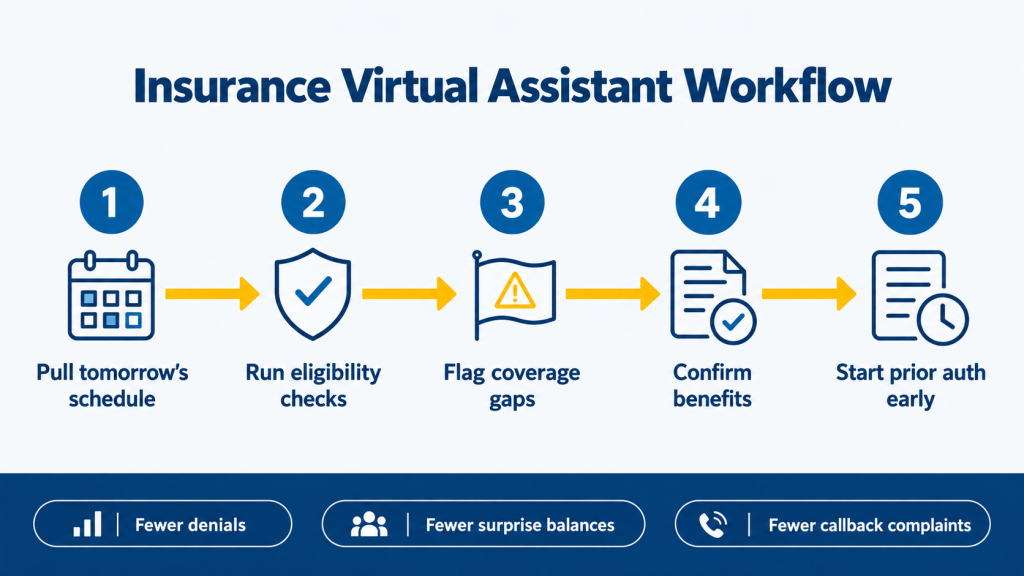
An insurance virtual assistant conducts eligibility verifications for the schedule of tomorrow, highlights the coverage issues, verifies benefits, and ensures prior authorizations are initiated. Your front desk stops making those calls between patients, which is when they were getting made badly.
The ROI here is the cleanest in the whole engagement. Fewer denials, fewer surprise balances, fewer angry phone calls three weeks later.
What a healthcare virtual assistant costs versus an in-house hire
Most comparisons go wrong here, because people put an hourly rate next to a salary. A salary isn’t what an employee costs you.
The BLS Employer Costs for Employee Compensation release from June 2026 puts private-industry compensation at $46.89 an hour. Wages account for $32.82 of that. Benefits are the other $14.07, which is 30% of the bill, and none of it shows up in a job posting.
Now apply that. A US medical assistant earns a median $45,690 a year, or $21.97 an hour. Load the benefits and you are at roughly $59,400 before recruitment, a workstation, software seats, or a single hour of supervision.
An administrative assistant runs a median $48,310, or $23.23 an hour, which lands near $62,800 loaded.
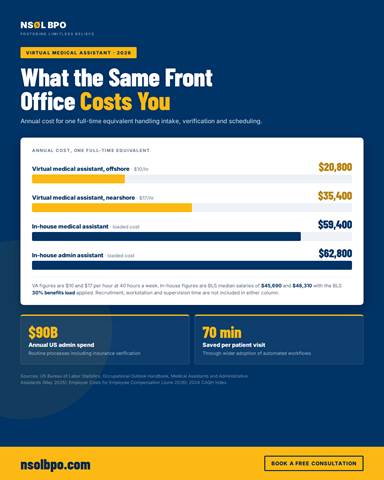
Annual cost for one full-time equivalent handling front-office work.
The cost of hiring a dedicated health care virtual assistant is between $8 and $15 per hour when hired from abroad, $12 and $22 per hour when hired nearby, and $25 to $50 for US-based hires.
There’s a hiring-market factor too. Medical assistant roles are projected to grow 13% through 2035, much faster than average, against 833,900 existing jobs. That’s a tight market getting tighter. Plenty of practices aren’t choosing between a VA and a local hire. They’re choosing between a VA and an empty chair.
The HIPAA part nobody explains properly
This is where the conversation usually gets vague, and it shouldn’t.
Under HHS guidance, any person or organization that handles protected health information on your behalf is a business associate. That covers claims processors, billing vendors, IT contractors, and a virtual medical assistant.
The requirement is not optional. According to HHS, before disclosing PHI to a business associate, a covered entity must ensure satisfactory assurances that are put in the form of a contract or any other document. This is what is known as a Business Associate Agreement, which must specify the permissible uses and disclosures of information and agree to abide by the Privacy Rule and not use the PHI for any purpose not specified in the agreement.
The agreement does more. In case you have knowledge of a practice pattern indicating a material breach of the terms of the agreement, you are supposed to ensure corrective action.
Here is the practical one. Before anyone touches a chart:
- A signed BAA is in place, not promised
- You know exactly which systems they access and at what permission level
- Access is individually credentialed, never a shared login
- Their HIPAA training is documented, and you have seen it
- There is a written process for revoking access the day someone leaves the account
Any provider who treats these as paperwork rather than the foundation of the engagement is telling you something useful.
When a virtual assistant for doctors is the wrong answer
Three situations. Worth saying plainly.
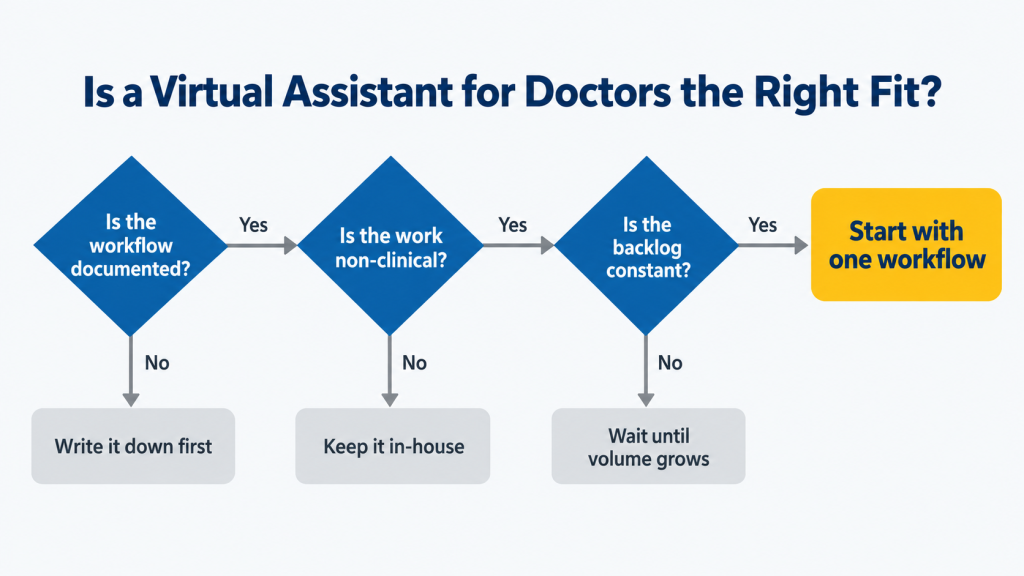
Nothing is documented. If your process of verification lives only in someone’s head, delegating it is not going to be easy. Document it first, in whatever form that is. Delegating an undocumented process simply transfers the messiness somewhere out of your reach.
The work crosses into clinical territory. Licensure, clinical judgment, and any type of counseling to the patient must remain internal. Period. A virtual assistant for physicians deals with administrative tasks, but not with the clinical ones.
Your volume genuinely is small. If your front office has slack time during a typical day, hiring an additional person to work remotely means adding the coordination layer that you don’t need yet.
What to ask before you sign
Six questions. They separate serious healthcare providers from generic VA firms with a medical landing page.
• Do you have a BAA for me to see prior to discussing cost?
• Does the assistant belong to my practice alone or do other accounts share it?
• In what EHR/PMS systems have they actually worked before?
• What do you teach about HIPAA? How often do you refresh the training?
• Who provisions and revokes access, and who is responsible for this?
• What do I do if the assigned assistant is not a good match for me?
Watch how fast the BAA answer comes. A provider doing this properly has it ready. One who needs to check will be learning compliance on your account.
How to start without betting the practice
Pick one workflow. It eats the most hours and requires the least judgment.
This is usually insurance verification for the next day, or prior authorization follow-up. Create a simple checklist and document it, sign the BAA, implement read-only or scoped access, and test it for two weeks with a trusted individual verifying each result.
If it holds, widen the scope. If it doesn’t, you’ve lost two weeks instead of a year and a salary.
Where NSOL BPO fits
We’ve been building outsourced teams since 2014. NSOL BPO has worked with more than 29,000 clients across the US, UK, UAE, and beyond, with over 350 people behind the service, operating as Niku Solutions PTE LTD out of Singapore.
Healthcare administration sits alongside our customer service, back office, and lead generation work. For the fuller picture of what each role covers, our guide to virtual assistant services lays it out, and our breakdown of virtual assistant costs in 2026 goes deeper on rates by region.
The front-desk side overlaps heavily with general support work, so our guide to hiring a customer service virtual assistant covers the patient-facing half, and what a BPO virtual assistant actually is explains how a managed engagement differs from hiring a freelancer directly.
Still comparing models? Our virtual assistant vs full-time employee comparison runs the numbers properly, and our roundup of the best virtual assistant companies for small businesses covers how to shortlist providers.
Frequently asked questions
What does a virtual medical assistant do?
The Virtual Medical Assistant, alternatively known as a medical virtual assistant, performs non-clinical tasks from home such as conducting patient intake, verifying patients’ insurance coverage and benefits, conducting prior authorization and following up, scheduling appointments, entering patient data into EHR, helping with the billing process, referring patients, and using the patient portal for messaging and more. Clinical or licensed tasks are left to your existing staff.
How much does a virtual medical assistant cost?
Average hourly rates are between $8-$15 per hour offshore, $12-$22 nearshore, and $25-$50 for USA-based staff. To put that into perspective, the salary of a USA-based medical assistant is $45,690 a year on average, according to BLS data, and with benefits it adds another 30%, coming close to $59,400.
Is a virtual medical assistant HIPAA compliant?
Yes, but it depends on the situation, not on the job itself. According to HHS guidelines, everyone who processes the protected health information in your interest becomes a business associate. You have to make sure that you have obtained satisfactory assurance in writing of this fact.
Can a virtual medical assistant work in our EHR?
Yes, provided they have individual credentials and the proper permissions. There should never be a shared login. Find out what EHR systems the assistant works with and whether there is a process to deny him access the day he stops working with you.
What should a medical practice delegate first?
Insurance verification and prior authorization follow-up on the next day’s schedule. These are high-volume operations based on scripts which can be performed before patients arrive. Nothing clinically significant is involved in this case. Create a workflow in the form of a checklist, and check all outputs in the first two weeks.
What factors are driving healthcare professionals to hire virtual assistants in 2026?
The heavy workload and shortage of staffing. According to the AMA, prior authorization alone takes up 12 hours weekly from physicians and office staff, and 35% of practices are already using someone dedicated only to it. Moreover, the number of US medical assistants is expected to rise by 13% by 2035.
Conclusion
A virtual medical assistant isn’t a clinical shortcut, and it isn’t a way to run a thinner practice. It’s a way to stop paying licensed people to do unlicensed work.
The arithmetic is straightforward. Twelve hours a week per physician lost to prior authorization. Ninety billion dollars a year across the industry on routine administrative processes. A loaded in-house hire near $59,400 against $20,800 to $35,400 for the same front-office coverage. And the medical assistant hiring market is growing 13% while practices struggle to fill the roles they already have.
What decides whether it works is you, more than the provider. Get the BAA signed first. Document one workflow. Hand over one thing. Review it properly for two weeks instead of assuming it’ll be fine.
Practices that do that usually widen the scope within a quarter. Practices that hand over a vague brief and hope tend to conclude outsourcing doesn’t work in healthcare, when what didn’t work was the handover.
Start with verification. Keep everything clinical in-house. Judge it on whether your front desk is answering the phone again.
Try it on one workflow
We run a three-day free trial on dedicated virtual medical assistants, so you can hand over one real workflow and see what comes back before committing to anything. Book a free consultation, and we’ll work out which one to start with.
Sources
American Medical Association. Prior authorization physician survey. Source for 43 requests per week, 12 hours of staff time, the 95% burnout and 94% care-delay findings, and the 35% dedicated-staff figure.
CAQH. 2024 CAQH Index on healthcare administrative spending. Source for the $90 billion annual administrative spend and the 70 minutes saved per patient visit.
US Department of Health and Human Services. HIPAA business associate guidance. Source for the business associate definition and the written-contract requirement for PHI disclosure.
US Bureau of Labor Statistics. Medical assistant pay and job outlook. Source for the $45,690 median salary, $21.97 hourly wage, 833,900 jobs, and 13% projected growth.
US Bureau of Labor Statistics. Administrative assistant pay data. Source for the $48,310 median salary and $23.23 hourly wage: U.S.Bureau of Labor Statistics. Employer Costs for Employee Compensation, June 2026. Source for the 30% benefits load and the $46.89 hourly total compensation figure.