

Marketing work expands. You know this already.
One newsletter turns into a newsletter plus a landing page plus eight social posts plus somebody chasing the designer at 6 pm. None of it’s difficult. All of it eats hours. And most of it ends up with whoever on the team is worst at saying no.
That’s usually the point where somebody googles virtual marketing assistant. Fair enough. It’s a trained remote marketer who takes the repetitive execution work off your desk so your team can go back to the thinking parts.
Here’s what the role actually covers, what the alternatives cost, and when it’s the wrong call.
What a virtual marketing assistant does day to day
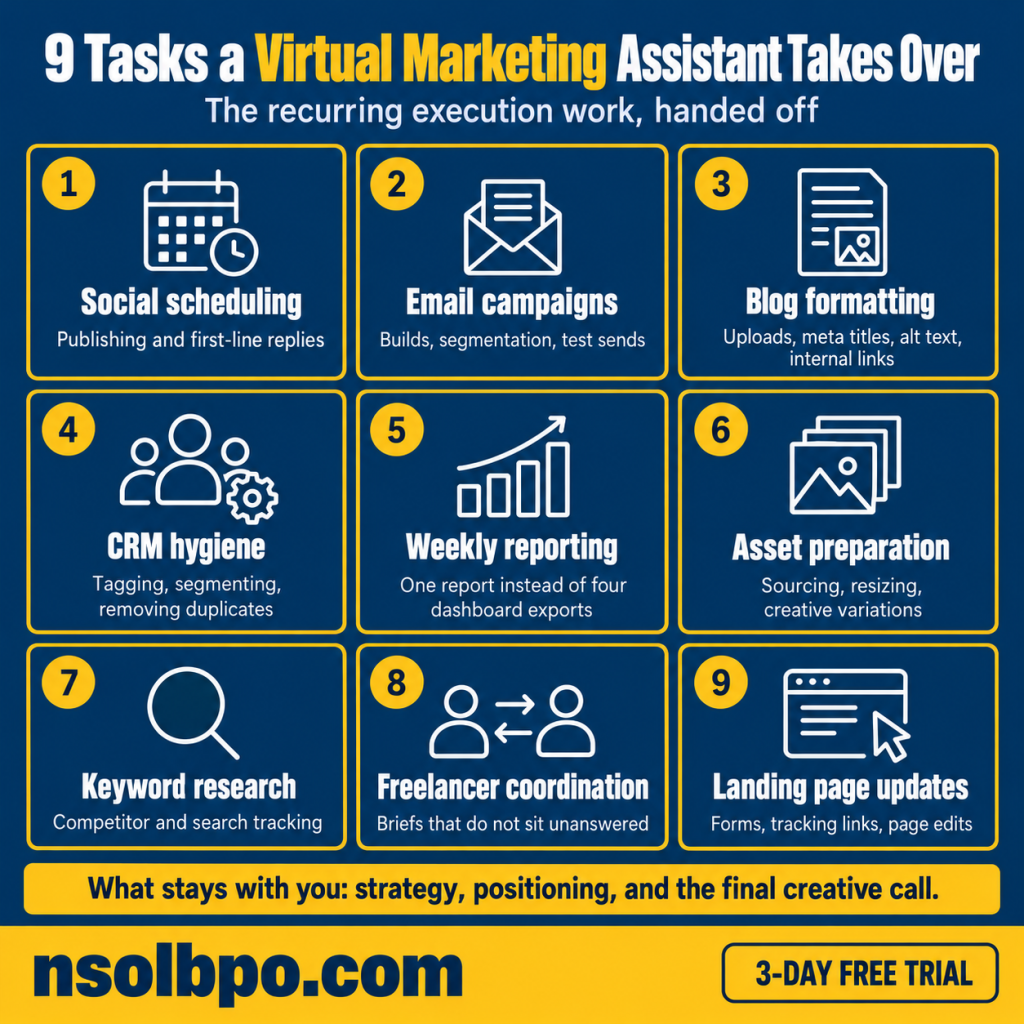
The title’s vague enough to mean almost anything, so let’s be specific. A virtual marketing assistant handles the repeatable layer of marketing execution:
- Scheduling and publishing across social, plus first-line replies to comments and DMs
- Building and sending email campaigns, managing lists, clearing out bounces
- Formatting and uploading blog posts, adding meta titles, alt text, internal links
- Keeping the CRM honest: tagging, segmenting, killing duplicates
- Pulling the weekly report, instead of someone exporting four dashboards by hand
- Sourcing images, resizing assets, prepping creative variations for testing
- Competitor and keyword research, in a sheet somebody will actually open
- Chasing freelancers and developers so briefs don’t sit there unanswered
- Updating landing pages, forms, tracking links
What’s not on that list? Strategy.
A good assistant will tell you a campaign’s tanking. Deciding what to do about it is still your job. Anyone pitching you a virtual marketing assistant as a replacement CMO is selling you something else entirely.
One thing worth knowing: most of this now runs through an AI-assisted stack rather than brute force, which is a big part of why one person can cover so much ground. We went through the current toolset in our guide to the AI tools every virtual assistant uses in 2026.
Social media virtual assistant work is usually the first thing to go
Social is where teams feel it first. It’s relentless, and the deadline is every single day.
A social media virtual assistant picks up the calendar, the scheduling tool, the asset resizing, the first pass on engagement. That’s most of the hours and almost none of the decisions, which is exactly the split you want.
Keep the voice, though. Hand over the calendar, not the opinions.
A decent assistant will draft in your tone once they’ve read enough of your stuff, but the first few weeks need you reviewing before anything publishes. Skip that, and you’ll be one of the people telling everyone that outsourcing social doesn’t work.
If you run an online store, the social work bleeds straight into order and customer questions, which is why ecommerce teams usually end up merging the two roles. Our post on why every online store needs an ecommerce virtual assistant gets into how that overlap plays out.
Email marketing virtual assistant work is where the time savings show up
Email looks cheap and isn’t.
Writing it takes an hour. Then there’s the build, the segmentation, the test sends, the broken-link sweep, the mobile preview, the post-send report. That’s four more hours, minimum, and none of it is the part you were hired for.
An email marketing virtual assistant absorbs those four. It’s usually where the before-and-after is most obvious in a team’s calendar.
It also kills a specific failure: the campaign that never goes out because nobody had a clear afternoon to build it. Everyone’s had that month.
Flat budgets, same workload what 402 CMOs told Gartner.
Why teams outsource digital marketing in 2026
The budget numbers explain most of it.
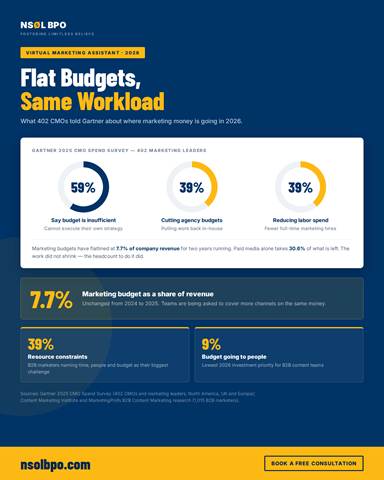
Gartner surveyed 402 CMOs and marketing leaders and found budgets flatlined at 7.7% of company revenue for a second straight year. Paid media swallows 30.6% of whatever is left.
Now look at what’s being cut inside that flat number. Thirty-nine percent of CMOs said they’re reducing agency spend. The same 39% said they’re reducing labor spend.
Read that twice. The work is being pulled back in-house at exactly the moment there are fewer people in-house to do it. Fifty-nine percent said their budget isn’t enough to execute the strategy they signed off on.
Content teams are living the same squeeze. Content Marketing Institute and MarketingProfs asked 1,015 B2B marketers what was hurting most, and resource constraints time, people, budget came second at 39%. Meanwhile, human resources sat dead last on their 2026 budget priorities, at 9%.
So: more channels to cover, same money, fewer people, and almost nothing budgeted to fix the people problem. That gap is the whole reason the market for marketing support exists.
When businesses outsource digital marketing now, it’s less about finding a cheaper rate and more about getting the work done at all.
What the alternatives actually cost
This is where most comparisons fall apart, because people put an hourly rate next to a salary. A salary isn’t what an employee costs you.
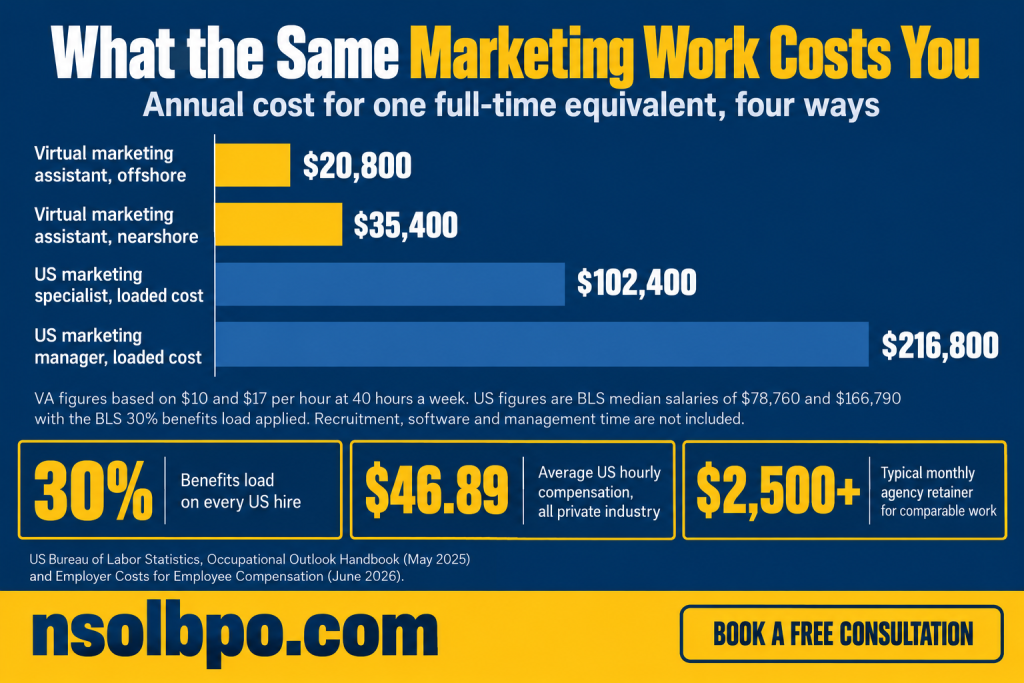
The BLS Employer Costs for Employee Compensation release from June 2026 puts private-industry compensation at $46.89 an hour. Wages are $32.82 of that. The other $14.07 is benefits, which works out to 30% of the bill that never shows up in a job ad.
Put that against real roles. A US market research analyst or marketing specialist earns a median $78,760 a year, or $37.87 an hour. Load the benefits on and you’re north of $100,000 before you’ve paid a recruiter, bought a software seat, or spent a single hour managing anybody.
Go up a level, and it gets worse. Marketing managers earn a median $166,790. Advertising and promotions managers earn $133,660. Both as of May 2025.
Against those numbers, a dedicated virtual marketing assistant runs $8 to $15 an hour offshore, $12 to $22 nearshore, $25 to $50 if you want US-based. An agency retainer covering comparable execution work tends to start near $2,500 a month and climbs quickly once you add channels.
But cheap versus expensive is the wrong frame. You’re buying three different things.
An agency sells you strategy and senior oversight. A full-time hire gives you context and someone who’s always there. An assistant gives you execution capacity at the lowest cost per hour. Most teams need a bit of all three. The real question is which one you’re currently overpaying for.
If it’s the first two you’re stuck between, we ran that comparison properly in virtual assistant vs full-time employee.
Where a digital marketing virtual assistant is the wrong answer
Three situations. Worth saying plainly, because nobody else will.
Nothing’s written down. If the only record of how your newsletter gets built lives in one person’s head, handing it over won’t work. Write the steps out first, even badly. Outsourcing an undocumented process just moves the confusion somewhere you can’t see it.
The work needs real product depth. Technical content for a complicated product, or anything where a wrong claim creates actual risk, stays with someone who lives in your business. No exceptions.
Your problem is strategy, not capacity. If campaigns are failing because the positioning is off, more execution hours just get you more failing campaigns, faster.
What to ask before you hire
Six questions. They sort the serious providers from the rest pretty quickly.
- Is the assistant dedicated to you, or shared across accounts?
- Which of your tools do they already know, and who pays for the seats?
- What gets reported, how often, against which numbers?
- Who reviews their work, and what does onboarding actually involve?
- How is access to your accounts handled, and is any of that in writing?
- If the person assigned isn’t a fit, what happens, and how fast?
Watch how they answer. Vagueness on more than one of those tells you plenty. And if you’re still putting the shortlist together, our roundup of the best virtual assistant companies for small businesses breaks down the three tiers of providers and what each is genuinely good at.
How to start without betting much
Pick one task. The one that eats the most hours and needs the least judgment.
For most teams, that’s social scheduling or the weekly report. Write it up as a short checklist, hand over that single thing, and run it for two weeks with you checking every output before it goes anywhere.
If it holds, add the next task. If it doesn’t, you’ve lost two weeks instead of a quarter and a salary. That’s the whole gamble.
Where NSOL BPO fits
We’ve been building outsourced teams since 2014. NSOL BPO has worked with more than 29,000 clients across the US, UK, UAE, and beyond, with over 350 people behind the service, operating as Niku Solutions PTE LTD out of Singapore.
Marketing support sits next to our customer service, back office, and lead generation work. For the fuller picture of what each role covers, our guide to virtual assistant services lays it out, and our breakdown of virtual assistant costs in 2026 goes deeper on rates by region.
Teams that start with marketing often add support soon after, because the same inbox pressure shows up on both sides. Our guide to hiring a customer service virtual assistant covers that half, and what a BPO virtual assistant actually is explains how a managed engagement differs from hiring a freelancer directly.
Frequently asked questions
What does a virtual marketing assistant do?
They handle the recurring marketing execution remotely: social scheduling and engagement, email campaign builds, blog formatting and on-page SEO, CRM maintenance, performance reporting, asset prep, and chasing freelancers. Strategy and final creative calls stay with your team.
How much does a virtual marketing assistant cost?
Roughly $8 to $15 an hour offshore, $12 to $22 nearshore, $25 to $50 US-based. For context, a US marketing specialist earns a median $78,760 a year according to BLS data, and benefits add about 30% on top of wages.
Is a marketing assistant better than an agency?
They solve different problems. An agency gives you strategy and senior oversight, usually from around $2,500 a month. An assistant gives you execution capacity at a much lower cost per hour but won’t set direction. If your strategy is clear and your backlog isn’t, an assistant wins.
What should I delegate to a marketing assistant first?
Whatever eats the most hours and needs the least judgment. Usually social scheduling or the weekly performance report. Write it up as a checklist, hand over that one task, and review every output for the first two weeks before adding anything else.
Can a remote marketing assistant write in our brand voice?
Usually, but not on day one. Expect to review drafts closely for a few weeks and give specific corrections rather than vague ones. The teams that skip that review period are the ones that conclude outsourcing marketing doesn’t work.
Why are companies outsourcing digital marketing in 2026?
Budgets are flat, workload isn’t. Gartner found marketing budgets held at 7.7% of company revenue for a second year; 59% of CMOs said that isn’t enough to execute their strategy, and 39% were cutting agency and labor spend at the same time.
Conclusion
A virtual marketing assistant isn’t a growth hack, and it isn’t a cheaper CMO. It’s capacity.
It takes the repeat execution work (the scheduling, the builds, the reports, the chasing) and hands you back the hours your team should be spending on positioning, offers, and the campaigns that actually move revenue.
The case for it in 2026 is mostly arithmetic. Budgets are flat at 7.7% of revenue. Fifty-nine percent of CMOs say that’s not enough. Agency and labor spend cut simultaneously. And a US marketing specialist still costs north of $100,000 once you load the benefits. The workload didn’t shrink to match any of that.
What decides whether it works, though, is you more than the provider.
Document one process. Hand over one task. Actually review the output for the first two weeks instead of assuming it’ll be fine. Teams that do that usually expand within a quarter. Teams that send a vague brief and hope tend to decide outsourcing marketing doesn’t work, when what didn’t work was the handover.
Start small. Keep strategy in-house. Judge it on whether your calendar looks different in a month.
Try it on one task
We run a three-day free trial on dedicated virtual marketing assistants, so you can hand over one real task and see what comes back before committing to anything. Book a free consultation, and we’ll work out which task to start with.
Sources
Gartner. 2025 CMO Spend Survey of 402 marketing leaders. Source for the 7.7% budget figure, 59% insufficient-budget finding, and the 39% agency and labor cuts.
Content Marketing Institute and MarketingProfs. B2B content marketing research across 1,015 marketers. Source for resource constraints at 39% and human resources as the lowest 2026 budget priority at 9%.
US Bureau of Labor Statistics. Employer Costs for Employee Compensation, June 2026. Source for the 30% benefits load and the $46.89 hourly total compensation figure.
US Bureau of Labor Statistics. market research analyst and marketing specialist pay. Source for the $78,760 median salary, $37.87 hourly wage and 952,700 US jobs.
US Bureau of Labor Statistics. advertising, promotions and marketing manager pay. Source for the $166,790 and $133,660 median manager salaries as of May 2025.