
Search for outsourcing statistics, and you’ll get a dozen listicles quoting each other. Trace any number back far enough, and it usually lands on a blog post from 2019 that cited a survey nobody can find anymore.
So we did it differently. Every figure on this page came from the primary sources: Deloitte’s Global Outsourcing Survey, the US Bureau of Labor Statistics, Grand View Research, HubSpot, and Salesforce. Each one is linked. If you want to check a number, click it.
Here’s what the outsourcing statistics actually say about 2026.
The outsourcing statistics on market size are hard to argue with
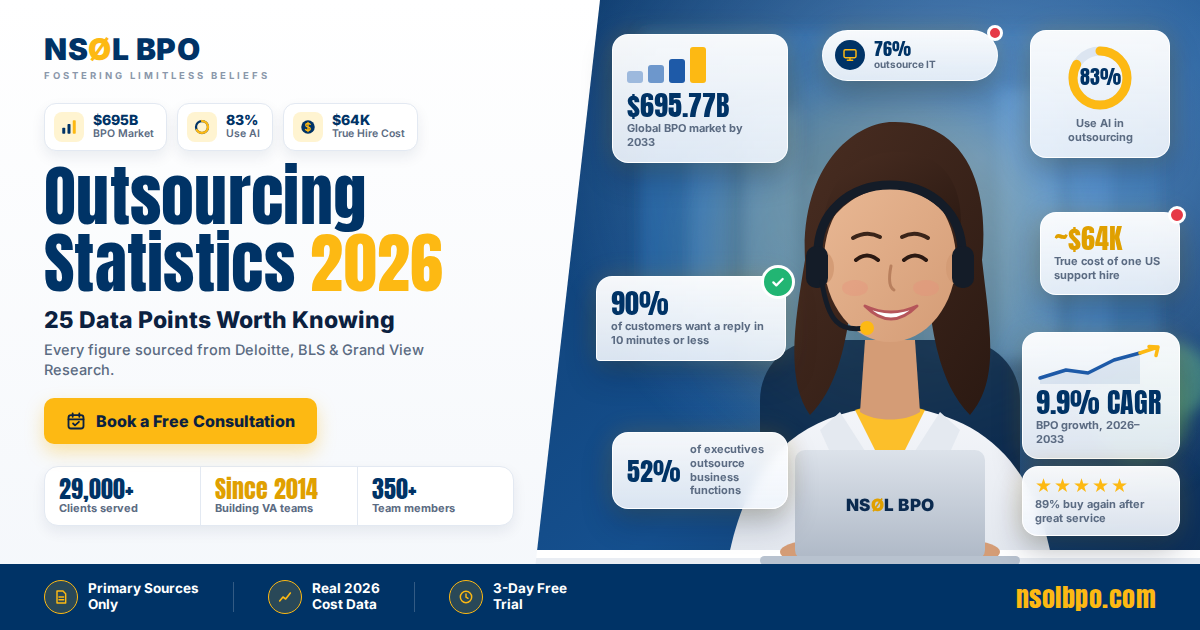
Grand View Research puts the global business process outsourcing market on track to hit $695.77 billion by 2033, growing at a 9.9% compound annual rate from 2026. That’s faster than the decade before it.
The US slice is worth $139.32 billion by 2030 on a 9.1% CAGR. Customer service is the biggest piece of it, holding over 30% of the US market. Finance and accounting take another 21.4% globally.
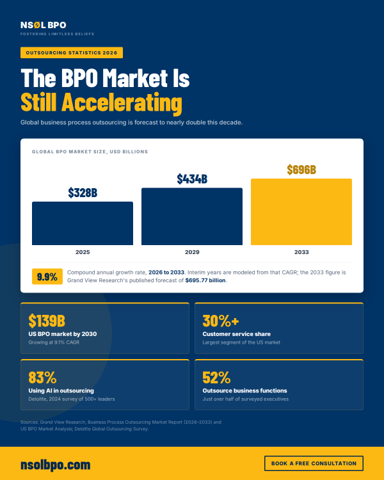
What’s driving it isn’t complicated. Deloitte surveyed more than 500 business and technology leaders, including 150-plus C-suite executives, and found that 52% of executives outsource business functions outright. IT leads at 76%. And 87% now count external workers as part of their actual workforce rather than as vendors sitting outside it.
That last number matters more than it looks. It’s the difference between “we use a supplier” and “this is our team.”
What a US hire really costs you
This is where most businesses get the math wrong, and it’s not their fault. Job boards quote salaries. Salaries aren’t what you pay.
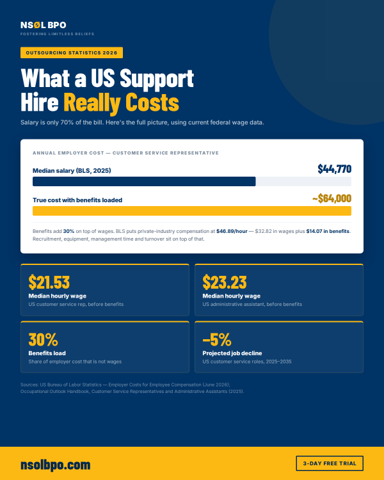
The BLS Employer Costs for Employee Compensation release from June 2026 breaks it down cleanly. Private industry employers pay $46.89 per hour worked in total compensation. Of that, $32.82 is wages. The other $14.07 is benefits — which works out to 30% of the bill that never shows up in a job posting.
Apply that to a real role. A US customer service representative earns a median $44,770 a year, or $21.53 an hour. Load the benefits on, and you’re at roughly $64,000 before you’ve spent a dollar on recruitment, equipment, onboarding, or the management hours that go into keeping that person productive.
Administrative assistants run slightly higher at $48,310 a year, or $23.23 an hour.
Compare that against outsourced rates, which run $8 to $15 an hour offshore, $12 to $22 nearshore, and $25 to $50 for US-based talent. We broke those numbers down properly in our guide to virtual assistant costs in 2026.
One more thing worth noting from the BLS data: customer service roles in the US are projected to shrink 5% between 2025 and 2035, and administrative assistant roles by 2%, a loss of 75,300 positions. There are still 2.67 million customer service jobs and 3.5 million admin jobs in the country, so nobody’s going anywhere overnight. But the direction of travel is clear.
Speed is what customers actually grade you on
Every business says it cares about customer experience. The research is more specific about what customers mean by that.
HubSpot Research found that 90% of customers rate an immediate response as essential or very important. Sixty percent define “immediate” as ten minutes or less. Not same-day. Not within the hour. Ten minutes.
Miss it often enough, and the consequences show up fast. Khoros reports 65% of customers have switched brands over a poor experience. Zendesk found that after more than one bad experience, around 80% of consumers would rather take their business to a competitor.
The flip side is just as stark. Salesforce Research found 89% of consumers are more likely to buy again after a good service experience, and 78% will come back even after a company makes a mistake, provided the recovery is handled well. Bain & Company’s often-cited finding still holds: lifting retention by 5% can lift profits anywhere from 25% to 95%.
All of these figures are collected with sources at Help Scout’s customer service statistics roundup.
Here’s the practical problem. Holding a ten-minute response standard across evenings, weekends, and seasonal peaks is nearly impossible for a small in-house team. You either hire ahead of demand and carry the cost, or you burn out the people you have. Coverage, not cost, is usually what forces the decision.
Outsourcing trends shaping 2026
Three shifts stand out in the current data.
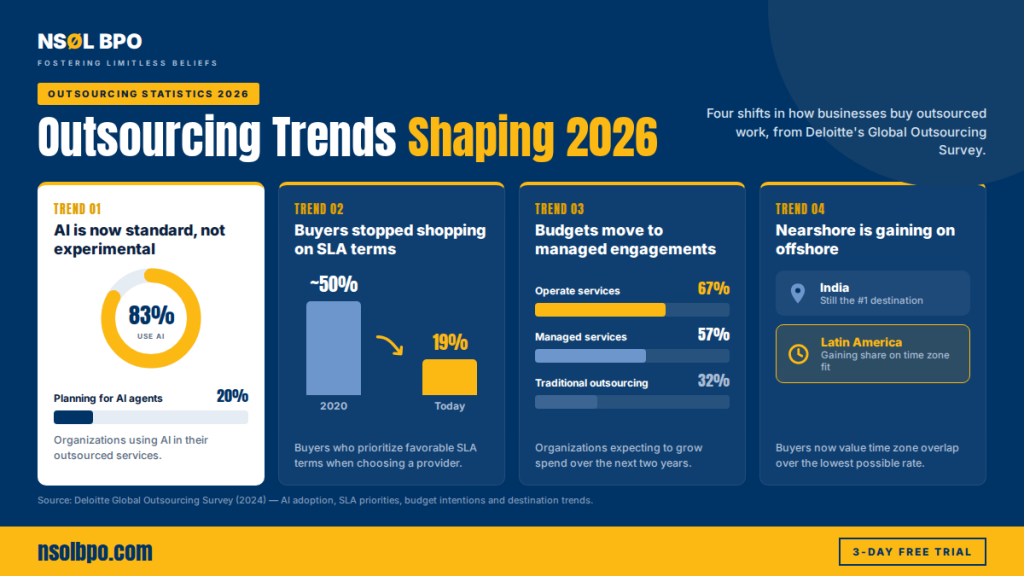
AI is now standard, not experimental. Deloitte’s 2024 survey found 83% of organizations are using AI as part of their outsourced services. A year or two ago, that was a pilot program. Now it’s the baseline expectation, and 20% of respondents are already building strategies to manage AI agents as part of their workforce planning.
Buyers stopped shopping on contract terms. Only 19% of buyers now prioritize favorable SLA terms when picking a provider, down from roughly 50% in 2020. That’s a big drop in a short window, and it tells you the market learned something: a tight SLA on paper doesn’t produce good service. Process, quality assurance, and honest reporting do.
Money is moving toward managed engagements. Deloitte found 67% of organizations expect to grow their budget for operations services over the next two years and 57% for managed services, while only 32% expect to increase traditional outsourcing spend. Businesses want someone who owns the outcome, not a supplier who fills seats.
Nearshore outsourcing is also gaining on offshore. India is still the leading destination, but Latin America keeps picking up share, mostly because buyers want time zone overlap more than they want the absolute lowest rate.
What these outsourcing statistics mean for your business
Put the outsourcing statistics together, and a few things become obvious.
The cost gap is wider than the salary gap. Comparing an outsourced rate to a $44,770 salary is the wrong comparison. The right one is roughly $64,000 once benefits are loaded, and that still excludes recruitment, equipment, and turnover. Most businesses underestimate the in-house side by about a third.
Talent shortage is doing more of the work than cost savings. Half of the executives Deloitte surveyed named talent acquisition as a top internal challenge, and 56% said their organization lacks adequate retention mechanisms. Outsourcing isn’t only cheaper. For a lot of companies, it’s the only way to staff a role at all.
None of this makes outsourcing automatically right for you. If your support volume is sporadic and project-shaped, a freelancer is still the better economic fit. If your product needs deep institutional knowledge and judgment calls, keep that in-house. But if your volume is steady, structured, and growing faster than your ability to hire, the data points one direction.
We wrote a fuller comparison of the options in virtual assistant vs. full-time employee, and if customer support specifically is where you’re feeling the pressure, our guide to hiring a customer service virtual assistant covers what to ask a provider before you sign anything.
Frequently asked questions
How much does outsourcing customer service cost compared to hiring in-house?
A US customer service representative earns a median $44,770 a year according to BLS data, and benefits add around 30% on top of wages, putting true employer cost near $64,000. Outsourced customer service typically runs $8 to $50 an hour depending on whether the team is offshore, nearshore, or US-based.
Is outsourcing still growing in 2026?
Yes. Grand View Research forecasts the global BPO market reaching $695.77 billion by 2033 at a 9.9% compound annual growth rate, with the US market hitting $139.32 billion by 2030.
What is the most commonly outsourced business function?
IT, outsourced by 76% of the organizations Deloitte surveyed. Within BPO specifically, customer service is the largest segment at over 30% of the US market.
How quickly do customers expect a reply?
HubSpot Research found 90% of customers consider an immediate response essential or very important, and 60% define immediate as ten minutes or less.
Are companies moving away from offshore outsourcing?
Not away from it, but increasingly alongside it. Deloitte reports India remains the leading destination while Latin America and other nearshore markets gain ground, largely because buyers value time zone overlap.
What percentage of companies use AI in outsourcing?
83%, according to Deloitte’s 2024 Global Outsourcing Survey of more than 500 business and technology leaders.
Where do reliable outsourcing statistics come from?
Primary sources, not blog roundups. The most dependable outsourcing statistics come from the US Bureau of Labor Statistics for wage and employment data, Deloitte’s Global Outsourcing Survey for buyer behavior, and firms like Grand View Research for market sizing. Every figure on this page links back to one of those.
Where NSOL BPO sits in this picture
We have been building outsourced teams since 2014. Over that time, NSOL BPO has worked with more than 29,000 clients across the US, UK, UAE, and beyond, with a team of over 350 people behind the service. Operating as Niku Solutions PTE LTD out of Singapore, we run dedicated customer service, back office outsourcing, e-commerce, and lead generation support for businesses that have outgrown what their in-house team can cover.
That history is why the Deloitte finding on managed engagements reads as familiar rather than surprising. The businesses that get the most out of outsourcing are not the ones chasing the lowest hourly rate. They are the ones who want documented processes, cover when someone is out, and reporting they can actually check against a target.
If you want the practical version of that rather than the market-level view, our guide to virtual assistant services sets out what each role covers day to day.
Test the numbers against your own workload
Outsourcing statistics describe a market. They don’t tell you whether outsourcing fits your business, your ticket volume or your margins.
We run a three-day free trial on dedicated customer service and admin virtual assistants, so you can put a real person on your real queue before committing to anything. Book a free consultation, and we’ll look at your numbers with you.
Sources for these outsourcing statistics
US Bureau of Labor Statistics. Employer Costs for Employee Compensation, June 2026. Source for the 30% benefits load and the $46.89 hourly total compensation figure.
US Bureau of Labor Statistics. Customer service representative pay and job outlook. Source for the $44,770 median salary, $21.53 hourly wage, and the projected 5% decline.
US Bureau of Labor Statistics. administrative assistant pay and employment data. Source for the $48,310 median salary and the loss of 75,300 positions through 2035.
Deloitte. Global Outsourcing Survey of 500+ business leaders. Source for every buyer-behavior figure, including the 52% outsourcing rate and 83% AI adoption.
Grand View Research. Global business process outsourcing market forecast. Source for the $695.77 billion by 2033 projection and the 9.9% CAGR.
Grand View Research. US BPO market size and segment analysis. Source for the $139.32 billion US forecast and the 30% customer service share.
Help Scout. Customer service statistics from HubSpot, Salesforce, and Zendesk. Aggregates the response-time and churn figures cited in the customer experience section.
Conclusion
Take away the noise and the outsourcing statistics for 2026 tell a fairly simple story. The market is growing close to 10% a year. A US support hire costs you about $64,000 once benefits are added, not the $44,770 you see on the job ad. And customers now expect a reply within ten minutes, which few small teams can keep up with after hours or on weekends.
The outsourcing trends point in the same direction. Buyers care less about what the contract promises and more about who owns the result. Offshore outsourcing is still where most of the volume goes. Nearshore outsourcing is winning on time zone overlap. Back office outsourcing is often the easiest place to start, because the work is repeatable and simple to measure.
None of this means you should outsource tomorrow. It means you should run your own numbers before you post another job ad. Add up what one hire really costs you, including the hours you’ll spend training and managing that person. Then compare it with a dedicated assistant who already knows the work.
If you’d like a second pair of eyes on the math, we’re happy to help. Book a free consultation and we’ll go through your workload with you. Or put a dedicated virtual assistant on your queue for three days, free, and see whether the numbers hold up for your business.