

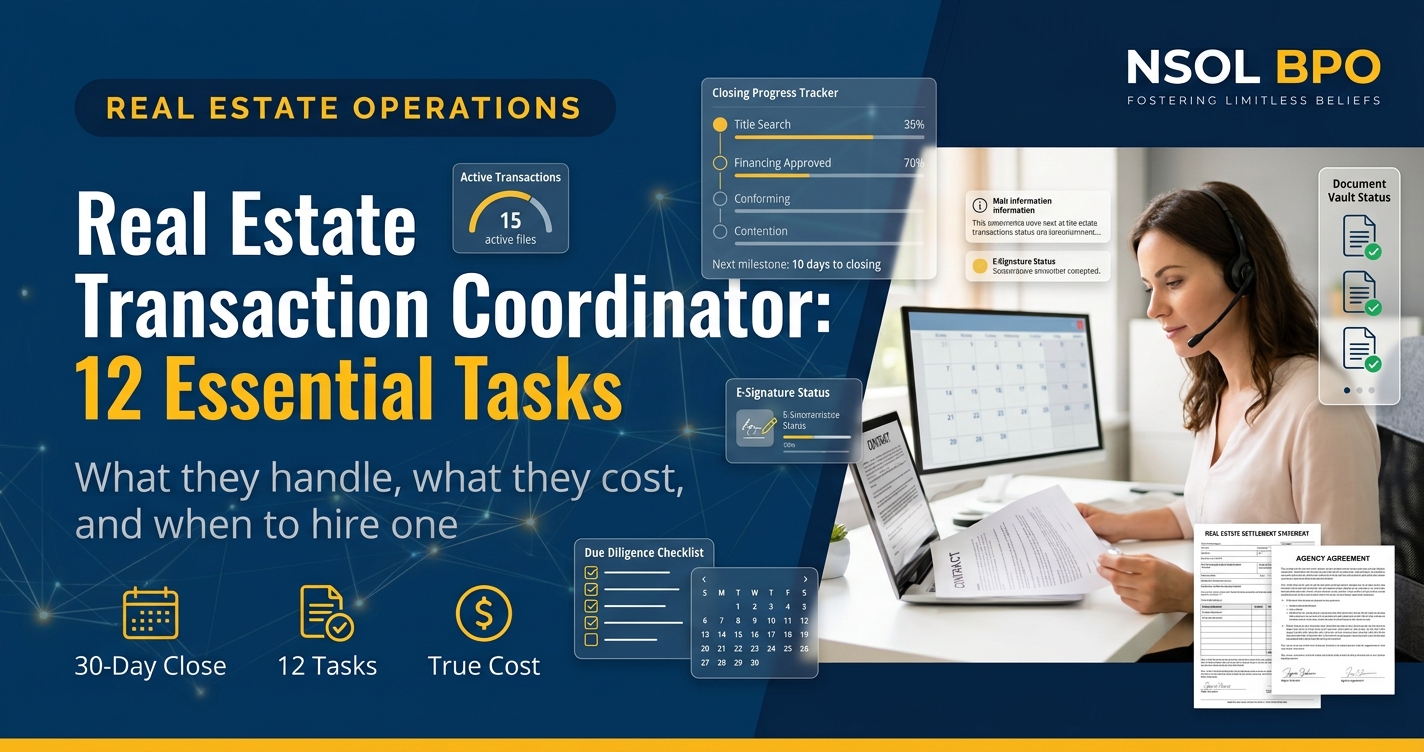
You got the contract signed. Congratulations. Now comes the part nobody posts about on Instagram: thirty days of deadlines, disclosures, lender emails, and a title company that won’t pick up the phone.
That’s the stretch where a real estate transaction coordinator earns their keep.
Most agents don’t hire one until something goes wrong. A missed inspection deadline. An earnest money deposit nobody confirmed. A closing that slips two weeks because one form was never countersigned. It’s rarely dramatic. It’s just small things, piling up, while you’re out showing houses.
Here’s the number that should get your attention. In NAR’s December 2025 Realtors Confidence Index, 14% of contracts had a delayed settlement and another 5% were terminated outright. Roughly one in five files hit trouble between contract and close. Some of that is financing. Some of it is appraisal. And some of it is simply nobody watching the calendar.
This guide covers what the role actually does, what it costs, and how to tell a good provider from a bad one.
What Does a Transaction Coordinator Do?
A real estate transaction coordinator, TC for short, takes a signed contract and drives it to the closing table.
They don’t sell. They don’t negotiate. They don’t advise your client on price. What they do is track, chase, and confirm, which sounds unglamorous right up until the day it saves a deal.
It helps to be precise about the boundary, because agents blur it constantly. Your coordinator is not a junior agent in training. They’re an operations person who happens to work in real estate, and the best ones think like air traffic control.
Think of them as the project manager for the escrow period. Every contract has somewhere between fifteen and forty moving pieces depending on your state and your brokerage. Deadlines for inspection, appraisal, loan commitment, title review, walkthrough. Documents that need signatures from four parties in a specific order. A real estate transaction coordinator owns that whole calendar so you don’t have to hold it in your head at 11pm.
The role grew out of necessity. NAR counted 1,438,569 members in mid-2026, and the typical member now has 13 years of experience. Experienced agents figure out fast that the highest-value hour of their day is the one spent in front of a client, not inside a document portal. Hiring a real estate transaction coordinator is how most of them buy that hour back.
The 12 Tasks a Real Estate Transaction Coordinator Handles
Every brokerage runs slightly differently, so treat this as the core set rather than a rigid job description. A good real estate transaction coordinator will own most of these from day one.
1. Opening the file. Contract goes in, all parties get logged, and the transaction gets a home in your CRM or transaction management platform. Dotloop, SkySlope, Brokermint, whatever you use.
2. Building the deadline calendar. Every date in the contract becomes a calendar entry with a reminder set a few days ahead. This single task prevents most blown deadlines.
3. Introducing everyone. One email that puts the buyer, seller, both agents, the lender, the title officer, and the TC on the same thread. Simple, and surprisingly rare.
4. Chasing signatures. Addenda, disclosures, amendments. Someone has to keep asking until the document comes back complete, and it shouldn’t be you.
5. Confirming earnest money. Deposit received, receipt obtained, copy filed. You would not believe how often this falls through a crack.
6. Coordinating inspections. Scheduling, access, reports delivered, repair requests tracked through to resolution.
7. Tracking the appraisal. Ordered, scheduled, completed, delivered. NAR’s survey found appraisal issues behind 6% of delayed settlements, so this one is worth watching closely.
8. Following the loan. Weekly check-ins with the lender on conditions, underwriting status, and the clear-to-close. No surprises three days out.
9. Managing title and escrow. Title commitment ordered and reviewed, liens flagged early, payoff requests sent.
10. Compliance review. Every brokerage has a file checklist. A TC fills it as the deal goes, not in a panic the week after closing.
11. Scheduling the final walkthrough and closing. Times confirmed with all parties, utilities and keys sorted.
12. Closing out the file. Settlement statement filed, commission disbursement submitted, client follow-up scheduled, file archived.
Twelve tasks. None of them require a license. All of them require somebody to care about the details on a Tuesday afternoon when you’re at a listing appointment. That is the whole job of a real estate transaction coordinator, and it is harder to do well than the list makes it look.
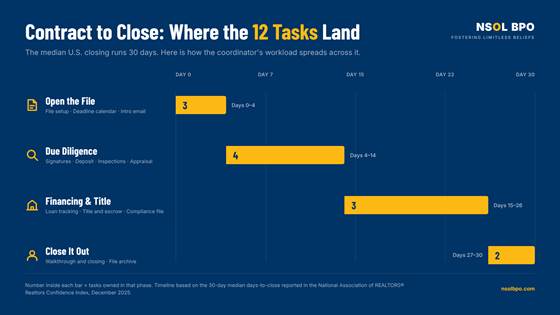
Where the 12 tasks fall across a median 30-day closing.
Transaction Coordinator Real Estate Math: What It Actually Costs
Here’s where most agents get the decision wrong, and it isn’t their fault. The numbers people quote when pricing a real estate transaction coordinator are the wrong numbers.
When someone asks about transaction coordinator real estate costs, they usually hear a wage. The Bureau of Labor Statistics puts the median pay for secretaries and administrative assistants at $48,310 a year, or $23.23 an hour, as of May 2025. That’s the figure that lands in most budget conversations.
It’s also incomplete.
Wages aren’t what an employee costs. BLS tracks that separately: as of June 2026, total employer compensation for civilian workers ran $49.46 per hour worked, split into $33.85 in wages and $15.61 in benefits. Benefits are roughly 31.6% of the total. Apply that to a $48,310 salary and a full-time in-house coordinator actually costs you about $70,600 a year, before you’ve bought a laptop or paid for software seats.
Now put that against your own time. The typical REALTOR earned $59,200 in gross income in 2025 and worked 35 hours a week, which works out to about $32.53 an hour.
Look at those two numbers side by side:
- Your own hour: $32.53
- An in-house coordinator’s hour, fully loaded: $33.96
- The wage people quote: $23.23
A full-time in-house hire costs more per hour than your own time is worth. That’s the part nobody mentions.
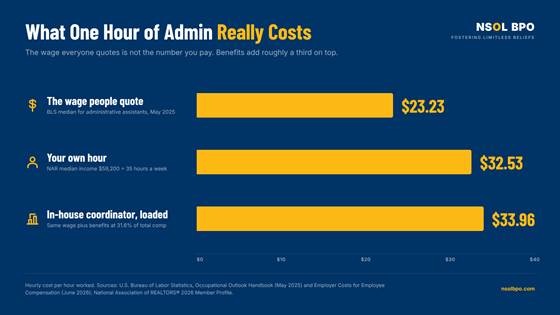
The quoted wage, the loaded cost, and what your own hour is worth.
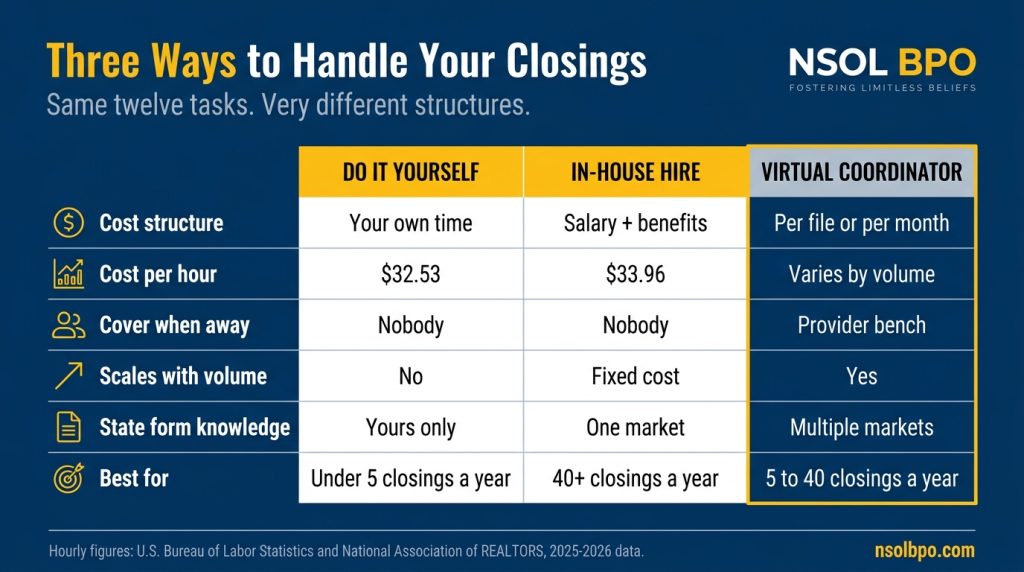
So does that mean coordination isn’t worth paying for? No. It means full-time, in-house, salaried is the wrong structure for an agent closing nine sides a year. The work is real, but it isn’t forty hours a week of work.
Why a Virtual Transaction Coordinator Changes the Numbers
A virtual transaction coordinator breaks the cost into something that matches your actual volume.
This is the structure most growing agents land on eventually, and it’s worth understanding why before you sign anything.
Instead of carrying a salary through your slow months, you’re paying for coverage on the files you have. Three closings in March, one in April, you pay accordingly. The fixed cost disappears, and so do payroll taxes, benefits, equipment, and the awkward conversation when business dips.
There’s a second advantage people underrate: coverage. A solo in-house coordinator takes vacations and gets sick, usually at the worst possible moment. A provider has a bench. Somebody picks up the file.
And a third: pattern recognition. A real estate transaction coordinator handling fifty files a month across several agents has seen more title problems than one handling nine a year. That experience shows up as earlier warnings.
If you want the broader comparison, we’ve broken down the full tradeoff in virtual assistant vs full-time employee, and the hourly ranges in our virtual assistant cost guide.
What to Look for in Real Estate Transaction Coordinator Services
Not every provider is equal, and the pitch decks all sound the same. These are the questions that separate them.
Do they know your state? Real estate contracts are state law. A coordinator fluent in Texas forms is starting from scratch in New York. Ask directly which states they’ve worked, and how recently.
Which platform do they work in? If your brokerage runs SkySlope and they’ve only touched Dotloop, that’s a learning curve you’re paying for. Good real estate transaction coordinator services will name their platforms without hedging.
What’s the response time, in writing? “We’re responsive” means nothing. Ask for a number. Four business hours is reasonable. Anything vaguer than that is a red flag.
Who covers when your coordinator is out? If the answer is a pause, you’ve found a single point of failure.
How do they communicate with your clients? Some agents want the TC emailing clients directly. Others want every message routed through them. Both work. What doesn’t work is finding out the preference after closing day.
Can they show you a file checklist? A real provider has a documented process. If they can’t produce one in five minutes, they’re improvising, and you’ll be the one who notices.
Ask these six and you’ll learn more than any sales call will tell you. We go deeper on vetting in our guide to choosing a virtual assistant provider.
When You Should Hire One, and When You Shouldn’t
Timing matters more than most agents think. Bring on a real estate transaction coordinator too early and you’ll pay for capacity you can’t use. Too late and you’ve already lost a deal to a missed date.
Hire when the pattern shows up.
You’re turning down listing appointments because you’re buried in paperwork. You’ve missed a deadline in the last six months, or come close enough that it scared you. You’re closing more than a dozen sides a year and the admin load scales with every one. Your evenings have become document-chasing time. Those are the signals.
Don’t hire yet if you’re in your first year with two or three closings behind you. At that volume you should be learning the contract yourself, end to end. You can’t supervise what you’ve never done, and a coordinator working for an agent who doesn’t know the process is a liability rather than a safeguard.
Also hold off if your real bottleneck is lead generation. A coordinator won’t fill an empty pipeline. If the problem is “not enough deals” rather than “too much admin,” spend the money on marketing support instead. Our breakdown of tasks realtors should outsource separates those two problems clearly, and our list of reasons to hire a real estate virtual assistant covers the wider role.
How to Onboard Yours in the First 30 Days
Most coordinator relationships that fail do so in week two, and the cause is almost always the same: nobody wrote anything down.
Give your real estate transaction coordinator a real ramp and the relationship holds. Here’s the schedule that works.
Week one. Share your contract templates, your brokerage’s compliance checklist, and three closed files as reference. Grant platform access. Agree on where communication lives, whether that’s email, Slack, or the transaction platform itself. Pick one and stay there.
Week two. Run one live file together. You stay in every thread, watching rather than doing. Correct the small stuff immediately.
Week three. Hand over two files completely. Check in daily, but let them drive. Resist the urge to reply to the lender yourself.
Week four. Review what broke. Something will. Write the fix into the checklist so it doesn’t break twice.
After thirty days you’ll know whether the fit is right. Trust that read. An experienced real estate transaction coordinator should be reducing your mental load by week four, not adding to it.
If your coordinator will also touch listings, MLS entry, and marketing, our post on virtual assistants for real estate agents covers how those roles stack. For investors and property managers the workflow differs again, which we cover in property management virtual assistant services. Agents working a single state market may also want our Florida real estate virtual assistant guide.
FAQ Block
Add these with the RankMath FAQ Schema block, not as plain headings. Six questions, each answered in one short paragraph so Google can pull them as a rich result.
What does a real estate transaction coordinator cost?
It depends on structure. A full-time in-house hire runs well past the salary figure: BLS puts median administrative pay at $48,310 a year, and with benefits at roughly 31.6% of total compensation, the real cost lands near $70,600. Virtual and per-file arrangements cost less because you only pay for the files you actually have.
Does a real estate transaction coordinator need a license?
In most states, no, as long as they stick to administrative work. The line is advice. Coordinating documents and deadlines is administrative. Telling a client what to offer is not. Licensing rules vary by state, so confirm with your broker before you delegate anything that touches negotiation.
What’s the difference between a real estate transaction coordinator and a real estate assistant?
A coordinator owns the escrow period: contract to close, compliance, deadlines. A real estate assistant covers a wider surface, including listings, marketing, CRM upkeep, and client follow-up. Plenty of agents use both, and some providers combine the two into one role.
How many files can one real estate transaction coordinator manage?
A full-time coordinator typically carries 25 to 40 active files, depending on how complex your market’s contracts are and how much client communication sits with them. Ask any provider for their current per-coordinator load before you sign.
Can a virtual transaction coordinator work in my state’s forms?
Yes, provided they’ve worked that state before. Contract forms and disclosure requirements are state-specific, so this is the first thing to verify. Ask which states they’ve handled in the last twelve months, not ever.
How long does a real estate closing take?
NAR’s December 2025 Realtors Confidence Index reported a median of 30 days to close. In the same survey, 14% of contracts had a delayed settlement and 5% were terminated, which is why deadline tracking matters as much as it does.
The Bottom Line
The case for a real estate transaction coordinator isn’t really about cost. It’s about where your hours go.
NAR’s data says the typical agent works 35 hours a week and closes nine sides a year. Those hours are the whole business. Spend them on contracts in a portal and your pipeline goes quiet. Spend them in front of clients and it doesn’t.
One in five contracts hits a delay or dies. Not all of those are preventable. A fair number are, and a real estate transaction coordinator is the cheapest insurance against the ones that are.
If you’re closing more than a dozen sides a year and you’ve felt that deadline panic even once, the role pays for itself. Start with one file, one coordinator, and thirty days. You’ll know quickly.
NSOL BPO places trained real estate coordinators who work inside your platform and your state’s forms. If you want to talk through whether the volume makes sense for your business, get in touch and we’ll be straight with you about it.