
The online market is bigger and more demanding than ever. Here is why a skilled e-commerce virtual assistant has become essential not optional- for growing stores.
Running an Online Store Has Never Been This Demanding
E-commerce of 2026 bears no resemblance to how it was just a few years ago and for the operators of these online shops, it is a blessing and a problem that has only gotten bigger. Global e-commerce sales are set to hit a stunning $7.41 trillion this year, up 8% from last year, thanks to 2.86 billion buyers, almost a third of the world’s population eMarketer/Statista). The opportunity is enormous. So is the workload which is exactly why a skilled e-commerce virtual assistant has quietly become one of the smartest hires an online store can make.
From managing products, inventories, and prices; handling customer orders and returns; interacting with suppliers and reviewing, to marketing and replying to customer emails round-the-clock, there is just no end to the list of things to do. For a solo founder or a startup team, it is impossible to focus on the growth areas of the business when there is no end to the list of things to be done.
This is where the role of an e-commerce virtual assistant comes into the picture. Rather than getting bogged down by operational tasks or making an expensive full-time hire, e-commerce business owners can bring on a dedicated remote professional to manage it all for them. In this guide, we will cover what an e-commerce virtual assistant is, why one is essential in 2026, what they cost, and how to bring one on without the risk.
What Is an E-Commerce Virtual Assistant?
Quick answer: The e-commerce virtual assistant is a professional who operates the business of running the day-to-day activities of the online store such as the product listing, order and inventory management, customer support and handling returns. The e-commerce virtual assistant is accessed via a managed service where you will be given a ready-made expert who is fully trained.
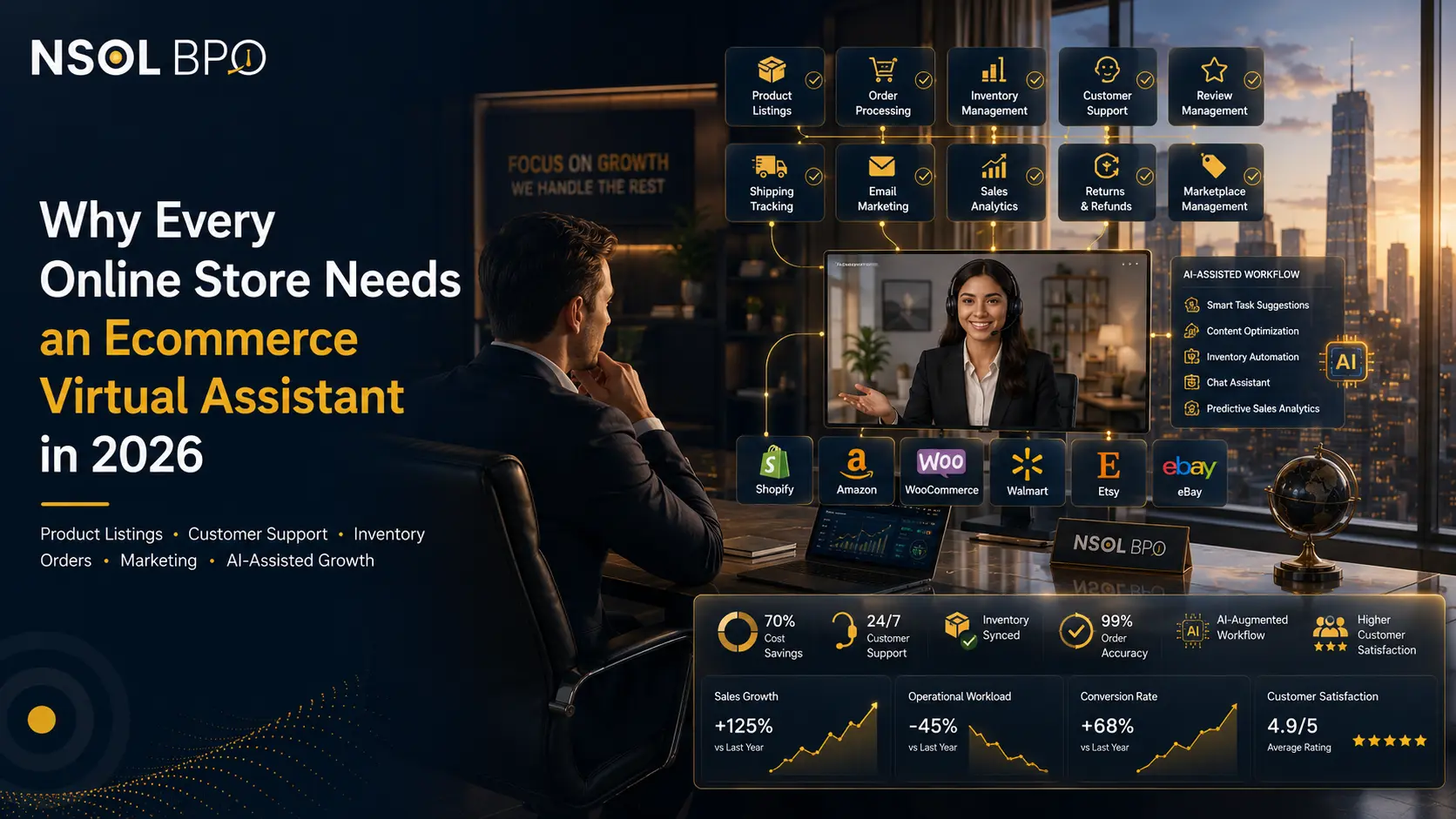
An e-commerce virtual assistant (or “ecommerce VA”) is a virtual assistant who knows how to sell through online platforms like Shopify, Amazon, eBay, WooCommerce, Etsy, and Walmart. An e-commerce virtual assistant knows how to handle tasks such as writing sales copy for a product listing, managing a marketplace account, handling a returns dispute, and keeping inventory synchronized across channels.
As opposed to working with an arbitrary freelancer, using a managed service like NSOL BPO ensures that your assistant has a team supporting them: a screening process, training on your tools, quality control, data security, and backup coverage.
It is important to understand what an e-commerce virtual assistant is not. They will never replace your business acumen, your brand identity, or your relationships with suppliers all of that stays with you. And they are not a plug-and-play robot: the most productive approach is to hand off clearly defined tasks and processes for an experienced professional to run and improve. Think of an e-commerce virtual assistant as the operational engine running the store you designed.
What Does an E-Commerce Virtual Assistant Do?
An e-commerce virtual assistant can own almost every operational task that keeps a store running. Providers typically group the work like this.
| Function | Typical Tasks |
|---|---|
| Product & catalog management | Creation and optimization of product listings; optimization of titles, descriptions, and images; categorization and variations; price and inventory management. |
| Order processing & fulfillment | Order processing and management; receiving order updates; supplier coordination; 3PL coordination; shipping issues and delays. |
| Customer service | Answering pre-sale inquiries; live chat, email, and marketplace messages; order status; post-purchase support. |
| Returns & refunds | Managing returns, replacements, refunds, and disputes on the marketplace. |
| Inventory management | Inventory management; low inventory alerts; quantity updates and synchronization for sales channels. |
| Marketing support | Social Media Scheduling; Setup of Email Campaigns; Promotion Updates; Graphic Design (Basic); Customer Review Collection & Analysis. |
| Reporting & research | Sales reports and inventory tracking; competitor and product research; trending products. |
Modern ecommerce virtual assistants increasingly work AI-augmented, using tools like ChatGPT for listing copy, automation platforms for order and inventory syncing, and AI chat drafting for faster support, while a human reviews and owns the outcome. (More on that in our guide to AI-augmented virtual assistants.)
Why Every Online Store Needs One in 2026
The case is not “nice to have.” Five forces make an e-commerce VA close to essential this year.
1. Customers now expect instant, always-on service
No more patience from customers. 76% of consumers are looking to speak to an individual right away upon contacting the company, while 42% are expecting the answer via live chat in less than five seconds (eDesk, LiveChat). It is clear that there are obvious benefits to meeting such expectations; companies answering the questions via live chat in under a minute have conversion rates 15% higher than those answering in five minutes, with live chat improving e-commerce conversion rates up to 45%. For many stores, this is the point where dedicated e-commerce customer service outsourcing stops being optional.
2. Cart abandonment is bleeding revenue
On average, an online shop loses the majority of its sales opportunities during checkout, with cart abandonment rates as high as 70% (85.6% on mobile). Each year, $4 trillion worth of goods is left behind in shopping carts. One key, fixable reason: 54% of customers abandon a cart when their questions aren’t answered right away. An ecommerce VA answers pre-sale questions in real time, runs abandoned-cart recovery (which recovers up to 10% of lost sales), and removes checkout friction directly protecting sales that would otherwise vanish.
3. Multi-channel selling is too complex to run solo
Successful retailers are everywhere at once on their own Shopify or WooCommerce site and on Amazon, eBay, Walmart, and Etsy. Every sales channel has its own listing guidelines, fees, messaging tools, and performance metrics. Managing all of that across channels is a full-time effort on its own. An e-commerce virtual assistant is expert at exactly this logistical complexity, so an expanding product line doesn’t turn into an expanding problem.
4. Your time is the real bottleneck
Every hour spent updating a spreadsheet or answering “where is my order?” is an hour not spent on sourcing, margins, partnerships, and growth. E-commerce is expanding at nearly 8% a year toward $8 trillion by 2027 — capturing your share requires focus on strategy, not busywork. Delegating operations to a VA is how founders reclaim the time that actually compounds.
5. Peak seasons punish stores without support
Black Friday, holiday rushes, and viral product moments create sudden order and inquiry spikes that overwhelm an unsupported store. Missed messages, delayed shipments, and stockouts during these windows cost the most both in lost revenue and in reviews. With a managed provider, you can scale support up for the peak and back down afterward, capturing the surge instead of buckling under it. That elasticity is something a single in-house hire simply cannot provide.
In short: In a market this large, this fast, and this demanding, an online store that runs on the owner’s personal bandwidth will stall. An e-commerce virtual assistant removes that ceiling.
How Much Does an E-Commerce Virtual Assistant Cost?
The economics are why e-commerce virtual assistants are so widely adopted. Offshore virtual assistants are priced at $5–$17 per hour, while those based in the USA run $19–$45 per hour, with most firms saving 30–70% compared with hiring in-house (Berry Virtual, Hire Overseas).
| Option | Typical Monthly Cost | Best For |
|---|---|---|
| Offshore part-time ecommerce VA | $800 – $1,200 | Newer or single-channel stores |
| Dedicated offshore full-time VA (160 hrs) | $1,988 – $3,000 | Growing, multi-channel stores |
| US-based full-time VA | $4,000 – $8,000 | Same work, higher rate |
| In-house ecommerce hire (US) | $3,500 – $5,000+ | Plus benefits, taxes, equipment |
Taking into account the losses that a shop suffers because of delayed support and abandoned carts, it becomes clear that any money invested in the assistance pays off several times. This is perhaps one of the most effective investments in a web-shop’s employees. (For a full breakdown, see our guide on how much a virtual assistant costs.)
E-Commerce Virtual Assistant Support by Platform
A good e-commerce virtual assistant adjusts to wherever your products are being sold.
| Platform | Where a VA Adds the Most Value |
|---|---|
| Shopify / WooCommerce | Store setup and theme tweaks, product uploads, app and order management, customer service, and abandoned-cart recovery. |
| Amazon | Product listing and A+ content, inventory and FBA management, review and feedback handling, and cases and claims. |
| eBay & Walmart | Product listings, repricing, order fulfillment, messaging, and dispute resolution. |
| Etsy | Product listing SEO, shop updates, order processing, and buyer communication. |
How NSOL BPO Delivers E-commerce Virtual Assistants
The value of an e-commerce Virtual Assistant depends entirely on how well the provider recruits, trains, and manages them. Like any strong managed BPO virtual assistant service, NSOL BPO is built for that reliability:
- Platform-trained talent: assistants experienced with Shopify, Amazon, WooCommerce, and other marketplaces trained on your store and tools before day one.
- Managed, not just placed: your processes never rely on one unmanaged freelancer; there is always a dedicated point of contact and management.
- Quality assurance: listing information, customer responses, and order processing are checked against required standards and your brand guidelines.
- Data privacy & account safety: clear rules protect customer data and your store and marketplace credentials.
- Coverage that fits your hours: support aligned to your customers’ time zones, including extended and US-hours coverage.
- AI-augmented efficiency: our VAs use vetted AI tools to move faster on listings, support, and reporting —with human review on everything.
The result: the cost advantage of offshore support with the reliability of a managed team, so you can hand off store operations with confidence.
Signs Your Store Is Ready for an Ecommerce Virtual Assistant
- You are replying to customer queries late at night and still can’t keep up.
- Product listings, inventory, or pricing updates keep slipping.
- You are expanding to a new marketplace but cannot keep up with the extra work.
- You are losing sales to abandoned carts and unanswered pre-sale questions.
- You are spending on operational hours that should go to sourcing, marketing, and strategy.
If two or more of these sound familiar, an e-commerce virtual assistant will likely pay for itself quickly.
Frequently Asked Questions
What is an e-commerce virtual assistant?
An e-commerce virtual assistant is a remote professional who manages the entire operation of your online store listing products, order processing and fulfillment, customer support, refunds, and marketing support so you can concentrate on growing your business.
What does an e-commerce virtual assistant do?
The job entails product and catalog management, order processing and fulfillment, customer support and live chat, refunds, inventory synchronization across channels, marketing support, and sales and product research.
Why does my online store need an e-commerce virtual assistant in 2026?
Because shoppers demand immediate customer service, average cart abandonment is about 70%, and multi-channel selling is very complex. An e-commerce virtual assistant delivers fast support, recovers lost sales, and runs operations so you can focus on growth.
How much does an e-commerce virtual assistant cost?
An offshore e-commerce VA generally costs $5–$17 per hour about $800–$1,200 monthly part-time and $1,988–$3,000 for a dedicated resource, roughly 30–70% cheaper than a US-based in-house hire.
Can an ecommerce virtual assistant manage my Amazon and Shopify stores?
Yes. An e-commerce virtual assistant is proficient across platforms including Shopify, Amazon, WooCommerce, eBay, Walmart, and Etsy, and can manage listings, orders, inventory, and customer service on each.
Will an e-commerce virtual assistant handle customer service?
Yes. An e-commerce Virtual assistant responds to pre-sale queries, live chats, emails, and marketplace messages, and manages returns and post-purchase support so your customers get the fast responses that drive conversions.
Is it safe to give a VA access to my store and customer data?
Yes, as long as you go with a legitimate, managed provider that guarantees confidentiality, secure processes, limited access, and monitoring of its virtual assistants.
How is an e-commerce VA different from a freelancer?
An e-commerce VA is hired and managed by a professional provider, unlike a freelancer whom you hire and manage personally.
How quickly can an e-commerce VA start helping my store?
Usually within the first week, since managed providers have vetted, platform-trained talent ready once your software and processes are shared.
Do e-commerce virtual assistants use AI tools?
Yes, more than ever. AI tools help with listing descriptions, order and inventory automation, and AI-assisted drafting to speed up customer service with a human in charge of the final result.
Can a VA help reduce my cart abandonment?
Yes. A VA can answer pre-sale questions, run abandoned-cart email outreach, and minimize checkout issues — the factors that cause cart abandonment most often.
How do I choose the right e-commerce VA provider?
Look for a provider with platform expertise, quality control and assurance, data and account security, time-zone coverage, and a dedicated point of contact not just the cheapest hourly rate.
The Bottom Line: Don’t Let Operations Cap Your Growth
There has never been a bigger opportunity in e-commerce than there is in 2026 but there has never been a greater operational burden to seize it, either. Stores that try to run everything on the owner’s personal availability hit a wall: slow responses, abandoned carts, listing errors, and no capacity to expand. An e-commerce virtual assistant removes that wall, delivering the fast service customers demand and freeing you to focus on strategy, sourcing, and scale.
NSOL BPO provides exactly that: vetted, platform-trained, AI-augmented e-commerce virtual assistants, backed by real management, quality assurance, and data protection so your store runs smoothly while you grow it.
Ready to take store operations off your plate?
Contact NSOL BPO today for a free consultation and see how an e-commerce virtual assistant can boost your sales, delight your customers, and give you your time back.
Get a Free ConsultationExternal Sources Cited
- Statista / eMarketer — global e-commerce sales ~$7.41 trillion in 2026 (+8% YoY); 2.86 billion online shoppers; approaching $8 trillion in 2027.
- Baymard Institute — average cart abandonment ~70% (85.6% on mobile); ~$4 trillion in goods abandoned annually.
- E-commerce customer-service research — eDesk, LiveChat, Nextiva — 76% expect immediate interaction; 42% expect a live-chat reply within 5 seconds; sub-1-minute replies convert 15% higher; live chat lifts conversions up to 45%; 54% abandon carts when questions aren’t answered instantly.
- 2025–2026 virtual assistant cost research — Berry Virtual, Hire Overseas, Wishup — offshore VA rates $5–$17/hr; US $19–$45/hr; 30–70% savings.
Conclusion: The Work Doesn’t Shrink. Your Team Has to Grow.
Here’s what most store owners figure out too late: the operational load doesn’t plateau once you hit a certain revenue. It grows with you. More orders mean more tickets. More SKUs mean more listings to fix. And every hour you spend on that is an hour you’re not spending on sourcing, margins, or the next channel.
An e-commerce virtual assistant doesn’t just clear your inbox; it buys back the part of the week where you actually think about the business. At $5–$17/hr against the $19–$45 you’d pay domestically, the math isn’t close. But cost is honestly the smaller half of it. The real return shows up when someone’s answering customers in under a minute instead of the next morning, and carts stop dying in silence.
If you’ve been putting this off because hiring feels like a project, start smaller. One e-commerce virtual assistant, one set of tasks you’re tired of doing, one month to see what it frees up. That’s usually all it takes to realise you should’ve done it sooner.