


Most business bookkeeping mistakes cost money. A trust account mistake can cost your license.
That’s the whole reason law firm bookkeeping is a specialist job rather than a general one. Your operating account behaves like any other company’s. Your trust account is governed by rules of professional conduct, and the people who audit it are not accountants. They are your state bar.
ABA Model Rule 1.15 on safekeeping property puts it plainly. A lawyer must hold client property “separate from the lawyer’s own property,” keep funds in a separate account in the state where the office sits, and preserve complete records of those funds for a defined period after the representation ends.
This guide covers the nine places law firm bookkeeping goes wrong, what the function costs to staff, and how to decide whether to keep it in-house.
Why Law Firm Bookkeeping Is Not Normal Bookkeeping
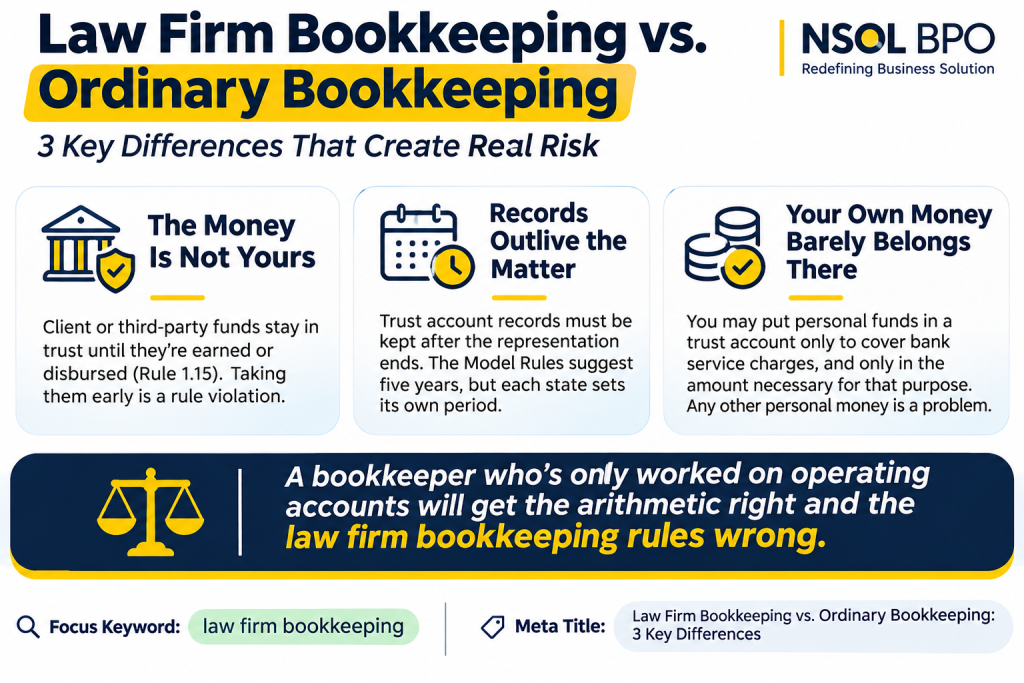
Three differences separate law firm bookkeeping from the ordinary kind, and all three create exposure a general bookkeeper won’t see coming.
The money is not yours. Funds in a trust account belong to clients or third parties until the moment they’re earned or disbursed. Rule 1.15 requires a lawyer to deposit advance fees and expenses into a client trust account “to be withdrawn by the lawyer only as fees are earned or expenses incurred.” Taking them early isn’t an accounting error. It’s a rule violation.
Records outlive the matter. Rule 1.15 requires complete records of trust funds to be preserved after the representation ends. The Model Rules set the period in brackets, which means each state fills in its own number. Five years is the figure in the model text. Check yours.
Your own money barely belongs there. A lawyer may put personal funds into a trust account only to cover bank service charges, and “only in an amount necessary for that purpose.” Any other personal money in that account is a problem, however small and however briefly it’s there.
A bookkeeper who’s only worked on operating accounts will get the arithmetic right and the law firm bookkeeping rules wrong.
The 9 Trust Account Traps
These are the law firm bookkeeping errors that turn into bar complaints. Work through them against your own books.
1. Taking fees before they are earned. An advance sits in trust until the work’s done. Moving it on the first of the month because cash is tight is the single most common serious violation.
2. Paying operating expenses from trust. Rent, payroll, a software renewal. Even when the firm’s owed more than the amount taken, the path matters. Earn it, move it, then spend it.
3. Leaving earned fees in trust. The opposite error, and still a violation. Once fees are earned they belong in the operating account. Leaving them in trust commingles your money with client money.
4. No client ledgers. An account balance isn’t enough. You need a running balance for every individual client. Without it you can’t prove no client’s funds were used for another.
5. Skipping three-way reconciliation. Bank statement, trust ledger, and the sum of all client ledgers must agree. Most firms reconcile the first two and never total the third.
6. Negative client balances. If one client’s ledger goes below zero, you’ve spent another client’s money. The overall account can look healthy while this is happening, which is exactly what makes it dangerous.
7. Disbursing against uncleared deposits. A deposited check that hasn’t cleared isn’t money you can pay out. If it bounces, the shortfall comes from other clients’ funds.
8. Ignoring unclaimed balances. Small residuals nobody collected. They don’t become yours by age. Most states have escheatment rules, and letting them sit is its own violation.
9. No documentation trail. Rule 1.15 requires a prompt full accounting on request. If you can’t produce one quickly, the records aren’t adequate regardless of whether the money’s correct.
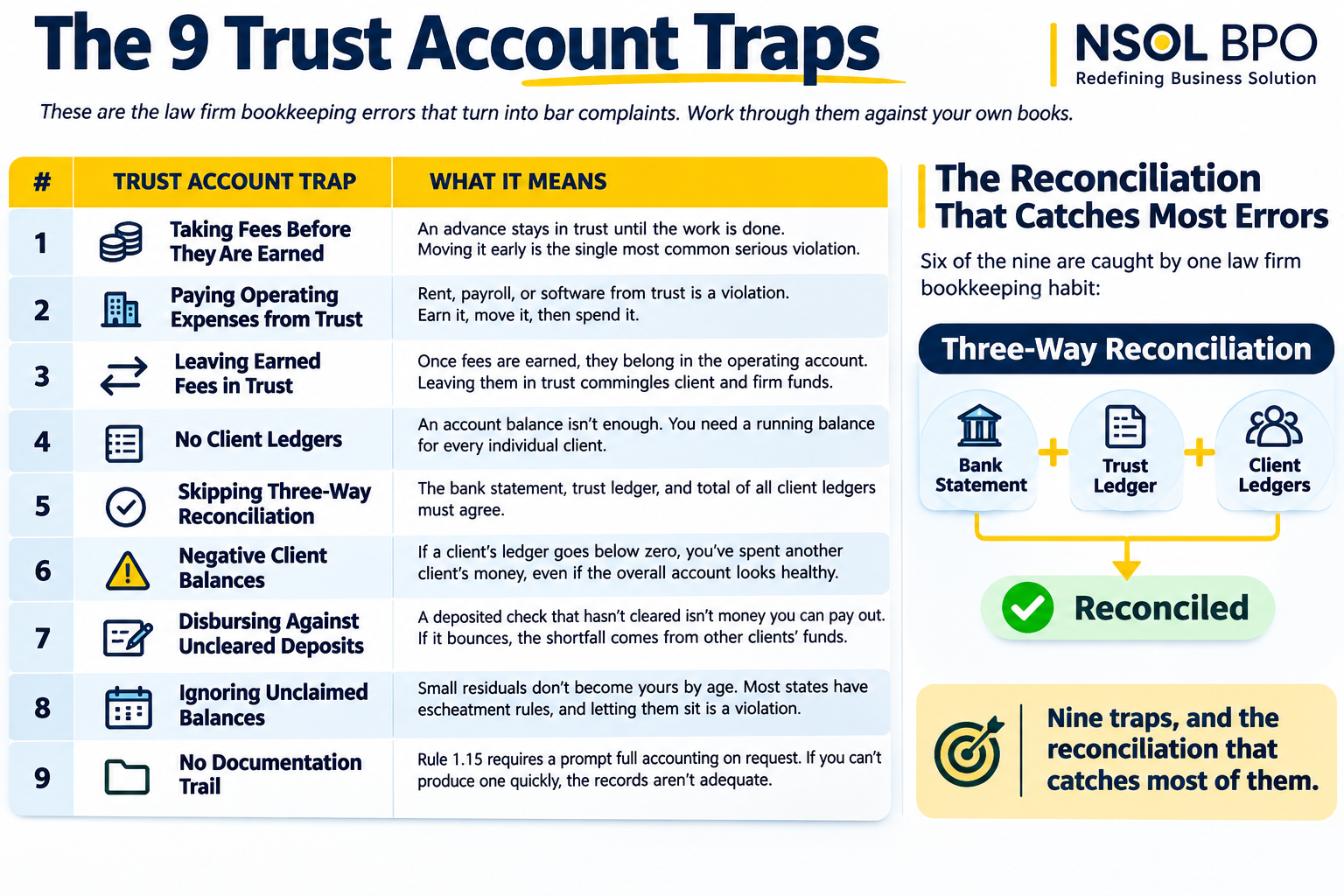
Nine traps, and the reconciliation that catches most of them.
Six of the nine are caught by one law firm bookkeeping habit: monthly three-way reconciliation, done properly, with client ledgers totaled.
IOLTA Reconciliation, Step by Step
IOLTA reconciliation is the law firm bookkeeping control that holds everything else together, and most firms do two thirds of it.
Three figures have to agree, every month:
- The bank statement balance, adjusted for outstanding items.
- The trust account ledger your accounting system shows.
- The total of every individual client ledger added together.
Firms reconcile the first two because that’s what accounting software does by default. The third is the one that catches a client balance drifting negative, and it’s the one skipped most often.
Do law firm bookkeeping reconciliation monthly, not quarterly. A discrepancy found four weeks after it happened is a correction. The same discrepancy found four months later is an investigation.
Keep the reconciliation itself. The reconciled report, signed and dated, is the evidence that the control existed. Most state bars will ask for the reports before they ask about the balances.
That distinction catches firms out. Having the right balance isn’t the same as being able to show you knew it was right. A firm with clean books and no reconciliation reports is in a worse position than a firm with a small historical error and twelve months of signed reconciliations behind it.
What Law Firm Accounting Services Cost
Firms pricing law firm accounting services compare against a salary, and a salary isn’t what an employee costs.
The Bureau of Labor Statistics puts the median wage for bookkeeping, accounting and auditing clerks at $50,670 a year, or $24.36 an hour. Then add benefits. As of June 2026, total employer compensation for civilian workers ran $49.46 per hour worked, split $33.85 in wages and $15.61 in benefits, so benefits are about 31.6% of the package. Apply that and an in-house bookkeeper costs roughly $74,080 a year, or $35.61 an hour.
Set that against your own hour at $76.76, the BLS median lawyer wage. A partner doing the monthly reconciliation personally is the most expensive bookkeeper in the state.
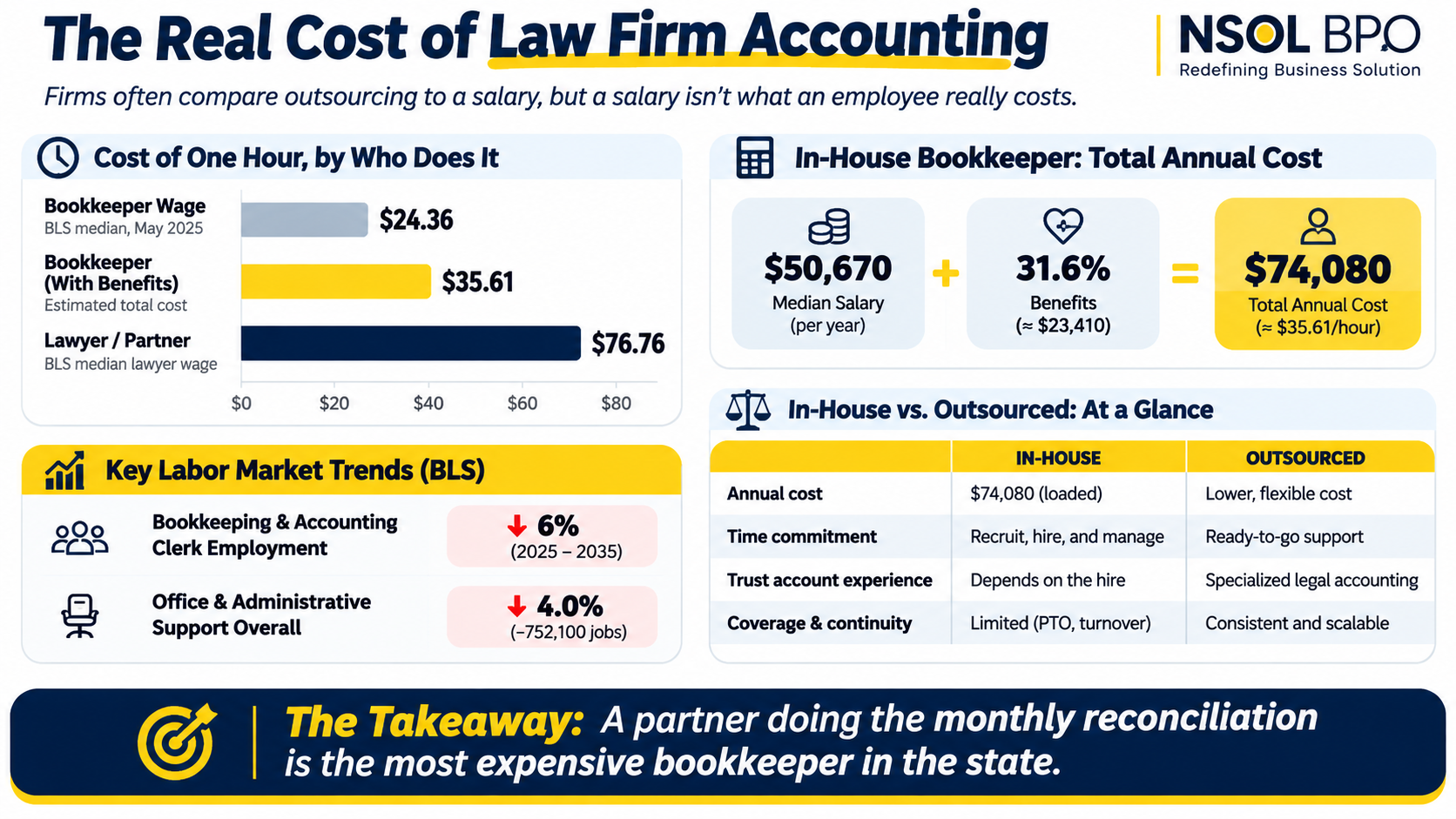
What an hour of reconciliation costs, depending on who does it.
There’s a supply problem underneath this too. BLS projects bookkeeping and accounting clerk employment to decline 6% between 2025 and 2035, and office and administrative support overall to fall 4.0% and shed 752,100 jobs over the same decade. Hiring locally for this role gets harder, not easier.
Our comparison of a virtual assistant versus a full-time employee runs the same tradeoff, and the virtual assistant cost guide has the broader hourly ranges.
In-House or Outsourced Legal Bookkeeping Services?
In-house legal bookkeeping makes less sense to do inside a law firm than most firms think. The explanation is specialization and not cost. Bookkeeping for law firms is a specialized function that requires repetition to perform better.
It should be kept in-house where your volume actually demands it, where you have someone who understands trust accounting, and where your cases are so complicated that specialization outweighs general knowledge.
It should be outsourced when the actual volume is ten hours instead of forty per month, where no one in the office has performed trust bookkeeping, or where the person doing it is a partner.
Volume is the test, not firm size. A three-attorney practice with heavy client fund movement can need more bookkeeping hours than a ten-attorney firm doing hourly corporate work with nothing in trust. Count the transactions, not the lawyers.
The last one is more common than firms admit. A partner handling reconciliation isn’t saving money. They’re spending a $76.76 hour on $35.61 work and doing it less accurately than someone who does it fifty times a month.
Whichever you choose, the supervision duty stays with you. ABA Model Rule 5.3 requires a lawyer with direct supervisory authority over a nonlawyer to “make reasonable efforts to ensure that the person’s conduct is compatible with the professional obligations of the lawyer.” Outsourcing the work never outsources the responsibility.
Our guide to legal process outsourcing covers how that supervision works in practice, and back office services covers the wider function.
Law Firm Financial Management Beyond Compliance
Compliance is the floor. Law firm bookkeeping that stops at compliance is doing half the job, and law firm financial management is what you do once the floor is solid.
Four numbers most small firms cannot produce on demand:
- Realization rate. What fraction of recorded time actually gets billed.
- Collection rate. What fraction of billed work actually gets paid.
- Work in progress. Time recorded but not yet invoiced, sitting as unbilled value.
- Aged receivables. What is owed, by whom, and for how long.
A firm that knows those four can tell whether a practice area is profitable. A firm that doesn’t is guessing, usually optimistically. Most firms discover more money in uncaptured time than in any client who refused to pay.
Our post on data entry support covers the capture side, and the law firm virtual assistant guide covers the invoicing and collections follow-up that sits alongside it.
What to Ask Any Provider
Five questions for anyone handling your law firm bookkeeping. By email, so the answers are in writing.
Have you handled IOLTA accounts before, and in which states? Trust rules are state-specific. A general bookkeeper who’s never touched one will learn on your account.
Do you perform three-way reconciliation monthly? If they describe two-way reconciliation, they’re describing normal bookkeeping.
Which systems do you work in? Clio, MyCase, Soluno, QuickBooks. If they’ve never touched yours, you’re paying for training.
What do you deliver each month, and when? Reconciliation reports, client ledger summaries, aged receivables. With dates.
What happens if you find a discrepancy? The answer should involve telling you immediately, not fixing it quietly.
We cover how NSOL structures legal support on our legal virtual assistant services page.
The Bottom Line
Law firm bookkeeping carries a risk ordinary bookkeeping does not. A reconciliation error in your operating account costs you money. The same error in trust costs you a conversation with the bar.
One law firm bookkeeping habit prevents six of the nine traps: monthly three-way reconciliation, with client ledgers totaled and the signed report kept.
If the person doing that reconciliation is a partner, the firm is paying $76.76 an hour for $35.61 work and getting a worse result. That’s the clearest case for moving your law firm bookkeeping somewhere else.
Wherever it ends up, the duty under Rule 5.3 stays with you. Supervision isn’t a formality here. Ask for the reconciliation report every month and read it, because the report existing and the report being correct are two different things.
None of this is legal or accounting advice, and trust rules vary by state. Check your own bar’s requirements, including the record retention period, before you change anything.
NSOL BPO handles legal bookkeeping for firms that would rather not have a partner reconciling at month end. If you want someone to look at your current process first, get in touch and we’ll be straight with you about whether it needs changing. Our full virtual assistant services cover the roles around it.
FAQ Block
What distinguishes law firm bookkeeping from regular bookkeeping?
The trust account. Client funds are not yours until earned or paid out and are therefore required to be kept separate from your personal assets, according to ABA Model Rule 1.15, and full documentation must be kept even after the work is done. The typical bookkeeper will do the math right but the compliance wrong.
What is three-way reconciliation?
Three numbers have to agree each month: the bank balance reconciled, the trust account general ledger within the accounting software, and the sum total of all individual client ledgers. Most companies do the first two, as that is how the accounting software works by default. The third ensures that a client account is not negative
How often should IOLTA reconciliation be done?
Monthly. A discrepancy found four weeks after it happened is a correction. The same discrepancy found four months later is an investigation. Keep the signed, dated reconciliation report, because most state bars ask for the reports before they ask about the balances.
Can we pay firm expenses from the trust account if the client owes us more?
No. Even where the firm is owed more than the amount taken, the path matters: fees must be earned, moved to the operating account, and only then spent. Paying operating expenses directly from trust is a rule violation regardless of the net position.
How costly are law firm accounting services?
Use the loaded cost rather than salary to compare. BLS reports that the median annual pay of bookkeeping and accounting clerks is $50,670. With the additional cost of benefits amounting to 31.6%, the cost of hiring an internal employee will be approximately $74,080 or $35.61 per hour. Outsourcing will cost less when the real number of hours of work per month is ten rather than forty.
Can it be ethical to outsource legal bookkeeping?
Usually yes provided that there is supervision involved. According to ABA Model Rule 5.3, a lawyer must make reasonable efforts to ensure that the conduct of a person who assists in the delivery of the lawyer’s services complies with the lawyer’s professional obligations.
Sources
Every figure in the post traces to one of these. All five are primary government sources, linked with descriptive anchor text.
- American Bar Association, Model Rule 1.15 on safekeeping property and client trust accounts
- American Bar Association, Model Rule 5.3 on responsibilities regarding nonlawyer assistance
- U.S. Bureau of Labor Statistics, median pay and job outlook for bookkeeping, accounting and auditing clerks
- U.S. Bureau of Labor Statistics, median pay for lawyers
- U.S. Bureau of Labor Statistics, employer costs for employee compensation