
A potential client calls your firm at 4:40 on a Friday. Nobody picks up. They leave a voicemail, then call the next firm on the list while they’re still in the parking lot.
You never knew that call happened.
That’s the problem intake has, and why legal intake services are a harder sell than they should be. The failures are invisible. A missed billing deadline shows up in your reports. A missed caller shows up nowhere, which is why firms spend thousands on marketing to generate calls and almost nothing on the system that catches them.
Legal intake services exist to close that gap. This guide covers the seven places intake leaks, what each one costs in attorney hours, and how to decide whether to staff it in-house or hand it over.
Why Intake Is a Revenue Function, Not an Admin One
Most firms file intake under admin. The economics say otherwise, which is why legal intake services get sold to marketing directors rather than office managers.
The Bureau of Labor Statistics puts the median wage for lawyers at $76.76 an hour. Every intake call an attorney handles personally costs the firm that rate, and most of those calls are not cases. They’re tire-kickers, wrong practice areas, and people who want free advice. Sorting them is necessary work. It isn’t attorney work.
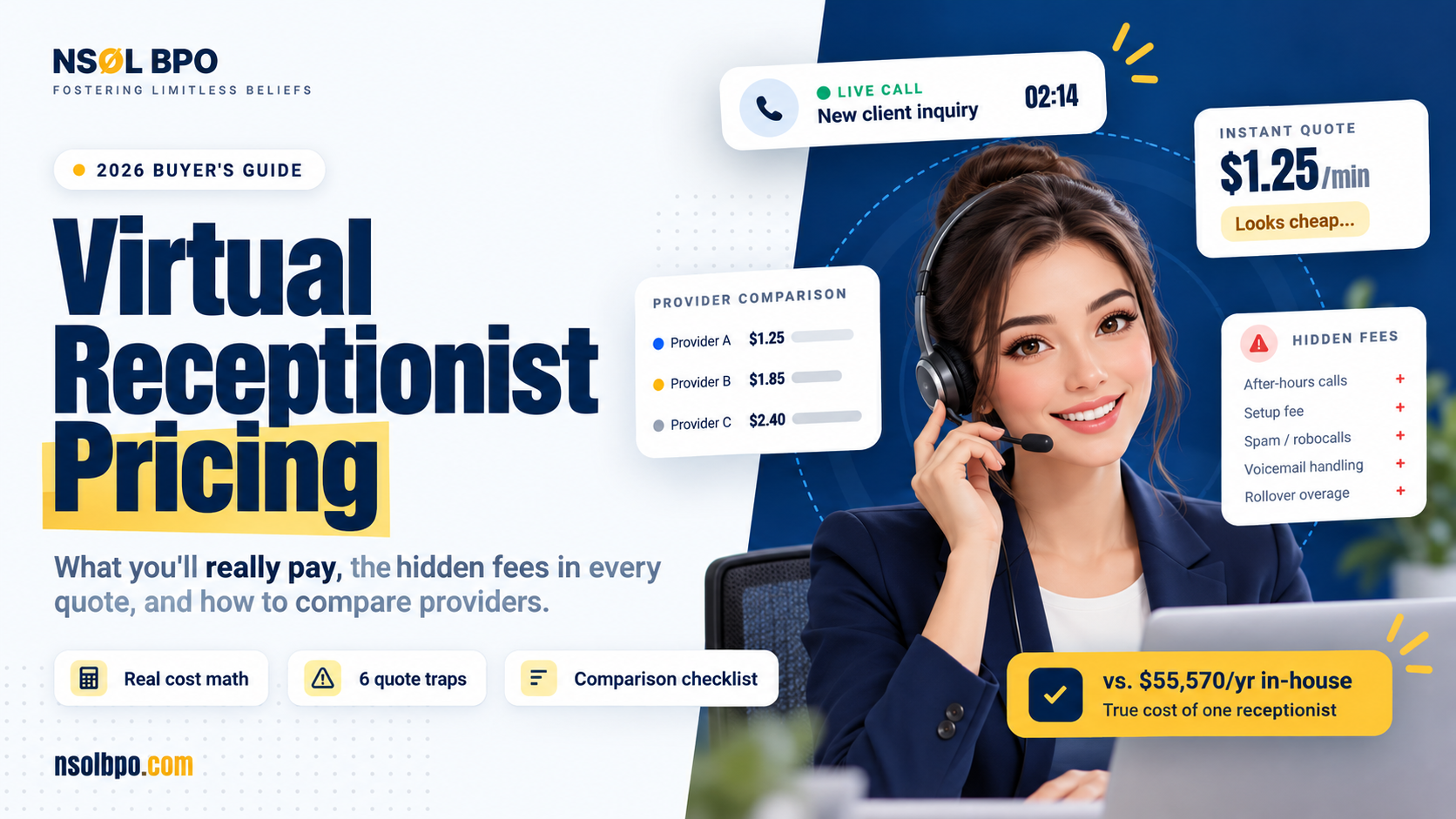
Compare that to what trained intake staff cost. BLS puts median receptionist pay at $38,010 a year, and with benefits running about 31.6% of total employer compensation, the loaded cost lands near $55,570, or $26.72 an hour.
An attorney taking intake calls costs roughly 2.9 times what a trained intake person costs to do it better.
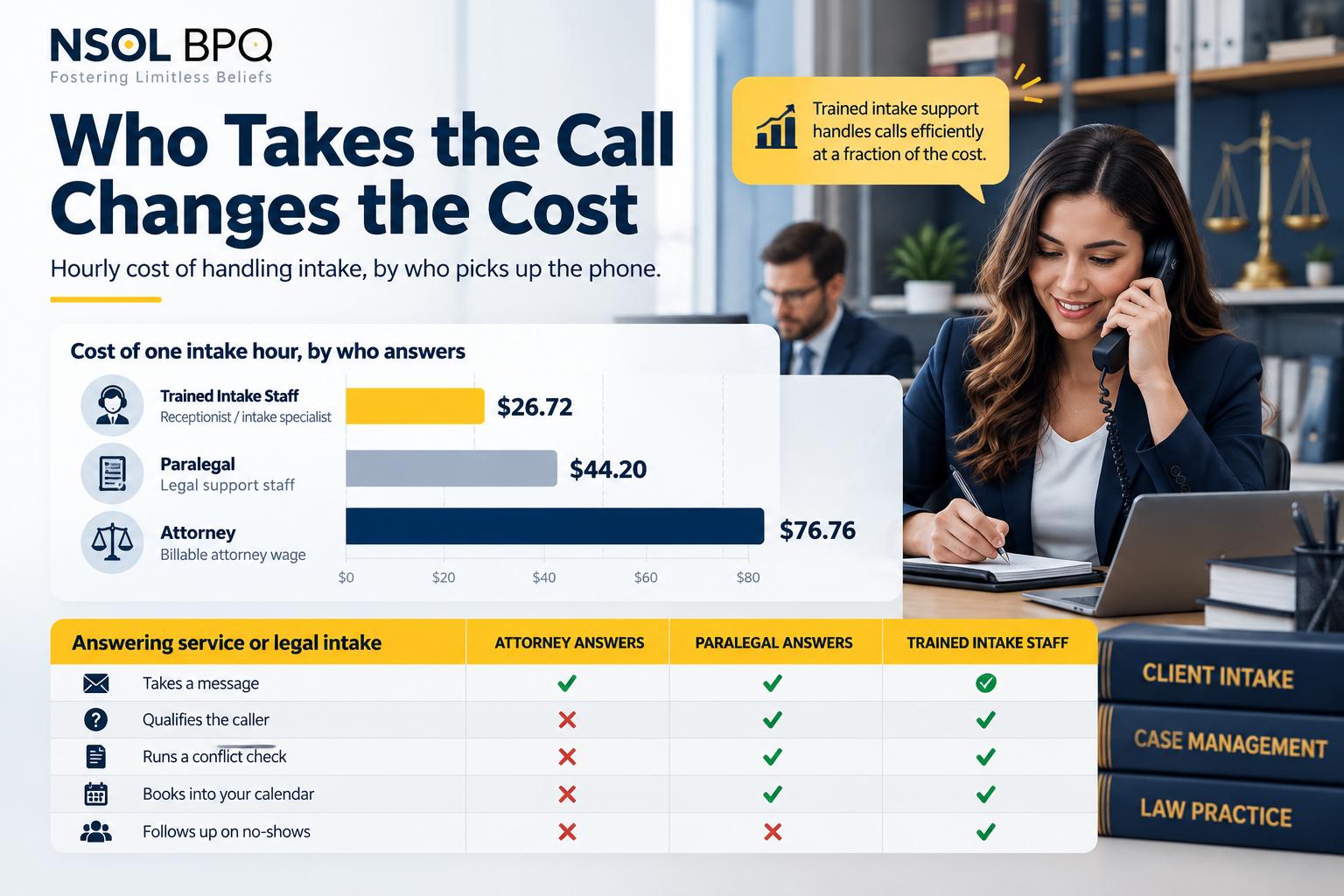
What one hour of intake costs, depending on who takes the call.
Better, not just cheaper, and that is the part legal intake services are actually sold on. An attorney answering their own phone is doing it between other tasks, without a script, without a conflict check, and usually without logging anything. A dedicated intake person follows the same process every time and writes it all down.
The 7 Leaks in Your Law Firm Intake
Run through these against your own firm. Most practices leak in at least three, and legal intake services earn their fee by closing whichever three you have.
1. Nobody answers. The call goes to voicemail during lunch, during a hearing, after five, on a weekend. Legal problems don’t keep office hours, and someone with a legal problem is rarely patient. They call the next firm.
2. Someone answers but cannot help. Whoever picked up takes a name and a number and promises a callback. By the time the callback happens, the caller has spoken to two other firms and signed with one.
3. No qualification script. Without a consistent set of questions, every call’s improvised. You end up booking consults for matters you don’t handle and losing cases you do, because the person asking the questions did not know which answers mattered.
4. Conflict check happens too late. Running the conflict search after the consultation means you occasionally sit through an hour you cannot bill and sometimes hear things you should not have heard. It belongs before the consult, not after.
5. The consult gets booked too far out. A slot nine days away is a slot the caller will fill with another firm instead. Urgency decays fast in legal matters, and the firm that sees them Tuesday beats the firm that sees them the following Thursday.
6. No follow-up on no-shows. Someone books a consult and doesn’t turn up. In most firms that’s the end of it. One phone call the next morning recovers a meaningful share of those, and almost nobody makes it.
7. Nothing is measured. If you can’t say how many calls came in last month, how many became consults, and how many became clients, you can’t tell which marketing works. Most firms are optimizing ad spend with no idea what happens after the phone rings.
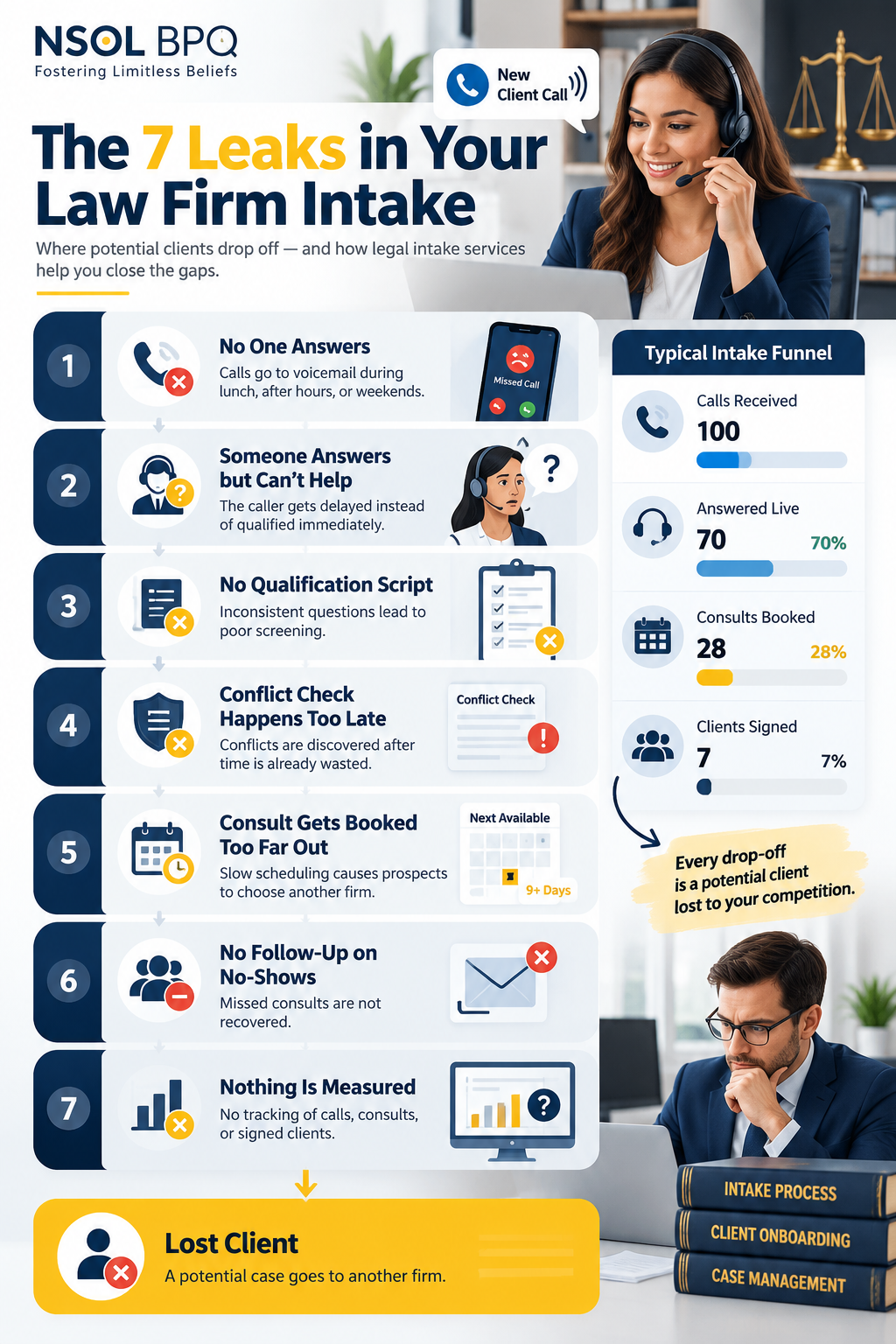
Seven stages, seven places a caller quietly disappears.
Notice that only one of the seven is about answering the phone. The rest are process. That matters, because firms that buy an answering service to fix intake usually plug leak one and leave the other six exactly where they were.
What a Legal Intake Specialist Actually Does
A legal intake specialist isn’t a receptionist who happens to work for a law firm. The job differs in three specific ways, and those three are what you’re actually buying when you buy legal intake services.
They qualify against your criteria. Practice area, jurisdiction, statute of limitations, case value thresholds, whatever your firm screens on. They know what disqualifies a matter and say so politely on the first call rather than booking it anyway.
They run the conflict check before the consult. Names, opposing parties, related entities, searched against your system while the caller is still on the line or immediately after.
They know what not to say. This is the part firms worry about, correctly. An intake specialist can describe your practice areas, your fee structure, and your process. They can’t evaluate a case, predict an outcome, or tell someone whether they’ve got a claim. That line is the unauthorized practice of law, and it applies to intake staff exactly as it applies to a virtual paralegal.
Done properly, the role sits between marketing and legal, and reports into neither. The person is measured on how many qualified matters reach a consult, not on how many calls they clear.
That measurement detail matters more than it sounds. Pay someone on call volume, and they’ll rush callers off the phone. Pay them on qualified consults, and they’ll spend eleven minutes with a caller who turns into a case. Same person, same script, completely different outcome.
In-House or Outsourced Legal Intake Services?
The honest answer depends on volume and hours, and most firms get it wrong in the same direction. Here’s how to tell which side you’re on.
In-house works when you take enough calls during business hours to keep someone busy, and when your matters are complex enough that deep familiarity with your practice beats breadth. A ten-attorney firm in one practice area usually clears that bar.
Outsourced legal intake services work when your call volume is uneven, when a meaningful share arrives outside business hours, or when you’re too small to justify a salary but too busy to keep answering yourself. Most solo and small firms are in this category and staff it in-house anyway, because it feels safer.
The cost comparison is the one firms skip when they price legal intake services against a hire. A full-time in-house intake hire is not $38,010. It’s roughly $55,570 once benefits load, before software, desk space, and the weeks when that person is sick or on holiday and the phone goes back to voicemail.
Our comparison of a virtual assistant versus a full-time employee runs the same tradeoff across other roles, and the virtual assistant cost guide has the broader hourly ranges.
One thing worth saying plainly: outsourcing intake doesn’t mean handing over judgment. The criteria stay yours. The script stays yours. What changes is who runs it and when.
Fixing the Client Intake Process Law Firm Owners Inherit
You don’t need a platform to start, and you don’t need legal intake services on day one either. You need four documents and two weeks.
- A qualification script. Eight to twelve questions, in order, with the disqualifying answers marked. Write it yourself, because it encodes your judgment.
- A disqualification message. What the intake person says when a matter is not a fit, including who to refer them to. A good referral out is worth more than a bad consult in.
- A conflict check procedure. What gets searched, where, and before which step.
- A follow-up sequence. What happens at 24 hours, 72 hours, and one week for anyone who does not book or does not show.
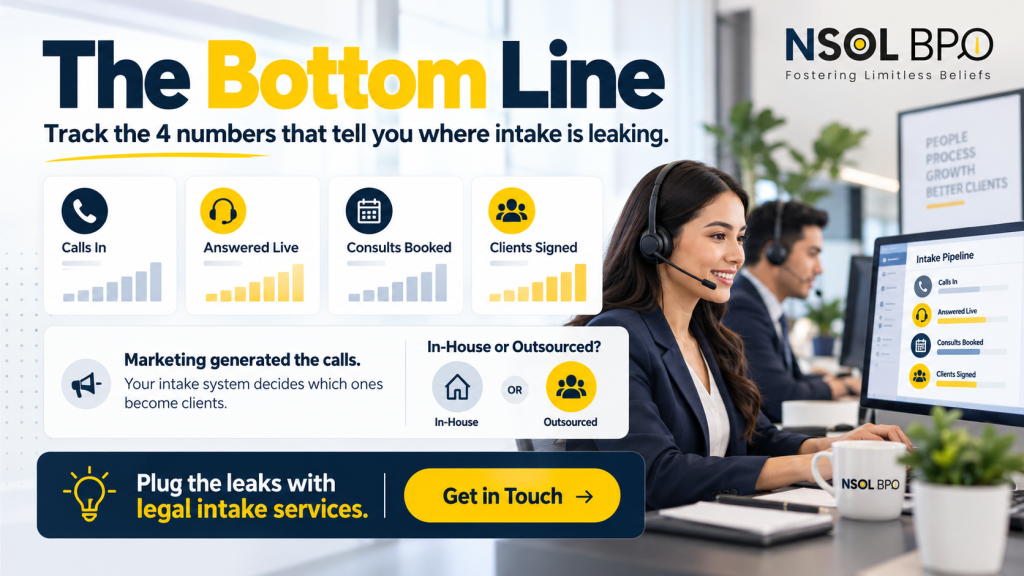
Then measure four numbers every month: calls received, calls answered live, consults booked, clients signed. That’s the whole dashboard. Firms that track those four for a quarter usually find the leak sits somewhere they wouldn’t have guessed.
Two weeks is realistic because none of it requires software. A shared document, a calendar, and somebody willing to follow the script will outperform most firms running expensive intake platforms with nobody minding them. Tools help once the process exists. They don’t create one.
Law firm client onboarding starts the moment someone signs, and it deserves the same treatment: engagement letter, file opened, first contact scheduled, expectations set. The handoff between intake and onboarding is where new clients most often go quiet.
What to Ask Any Intake Provider
Six questions for anyone selling you legal intake services. Ask them by email so the answers are in writing.
Do your agents work only legal accounts? An agent handling a law firm, a plumber, and a dental practice in the same shift will not catch a statute of limitations issue.
Who writes the qualification script? The answer should be you, with their help. If they hand you a generic script, they’re selling call answering and calling it intake.
How do you handle conflict checks? They should be asking which system you use, not explaining their own.
What is the confidentiality arrangement? Signed agreement, defined access, and a clear answer on where call recordings and notes are stored. Your duty doesn’t shrink because the call was answered elsewhere.
Can your agents book directly into our calendar? If not, every consult needs a second touch from your staff, and you have bought a message service.
What do you report, and how often? Calls, answer rate, qualification outcomes, consults booked. If they can’t report it, you can’t manage it.
We cover how NSOL structures legal support on our legal virtual assistant services page, and the wider front-office version in customer experience outsourcing.
The Bottom Line
Intake is the cheapest growth available to most firms, and the most ignored. Legal intake services aren’t a luxury line item. They’re the thing standing between your ad spend and your caseload.
You’re already paying for the calls. Marketing generated them. The only question is whether the system catching them is worth what the calls cost, and in most firms it clearly isn’t.
Start with the four numbers. Calls in, answered live, consults booked, clients signed. Track them for one month. Whichever of the seven leaks you have, those four numbers will point at it.
Then decide whether to staff it or buy it. Legal intake services make sense when your calls arrive unevenly or outside office hours. An in-house hire makes sense when they don’t. Either way, the script and the criteria stay yours, because those encode judgment nobody outside the firm can supply.
NSOL BPO builds legal intake around your criteria, your script, and your calendar, with agents who work legal accounts only. If you want someone to look at where your intake is leaking before you spend another dollar on ads, get in touch and we’ll walk through it with you. Our full virtual assistant services cover the rest of the firm if intake is only part of the problem.
FAQ Block
What are legal intake services?
Legal intake services process the very first interaction between you and a possible client – from answering the call, determining whether the matter qualifies according to your criteria, doing a conflict check, and scheduling an appointment. They fall between your marketing department and your lawyers, and their efficiency is measured through qualified consultations, not cleared calls.
What are legal intake services vs. in-house costs?
The benchmarking needs to be done not by salaries but rather by the total cost of an employee. According to the Bureau of Labor Statistics, the median salary for a receptionist is $38,010 per year, and including the benefits that are about 31.6% of total compensation makes the hiring price about $55,570, plus software and desk space.
Can the legal intake specialist provide you with legal advice?
No. The intake specialist is able to inform the caller about your specialty, fees, and process, but is unable to analyze the case or predict the outcome of your consultation or the fact whether the caller has a case or not. This would be unauthorized practice of law, and it applies to the intake specialist just like it applies to everyone else.
What is the difference between an answering service and legal intake?
The answering service takes a message. The legal intake analyzes the situation according to your criteria, performs a conflict check, schedules the consultation, and follows up on missed appointments. The companies that purchase answering services to solve their intake problems usually solve only one of them.
How quickly should a law firm reply to an enquiry?
A live answer on the very first phone call whenever possible. Legal issues demand urgency, and phone callers will call until someone answers. When a live answer isn’t possible, getting back within the same business hour is way better than waiting until the next.
What measures should be kept by our law firm intake?
These four numbers each month will do: number of calls received, number of live calls answered, consultations booked, and clients signed. It’s more than enough to find out the source of the leaks. Law firms tracking these four numbers for three months realize the problem is somewhere else
Sources
- Lawyer Salaries and Employment Outlook: median pay and job outlook for lawyers
- Receptionist and Administrative Support Costs: median pay for receptionists and administrative support occupations
- Paralegal and Legal Assistant Salaries: median pay for paralegals and legal assistants
- Employee Compensation and Benefits: employer costs for employee compensation
- Employment Trends and Workforce Projections:, employment projections for 2025 to 2035 by occupation group